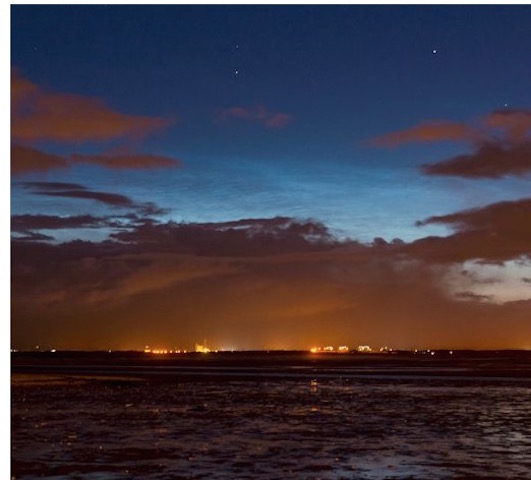
© M. J. S. FerrierBarassie Beach in Ayrshire, Scotland.
The fine-structured blue clouds floating above the dark, ordinary storm clouds are the NLCs. "It was hard to tell the full extent of the display due to a storm system passing through," says Ferrier. "But the noctilucent clouds were definitely there." Jimmy Fraser of Alness, Scotland, also photographed the display. "It was
a great start for the NLC season here in northern Scotland," says Fraser.
NLCs are Earth's highest clouds.
Seeded by meteoroids, they float at the edge of space more than 80 km above the planet's surface. The clouds are very cold and filled with tiny ice crystals. When sunbeams hit those crystals, they glow electric-blue.
Noctilucent clouds first appeared in the 19th century after the eruption of super-volcano Krakatoa. At the time, people thought NLCs were caused by the eruption, but long after Krakatoa's ash settled, the clouds remained. In recent years, NLCs have intensified and spread with sightings as far south as Utah and Colorado. This could be a sign of
increasing greenhouse gases in Earth's atmosphere.
Observing tips:Look west 30 to 60 minutes after sunset when the Sun has dipped 6
o to 16
o below the horizon. If you see luminous blue-white tendrils spreading across the sky, you may have spotted a noctilucent cloud.










Comment: In the last week, Alaska has also experienced more chaotic weather with record heat in some parts, and 'epic' flooding in others.