
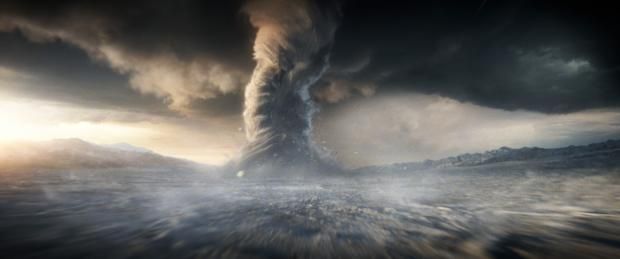
© Skywalker Sound
That's true of many, many other places, too. And now, in a new study in Nature Climate Change, Princeton's Ning Lin and MIT's Kerry Emanuel demonstrate that when it comes to three global cities in particular — Tampa, Fla., Cairns, Australia, and Dubai, United Arab Emirates — there could come a storm that is much worse than anything in recent memory (or in any memory).
Granted, these theoretical storms are also highly unlikely to occur — in some cases, they are 1-in-10,000-year events, or even rarer. The researchers refer to these possible storms as "gray swans," riffing on the concept of a "black swan" event, an unpredictable catastrophe, or highly impactful event. A "gray swan," by contrast, can indeed be predicted, even if it is extremely rare.
The purpose of the study is "to raise awareness of what a very low probability, very high impact hurricane event might look like," said Emanuel. The gray swan storms were generated by a computer model that "coupled" together, in the researchers' parlance, a very high-resolution hurricane model with a global climate model. That allowed the researchers to populate the simulated world with oodles of different storms.










Comment: While the study misses the boat when it comes to global warming, it is interesting that one of the authors notes a theoretical "hypercane" involving an asteroid hitting and drastically warming ocean waters. This may be closer to our potential future if our history is any indicator. See Comets and the Horns of Moses for more information.