Earth ChangesS


Fire

At least 43 people killed in forest fires in central Portugal

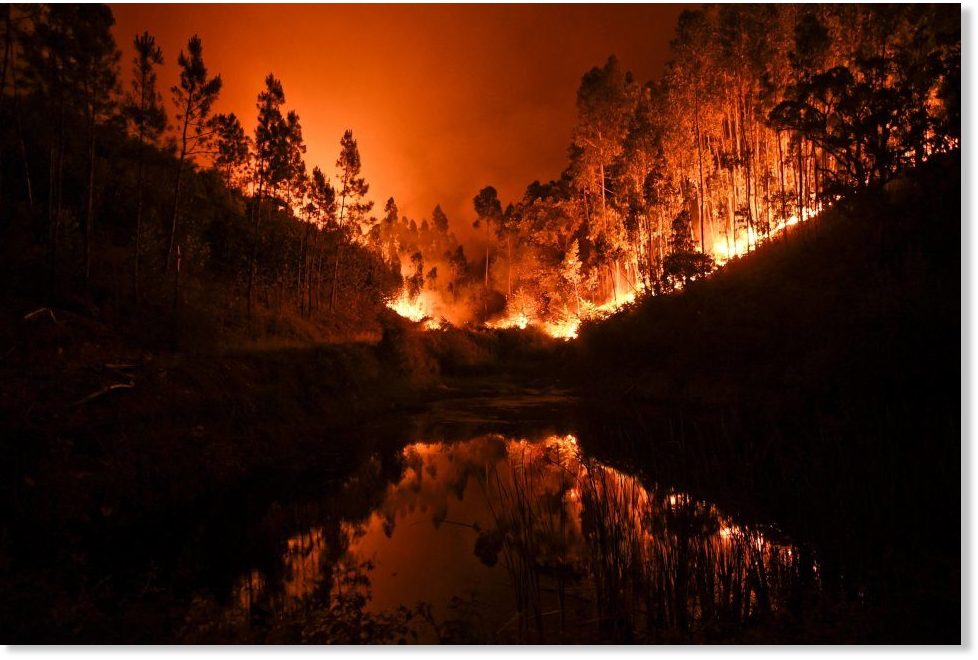
A wildfire is reflected in a stream at Penela, Coimbra
© GettyA wildfire is reflected in a stream at Penela, Coimbra
At least 43 people have been killed in forest fires in central Portugal, many of them trapped in their cars as flames swept over a road.

The deaths happened as blazes rage in the Pedrogao Grande area, about 93 miles north east of Lisbon.

Around 600 firefighters were trying to put out the blazes, which started on Saturday.

Interior Ministry official Jorge Gomes said 16 people died in their cars on a road between the towns of Figueiro dos Vinhos and Castanheira de Pera and three died from smoke inhalation in Figueiro dos Vinhos.

Public broadcaster RTP said there were about 20 injured, including six firefighters. Fourteen of the injured were in a serious condition.


Seismograph

Two earthquakes rattle Aegean Sea off western Turkey

Aegean Sea earthquake

No casualties or damage reported so far, Turkey's disaster authority says


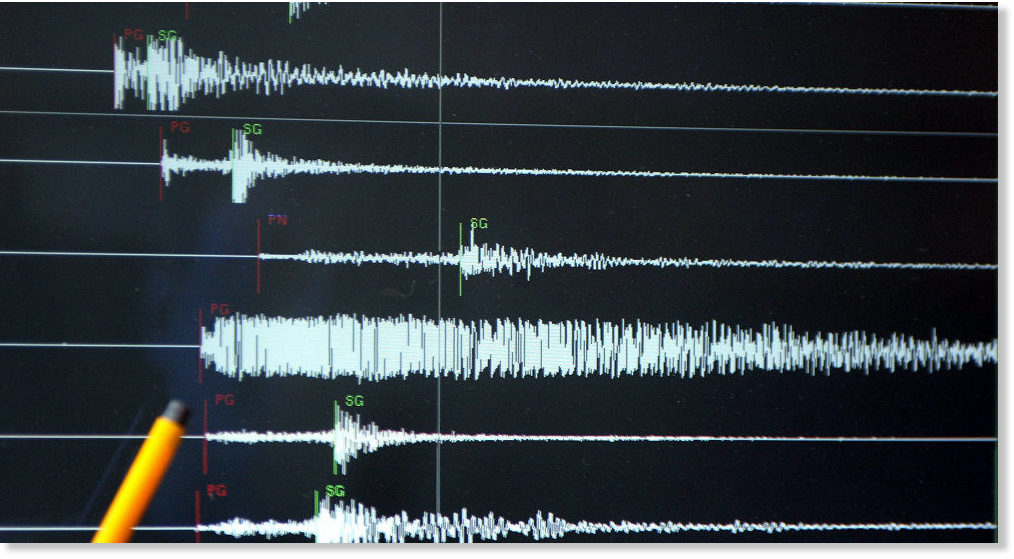
A pair of earthquakes shook Aegean Sea, western Turkey late Saturday, according to the country's Disaster and Emergency Management Authority (AFAD).

One quake measuring 4.2 on the Richter scale hit at 10.33 p.m. local time (1933GMT) while a second one measuring 5.3 struck 17 minutes later at 10.50 p.m. (1950GMT), AFAD said on its website.

No casualties or structural damage have been reported so far.

Last week, the region was rattled by a 6.2-magnitude quake which struck coastal İzmir's Karaburun district at 3.28 p.m. local time (1228GMT) at a depth of 22.98 kilometers (14 miles).

Snowflake

It's June but California is still covered in snow

The summer solstice is just around the corner, but someone forgot to tell California's snowpack.

After years of wallowing in drought, this winter walloped California's Sierra Nevada mountains in a major, record-setting way. And while the calendar says summer, winter still has its grips on the granite spine of the Sierras.

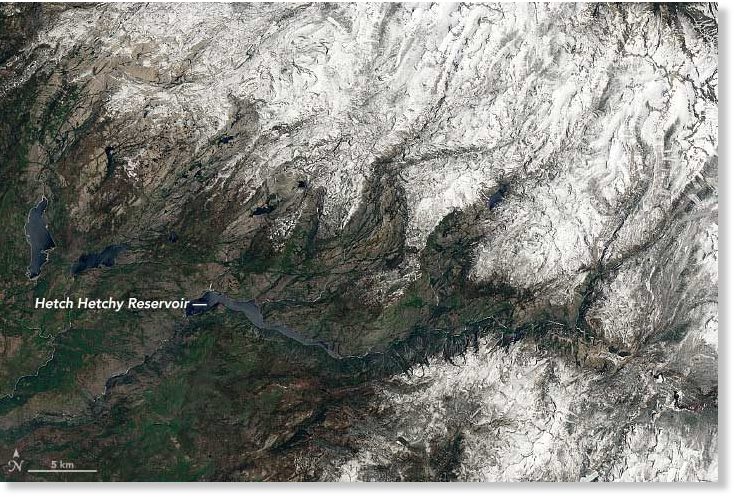
NASA Earth Observatory released satellite imagery on Thursday that shows what a difference a year makes. Snowpack is at 170 percent of normal when averaged across the state and some areas are reporting way higher totals than that, according to the California Department of Water Resources. Alpine Meadows, located just west of Lake Tahoe, reported 288 inches of snow on the ground (no, that's not a typo) as of early June. Deep green hues of healthy vegetation also extend down the Sierra Nevada western slope, another benefit of all that precipitation.

snowpack

Comment: See also: California roads still being cleared of snow in June


Snowflake

Snow cancels Yukon-Alaska bicycle race

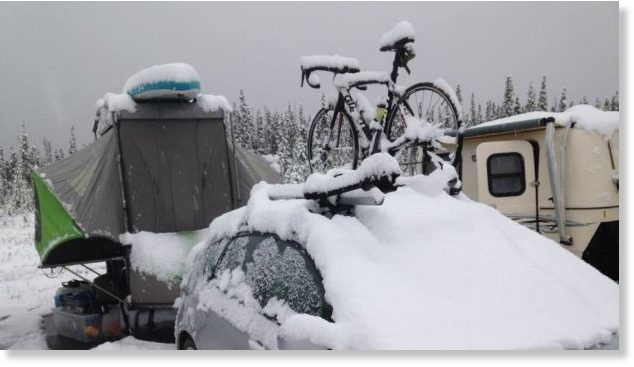
Snow in Haines Junction, Yukon, has cancelled the 25th-annual Kluane Chilkat International Bike Relay.
© Dan ReimerSnow in Haines Junction, Yukon, has cancelled the 25th-annual Kluane Chilkat International Bike Relay.
The 25th-annual Kluane Chilkat International Bike Relay has been cancelled due to snow at the starting line, affecting about 1,300 riders who were set to begin the race Saturday morning.

This is the first time the race has been cancelled.

"The race was cancelled because not only snow and slush in the upper elevations in the summit legs, but right here in Haines Junction at the start," said Mike Kramer, race coordinator.

Fish

Dozens of bathers savaged in a wave of horrific piranha attacks near resorts in Brazil

Tourists have complained that local authorities are not doing enough to remind them of the threats of the shoals of predatory fish
Bathers in Brazil have been savaged in a wave of horrific attacks by piranhas scavenging for food near popular holiday resorts.

Scores of tourists have complained to local authorities are not doing enough to warn of the threats of shoals of the predatory fish.

Last Saturday a young woman had a chunk of flesh bitten out of the sole of her foot by the omnivorous six-inch red-eye species after swimming off the Praia de Cristo in north east Brazil.

The 22-year-old was rushed to hospital suffering from shock and heavy blood loss from the open wound.

She is the sixth person to be attacked by white piranha in the region this month and one of over forty since the beginning of this year.

Cloud Lightning

Lightning bolt kills 2, injures 25 in Jharkhand, India

LIGHTNING
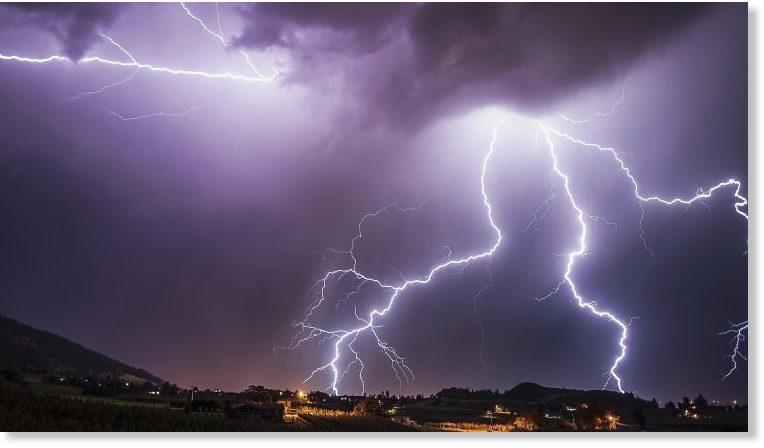
Two persons died while 25 others got severely injured when lightning struck them during Roja Sankranti fair being held at Nishchintpur village of Chakradharpur on Friday.

The injured were taken to various hospitals in Chakradharpur, Chaibasa and Jamshedpur, sources said.

Sources said the incident occurred when weather suddenly changed and it started raining at the fair venue. A sudden streak of lightning was seen at the fair. Two persons died of electrocution on the spot while many others were badly burnt in the incident. The incident caused panic among the villagers who ran for shelter.

In another incident, one Jonko Bankira of Majhgaon died of electrocution after being struck by lightning.

Seismograph

Shallow 5.7 magnitude earthquake on the Pacific-Antarctic Ridge

graph

5.7 magnitude earthquake

USGS page: M 5.7 - Pacific-Antarctic Ridge
USGS status: Reviewed by a seismologist
Reports from the public: 0 people

2017-06-16 19:37:26 UTC 5.7 magnitude, 10 km depth

Comment: A day earlier: Shallow 5.8 magnitude earthquake at Southern East Pacific Rise


Fire

Study: Wildfires in the U.S. Great Plains have more than tripled in 30 years

Great Plains wildfire increase
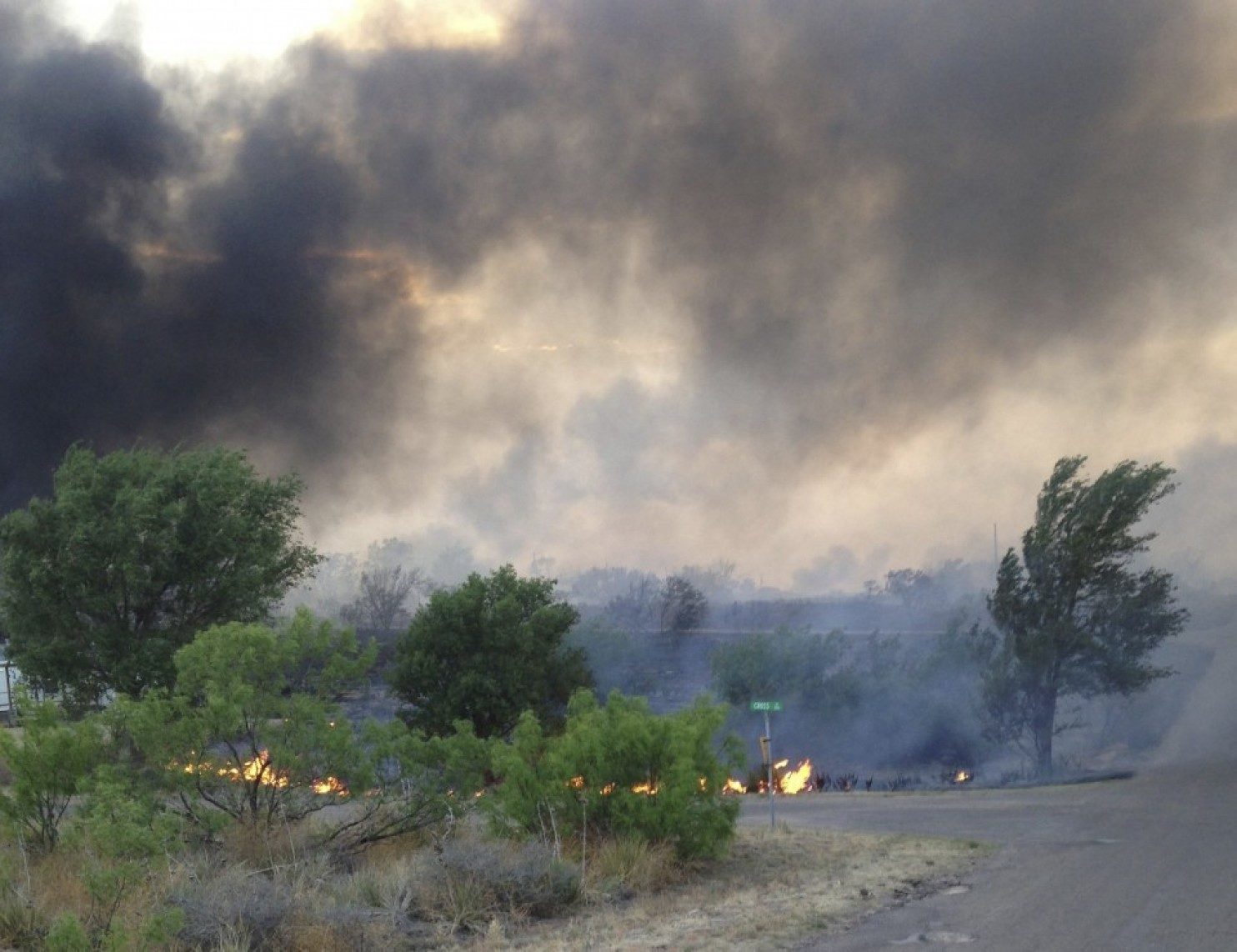
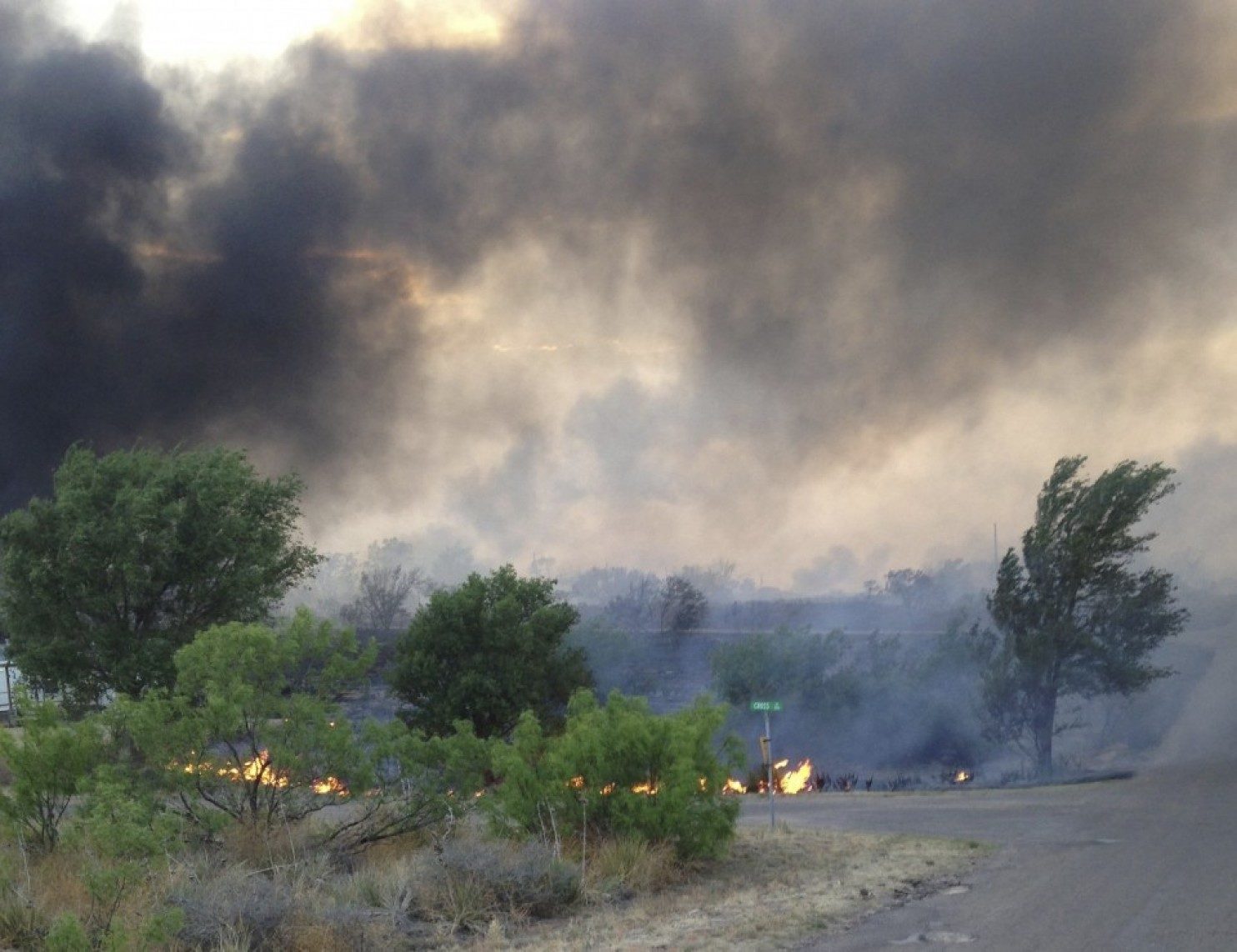
© Chris Ray/Texas Highway Patrol via ReutersFlames are seen along a road in a residential area in Fritch, Tex., in this image taken May 11, 2014. Fritch, located north of Amarillo, is in the southern Great Plains, which stretches into Texas.
The grasslands of U.S. Great Plains have seen one of the sharpest increases in large and dangerous wildfires in the past three decades, with their numbers more than tripling between 1985 and 2014, according to new research.

The new study, published in the journal Geophysical Research Letters, found that the average number of large Great Plains wildfires each year grew from about 33 to 117 over that time period, even as the area of land burned in these wildfires increased by 400 percent.

"This is undocumented and unexpected for this region," said Victoria Donovan, the lead author of the study and a researcher at the University of Nebraska at Lincoln. "Most studies do document these shifts in large wildfires in forested areas, and this is one of the first that documents a shift, at this scale, in an area characterized as a grassland."

Donovan published the study with two university colleagues. The research looked at large wildfires, defined as fires around 1,000 acres or more in size.

In other parts of the globe, such as Africa's savannas, grassland fires are extremely common — and that used to be true for the Great Plains as well. But in the past century or more, Donovan explained, wildfire suppression techniques — such as rapidly catching fires and putting them out — had largely eradicated them from the region.

Comment: Another factor for this sharp increase could be outgassing, possibly 'sparked' by an increase in atmospheric electric discharge events, such as lightning strikes and other 'cosmic' ignition sources?

Last year a rare winter wildfire ignited in Alaska, despite a foot of snow on the ground and forest fires broke out in Switzerland (in the dead of winter!)


Tornado1

Largest tornado outbreak in northeast Wisconsin history

Storm damage in wisconsin
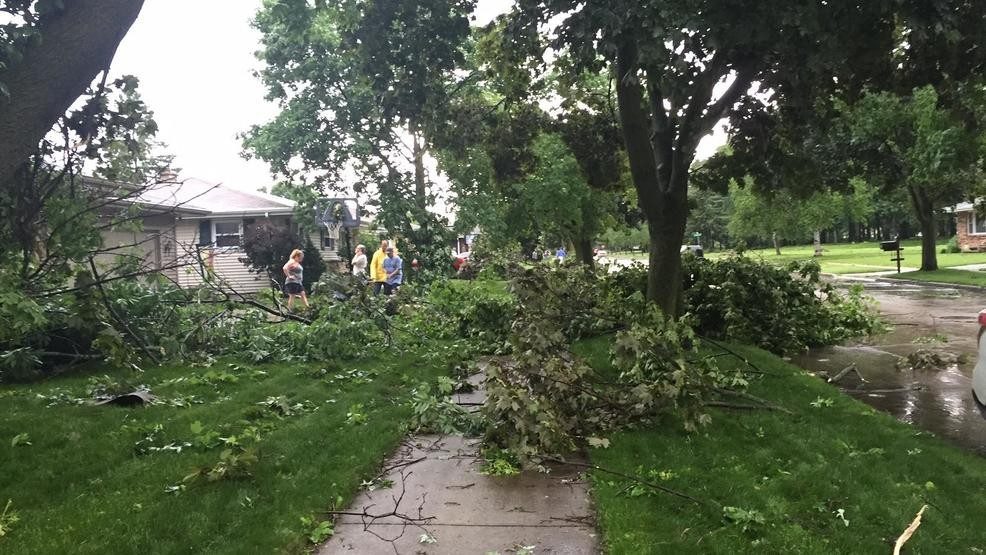
© WLUK/Alex RonalloTrees down on the sidewalk on Fidelis Street near College Avenue in Appleton, June 14, 2017.

The National Weather Service offices in Green Bay and Milwaukee, Wis. has revised the number of confirmed tornadoes in affiliate WBAY's viewing area from 11 to 10, which is still the largest tornado outbreak in northeast Wisconsin history, tying with the outbreak on April 10, 2011.

The NWS says tornadoes touched Green Lake, Shawano, Winnebago, Outagamie and Brown counties during Wednesday's severe weather.

The NWS has removed a tornado in Navarino from its list, though it's unclear why. The investigation is fluid, and the National Weather Service says the information may change.

We've listed the reports here chronologically:

2 miles east-northeast of Gresham
Rating: EF0
Peak Winds: 70 mph
Length: Brief
Width: 25 yards
1:47 p.m.

Markesan
Rating: TBD
Peak Winds: TBD
Length: TBD
Width: TBD
2:45 p.m.
This tornado report is based on video of a tornado and a Green Lake County Emergency Management survey of a damage path. The National Weather Service says the highest winds measured in this area Wednesday were 75 mph, which would likely place this at an EF0 or EF1 depending on the extent of damage.

Cloud Grey

The mystery of absent noctilucent clouds

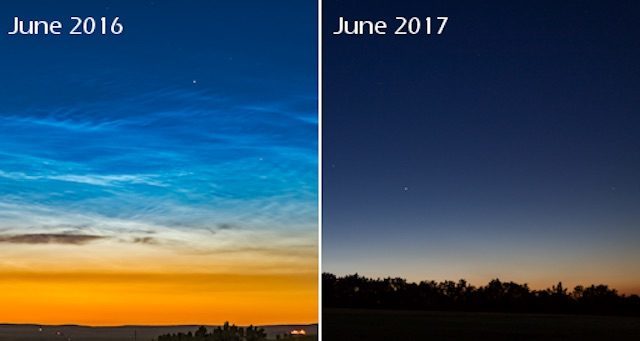
NLCs from 6/2016 to 6/2017
© spaceweather.com
In late May 2017, observers in Europe began seeing electric-blue tendrils snaking over the western horizon at sunset. The summer season for noctilucent clouds (NLCs) was apparently beginning. Normally, the strange-looking clouds surge in visibility in the weeks immediately after their first sighting. This year, however, something mysterious happened. Instead of surging, the clouds vanished. During the first two weeks of June 2017, Spaceweather.com received zero images of NLCs — something that hasn't happened in nearly 20 years.

Where did they go? Researchers have just figured it out: There's been a "heat wave" in the polar mesosphere, a region in Earth's upper atmosphere where NLCs form. Relatively warm temperatures have wiped out the clouds.

Lynn Harvey of the University of Colorado's Laboratory for Atmospheric and Space Physics made the discovery using temperature data from the Microwave Limb Sounder onboard NASA's Aura satellite.
"In early May, the summer mesosphere was cooling down as usual, approaching the low temperatures required for NLCs," she says. "But wouldn't you know it? Right after May 21st the temperature stopped cooling over the pole! In fact, it warmed a degree or two over the next week. The warming resulted in 2017 being the warmest summer mesopause in the last decade."