Earth ChangesS


Cloud Precipitation

More than 10,000 evacuated from floods in Malaysia

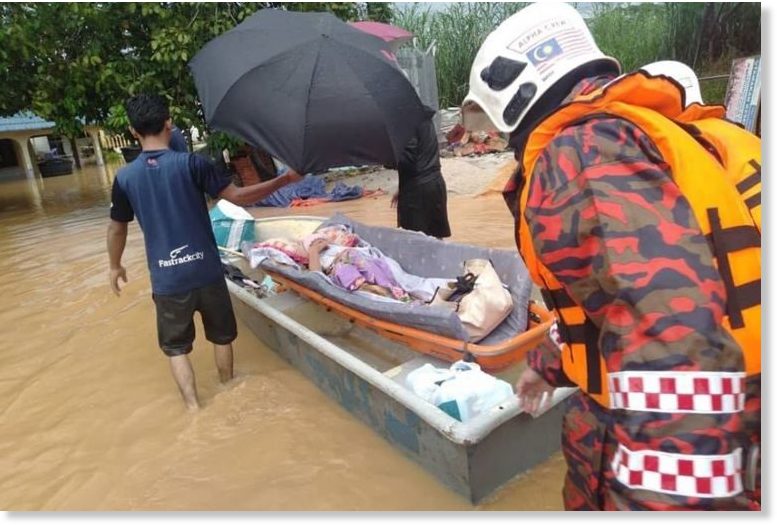
Personnel from the Johor Fire and Rescue Department yesterday helping to move people with disabilities
© JABATAN BOMBA DAN PENYELAMAT MALAYSIA NEGERI JOHORPersonnel from the Johor Fire and Rescue Department yesterday helping to move people with disabilities, as well as children, from the Skudai and Tebrau areas to relief centres. Of the nearly 100 centres set up in Malaysia, 85 of them are in Johor.
Malaysia's annual monsoon season continues unabated and Johor is facing the brunt of it, with some areas struggling with flood waters up to 2.5m deep.

As of yesterday afternoon, the number of people evacuated in Johor state had more than doubled to 9,348, from 3,934 on Sunday.

Over two-thirds of the state's victims are from Kluang, Segamat and Kota Tinggi, the three most severely hit areas.

Engineer Lor Wei Keong, 43, was stranded atop his four-wheel drive along Jalan Kota Tinggi-Mersing for two hours before he was rescued by an amphibious boat.

"The water level was only halfway up my vehicle tyres, and I thought I could go," he told the New Straits Times daily. "Unfortunately, the vehicle was trapped in the rising flood water, which was gaining speed as well."


Cloud Precipitation

5 killed by floods in Kampala, Uganda

Red Cross volunteers are assisting with relief and recovery efforts in Uganda
© UGANDA RED CROSSRed Cross volunteers are assisting with relief and recovery efforts in Uganda
Five people were killed by floods in Kampala, Uganda over the weekend, among them a marine officer on a rescue mission. Kampala Metropolitan Deputy Police spokesperson Luke Owoyesigyire said that the body of the marine police officer, Sgt Godfrey Mwondha an officer with Uganda Police Force, was found in Mbuuya Katoongo swamp which is often used as a washing bay.

Police said that Mwondha was trying to save a person named Ssekitoleko of Biwologoma, Kira Division who was drowning. The bodies of the two were retrieved on Sunday morning in Nakawa Division in Kampala. The third person was a woman identified as Joweria Tumusiime, a resident of Zana Lufuka, who was also washed away by the raging flood waters. She worked with Nippon cleaning services. The bodies of the three were taken to city mortuary awaiting post mortem.

Comment: Floods kill at least 12 people in western Uganda as country is battered by torrential rain


Tornado2

3 people killed as severe weather, tornadoes hammer Deep South

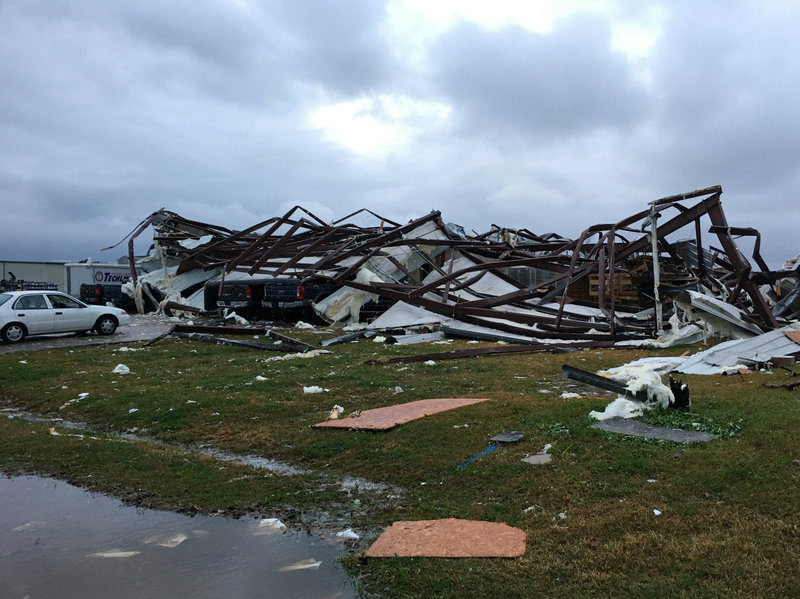
Tornado damage in Deep South
© Brad Kemp/APThe remains of a tornado-damaged building in Alexandria, La., on Monday, after storms went through the Deep South and killed three people.
Three people were killed by apparent tornadoes, one in Louisiana and two in Alabama on Monday, local authorities reported. Severe thunderstorms and high winds are expected to pummel areas of the Deep South overnight, according to meteorologists.

There were few details on the extent of the damage in Vernon Parish in western Louisiana where downed power lines and trees blocked roads and impeded rescue crews, according to Deputy Chief Calvin Turner of the sheriff's department, who said a local church fellowship hall also was demolished and some homes were damaged.

Another tornado was reported in nearby Alexandria, La., which tore off the roof of a church school, but no deaths or injuries were reported.

Two people died, identified by local officials as a husband and wife, and several others, including a child, were injured in Town Creek in northern Alabama.


Seismograph

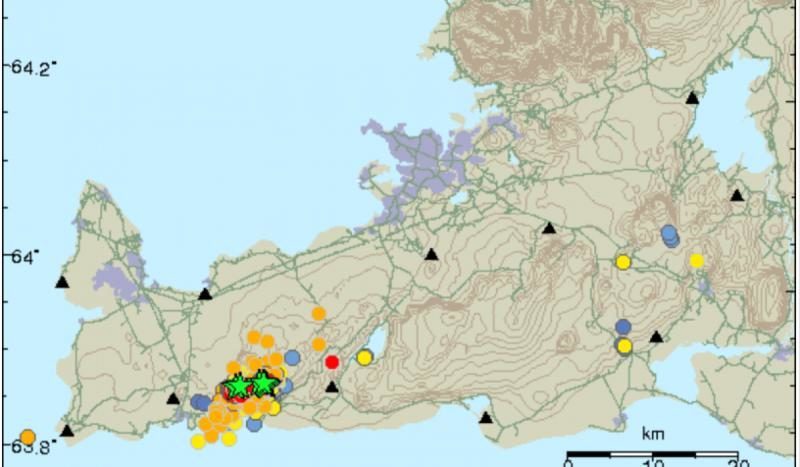
More than 1000 earthquakes detected on Reykjanes Peninsula, Iceland

Iceland earthquake swarm
Over 1,000 earthquakes and aftershocks have been detected in a wave of seismic activity on the Reykjanes peninsula which began yesterday morning. Nine of the earthquakes measured between a magnitude of 3.0 and 3.7. According to the Icelandic Met Office, there are no signs of volcanic tremor.

The earthquake swarm began around 7.00am on Sunday morning, with an earthquake of magnitude 3.5 measured at 8.00am. The activity calmed down around noon yesterday but began increasing again around 8.00pm. The largest earthquakes measured occurred just after that time, reaching magnitudes of 3.6 and 3.7. A third of magnitude 3.4 occurred 20 minutes later.

Three other quakes over 3.0 have occurred since 11.00pm last night. The seismic activity has continued into today, with earthquakes felt by residents in the capital region and as far away as Akranes.

Comment: Last month another earthquake swarm raised concerns for big volcanic eruption in Iceland.


Nebula

Cosmic rays reaching atmosphere increase 12% in 3 years - highest levels ever recorded

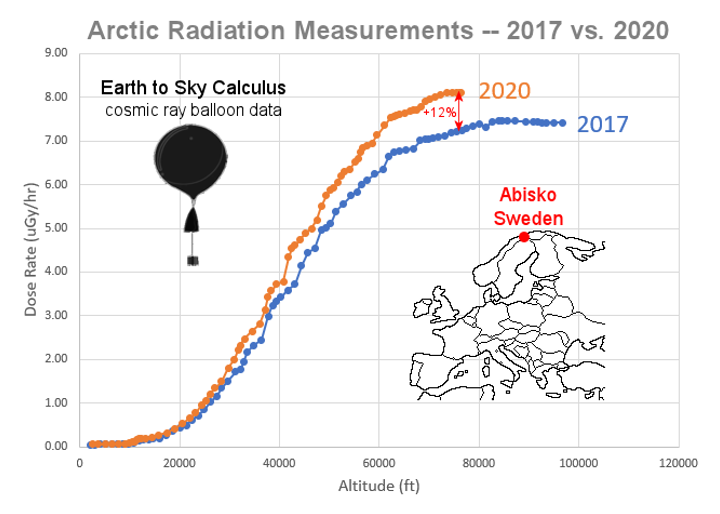
We're back from the Arctic, and we have some new results to share. In January 2020, the students of Earth to Sky Calculus and Spaceweather.com traveled to Abisko, Sweden, to launch a pair of cosmic ray balloons. We'd been there before, launching three identical balloons in March 2017. Putting all the data together, 2017+2020, we find that radiation has increased +12% in the past 3 years:
Cosmic Rays at Altitude
© SpaceWeather
The graph shows radiation dose rate (uGy/hr) vs. altitude (feet) all the way from ground level to the stratosphere. Radiation appears to be increasing at nearly all altitudes-even in the range 25,000 ft to 40,000 ft where airplanes fly. Polar flight crews and passengers are therefore absorbing ~12% more cosmic radiation than they did only a few years ago.
cosmic ray 2019
Something ironic is happening in Earth's atmosphere. Solar activity is low-very low. Yet atmospheric radiation is heading in the opposite direction. Cosmic rays percolating through the air around us are at a 5 year high.


Comment: It's not 'ironic'! Geez, talk about anthropocentric projection.

It's what one would expect, provided one has a correct understanding of astrophysics, which takes into account elements of Electric Universe theory. The Sun normally buffers cosmic rays from penetrating the Earth's atmosphere, as it does all planets in our solar system, because the heliosphere (the sheath or 'bubble' around the system caused by the solar wind) keeps them out. But because it's so quiet the solar wind has weakened to allow more cosmic rays 'through' into our system. In parallel, and to a smaller extent, the weakened solar wind weakens Earth's magnetic shield, again allowing more cosmic rays than 'normal' to penetrate to the lower atmosphere.


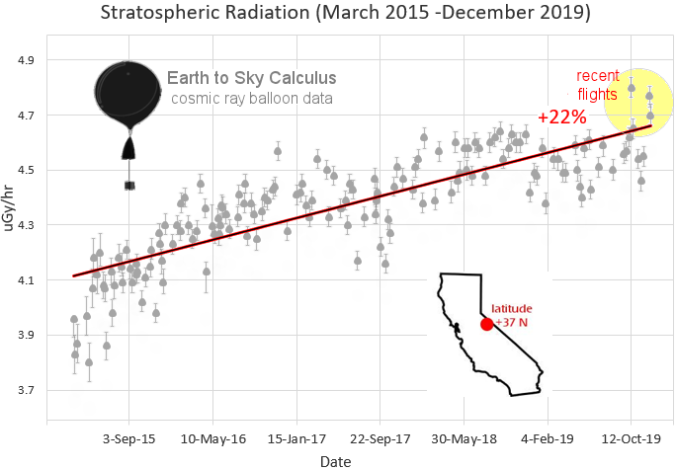
Take a look at these data gathered by cosmic ray balloons launched by Spaceweather.com and the students of Earth to Sky Calculus almost weekly since March 2015.

Radiation levels have been increasing almost non-stop since the monitoring program began, with recent flights registering the highest levels of all.

What's happening? The answer is "Solar Minimum"-the low point of the 11-year solar cycle. During Solar Minimum (underway now) the sun's magnetic field weakens and allows energetic particles from deep space to penetrate the Solar System. As solar activity goes down, cosmic rays go up; yin-yang.


Comment: Yes, although cosmic ray flux was unusually high during the last 'solar maximum' too.


Comment: Cosmic rays have long been considered - in obscure academic studies that sadly never got much publicity - to regulate the rhythms of ALL life on Earth.

See also: Solar activity just reached a new space age low


Solar Flares

Solar activity just reached a new space age low

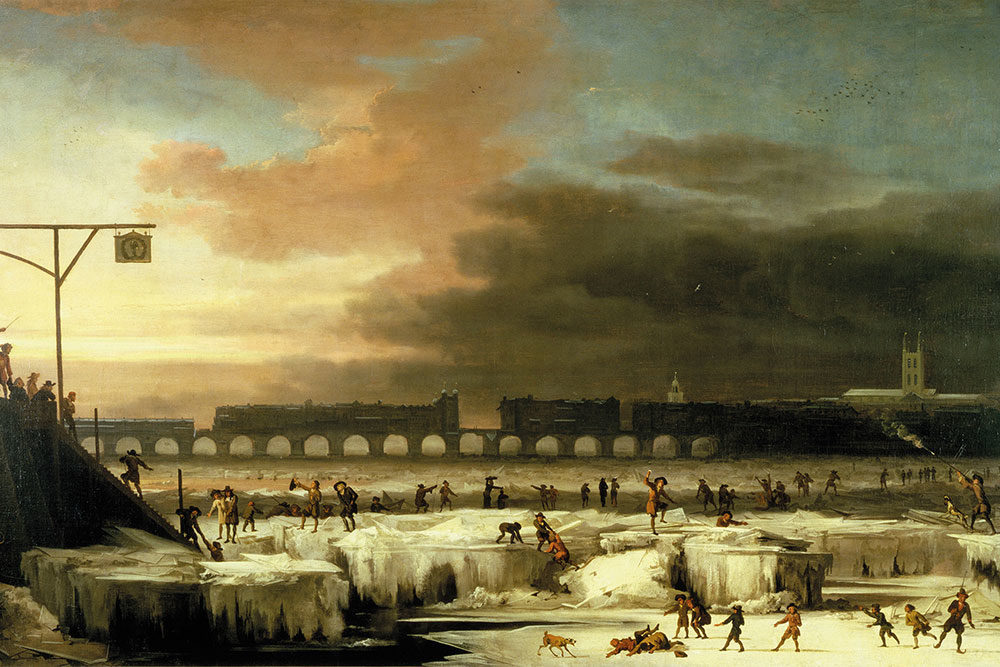
1677 painting by Abraham Hondius,
© Museum of London1677 painting by Abraham Hondius, "The Frozen Thames, looking Eastwards towards Old London Bridge."

During periods of low solar activity,
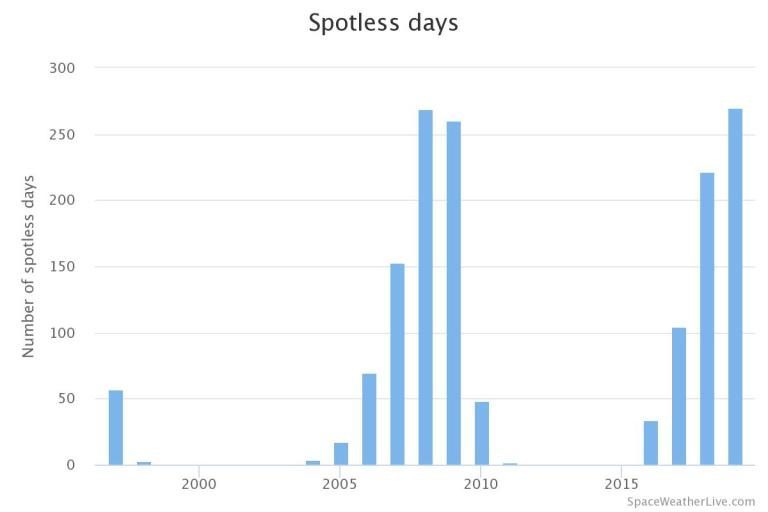
such as the deep solar minimum we're in now, the Sun will often be devoid of sunspots-a great barometer for the depth and longevity of solar minima.

The below graph shows how many days during a specific year that the earth-facing side of the Sun has been spotless:

sunspots graph
© www.spaceweatherlive.com

Comment: See also:


Snowflake

Multiple feet of fresh snow recorded across Colorado's high country

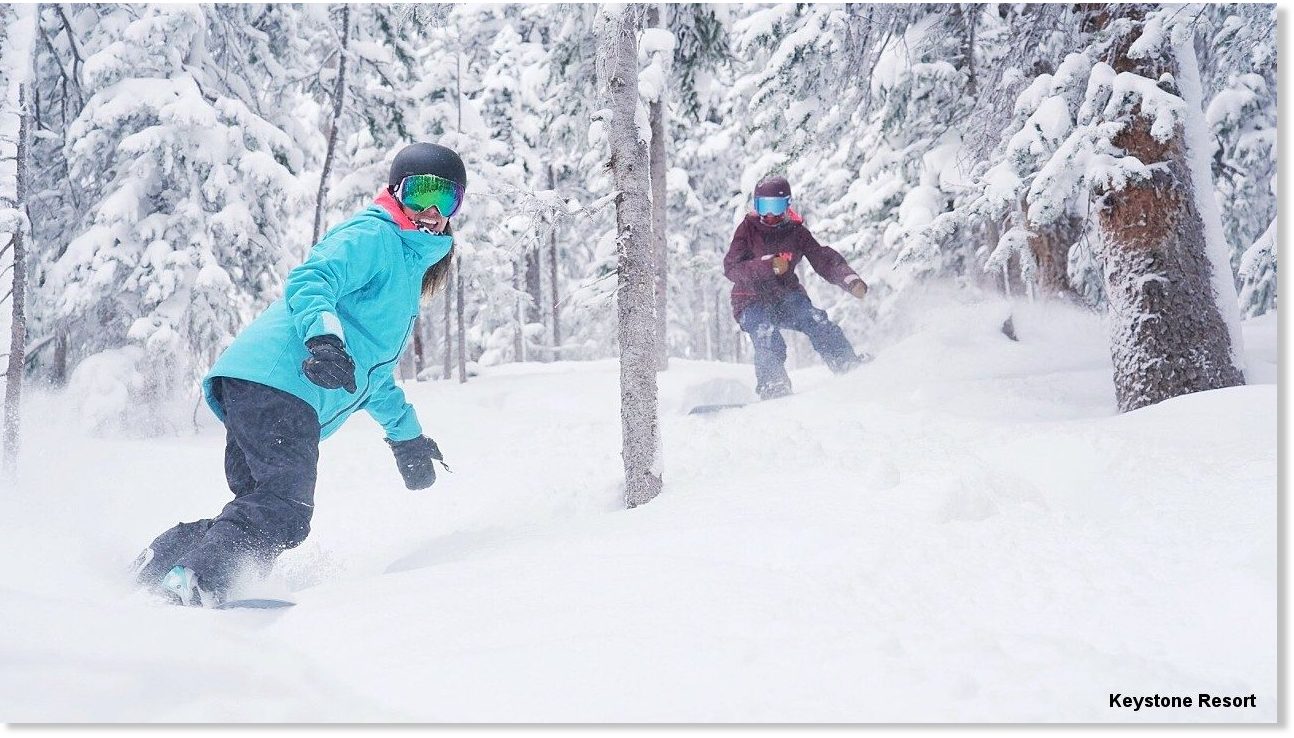
Snowboarding on fresh powder at Keystone Mountain Resort
© Keystone Mountain ResortSnowboarding on fresh powder at Keystone Mountain Resort
Snow was possible along the Front Range on Sunday, mainly in the afternoon and evening, when the Denver area could see 1-3 inches. But the heaviest snow was expected to remain in the mountains. Another round of the storm was dumping snow over the southern and central mountains, from Vail to Aspen.

But even before the snow Sunday, the snowfall totals since Thursday were pretty high across the mountains. Near Rabbit Ears Pass, more than 43 inches
had fallen as of Sunday morning, according to the National Weather Service's snowfall reporting location.


Below is the full list of snowfall totals from around Colorado, via the NWS locations . The totals below are all listed in inches.

1 NNE Rabbit Ears Pass: 43.4
1 NW Climax: 33.6
5 SSW Blue River: 32.2
1 NNW Berthoud Pass: 30.8
4 SE Mount Zirkel: 30.8

Cloud Precipitation

Heavy hailstorm leaves blanket of ice in several districts of Rajasthan, India, damages crops

ice hail
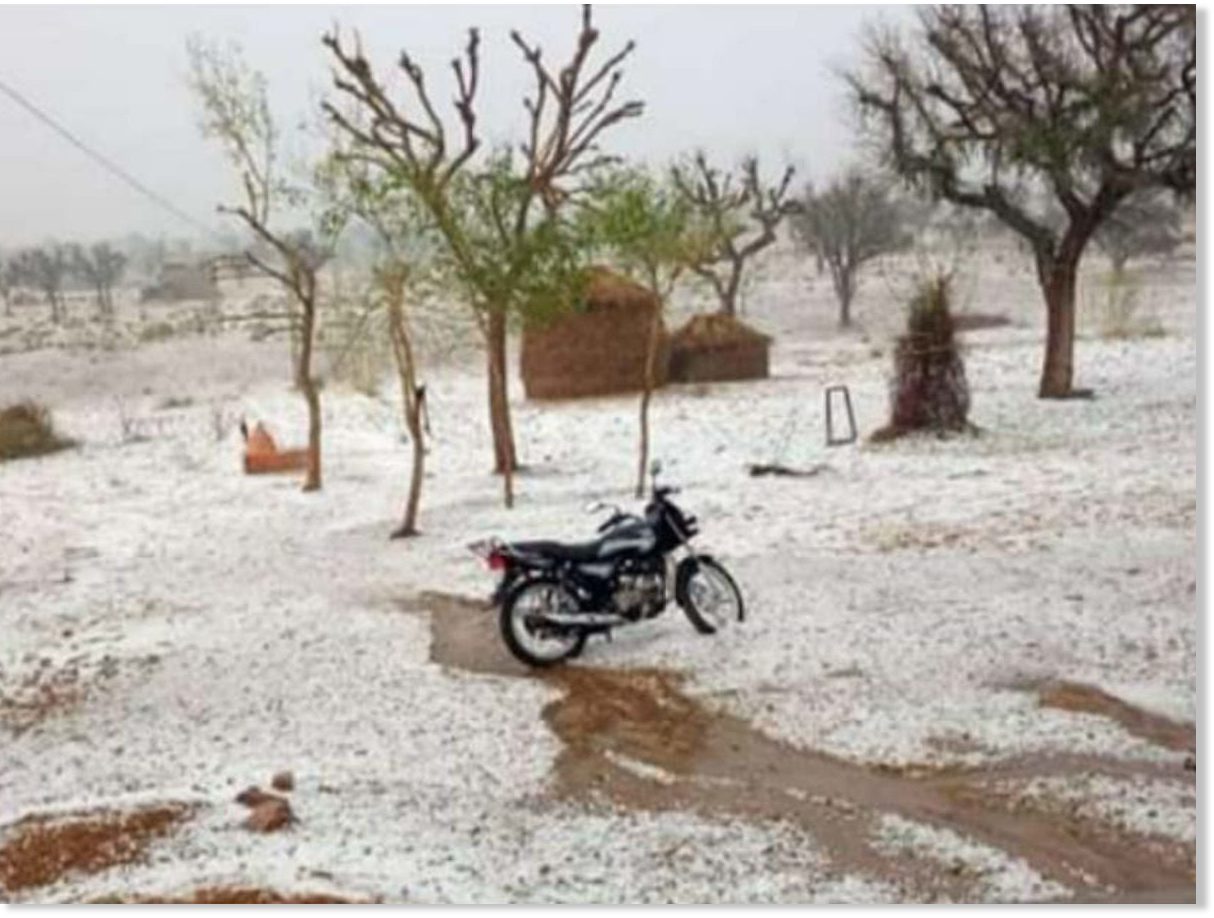
Nagaur district in Rajasthan witnessed unusual weather conditions as the area was hit by heavy rains and hailstorms causing it to be covered in a blanket of ice on Thursday.

Several areas of Nagaur, including villages of Chhapri, Maulasar, Keechak, were hit by heavy hailstorm that caused roads and roofs of houses to be completely covered in sheets of ice making it look like snow.

The hailstorm has caused significant damage to crops in the region. Reportedly, several animals and birds have also sustained injuries.


Cloud Precipitation

At least 24 people killed by landslide after heavy rain in DR Congo

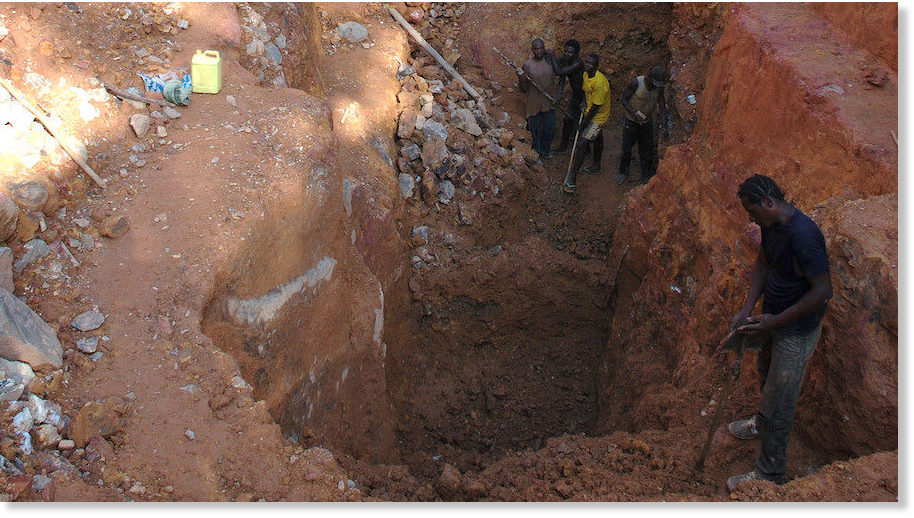
Artisanal mining in the DRC.
© Julien HarneisArtisanal mining in the DRC.
At least 24 people have died after a landslide buried a mine in Ituri province, Democratic Republic of the Congo (DR Congo).

Ituri province is in the far north east of the country, close to the border with Uganda, which is also experiencing heavy rain that has triggered deadly landslides over the last few days.

In the DR Congo, the landslide in Ituri province struck on 14 December. According to AFP, the provincial minister of mining said days of heavy rainfall was the main cause of the landslide. Rescuer workers are still searching the area and it is feared the death toll could rise.

Heavy rain since October has caused flooding and landslide across the country, affecting over 600,000 people in 12 of the 26 provinces, according to the UN.


Fire

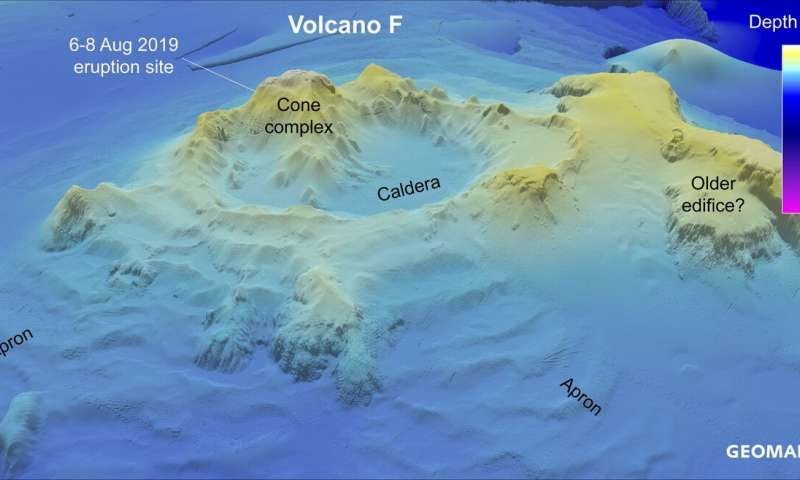
Scientists identify underwater volcano as source of August's huge pumice raft near Tonga

Volcano F Pacific Oceon
© GEOMAR
Stones do not float in water — this is a truism. But there is hardly a rule without exception. In fact, some volcanic eruptions produce a very porous type of rock with a density so low that it does float: Pumice. An unusually large amount of it is currently drifting in the Southwest Pacific towards Australia. When it was first sighted in the waters around the island state of Tonga at the beginning of August, it almost formed a coherent layer on the ocean's surface. The "pumice raft" made it into headlines all over the world.

Various underwater volcanoes were discussed at that time as the potential source. But direct proof for the exact origin of the pumice was missing so far. Researchers at the GEOMAR Helmholtz Centre for Ocean Research Kiel (Germany), together with colleagues from Canada and Australia, are now publishing evidence in the Journal of Volcanology and Geothermal Research that clearly identifies the culprit. It is a so far nameless underwater volcano just 50 kilometres northwest of the Tongan island of Vava'u. "In the international scientific literature, it appears so far only under the number 243091 or as Volcano F," says Dr. Philipp Brandl of GEOMAR, first author of the study.