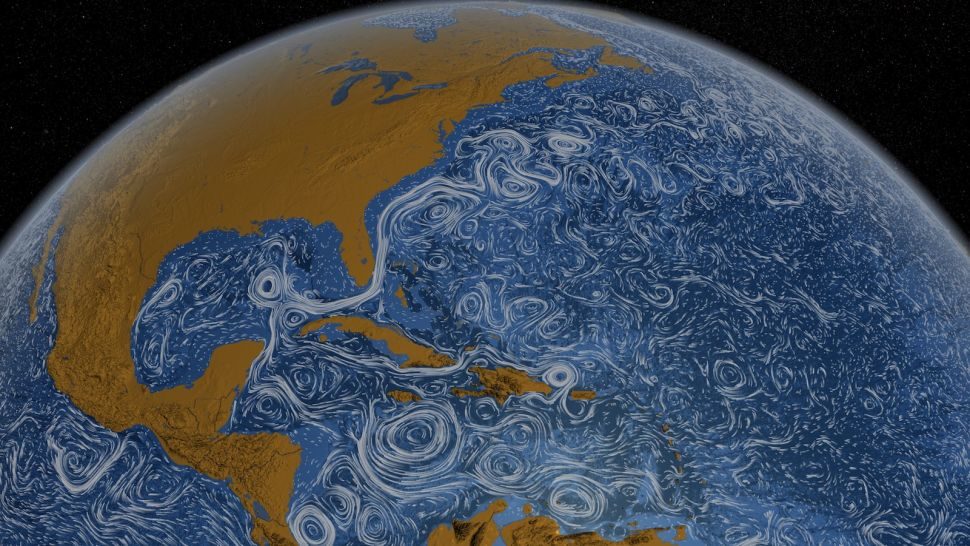
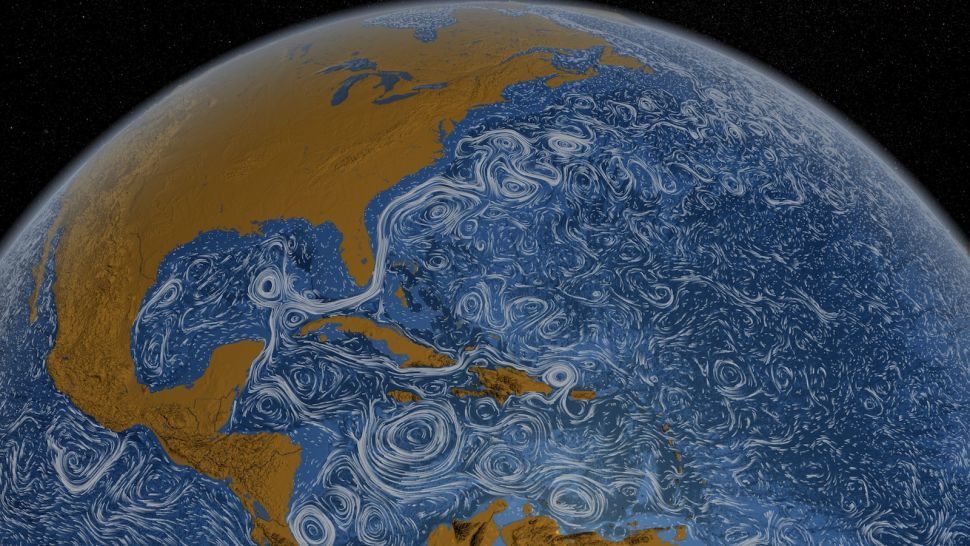
© NASA/Goddard Space Flight Center Scientific Visualization StudioOcean currents visualized using data gathered between 2005 and 2007. New evidence suggests ocean currents are moving faster now than they did two decades ago.
New research, published today (Feb. 6) in the journal Science Advances, finds that this acceleration is occurring around the globe,
with the most noticeable effects in the tropical latitudes. The enhanced speed isn't just at the ocean's surface, but is occurring as deep as 6,560 feet (2,000 meters).
"The magnitude and extent of the acceleration in ocean currents we detected throughout the global ocean and to 2000-meter (6,560 foot) depth was quite surprising," study co-author Janet Sprintall, an oceanographer at the Scripps Institution of Oceanography at the University of California, San Diego,
said in a statement. "While we expected some response to the increased winds over the past two decades, that the acceleration was above and beyond that was an unexpected response that is likely due to global climate change."
Winds over the ocean have been picking up at a rate of 1.9% per decade, the researchers found. This increase in wind speed transfers energy to the ocean's surface, and subsequently, deeper waters. About 76% of the upper 6,560 feet (2,000 m) of the oceans have seen an increase in
kinetic energy since the 1990s.
Overall, ocean current speeds have crept up about 5% per decade since the early 1990s, the study found.
Comment: In addition,
wave heights and winter storms have been on the rise over the last 70 years too. However, despite the claims in the article that this is all because of 'global warming', what researchers have actually discovered is that the depths of the Pacific Ocean are
cooling.
It's true that the climate
is changing, it just has nothing to do with global warming, nor is it man-made. As reported in a recent
study, also by scientists in China, we are entering a period of
cooling.
For more, check out SOTT radio's:














Comment: Astrophysicist- Mini Ice Age is now accelerating