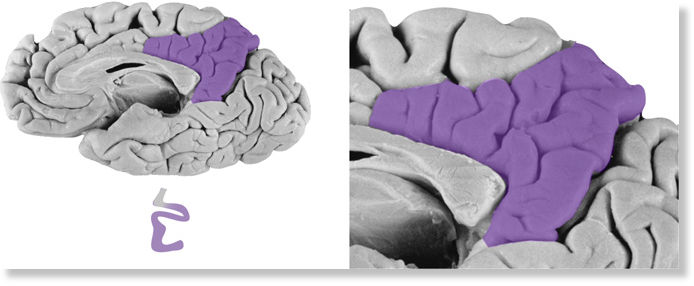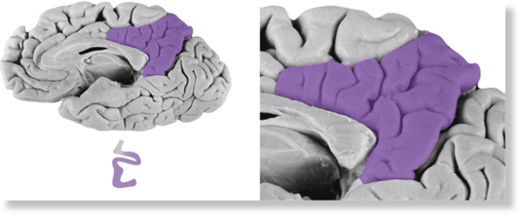
© PNASAnatomy of the posteromedial cortex (PMC). (A) PMC (highlighted region in purple), which forms a core node of the default mode network, is located on the medial surface of the brain. (B) The PMC is bounded ventrally by the parieto-occipital sulcus (which divides it from the cuneus); dorsally by the cingulate sulcus (cgs) and its marginal branch (mb); and extends anteriorly to approximately midcingulate level before it joins the anterior cingulate cortex. The PMC contains the PCC (areas 23a, 23b, and 23c), RSC (areas 29 and 30), medial parietal cortex (area 7m), and a transitional cortical area 31. The RSC is superficially visible as gyral cortex around areas 29 and 30; however, it extends perisplenially around the corpus callosum (cc) hidden within the callosal sulcus (cs; B and C).
Drs. Josef Parvizi, Brett L. Foster, and Mohammad Dastjerdi faced a range of challenges when recording intracranially from the human posteromedial cortex. "A key challenge in specifically studying the
electrical activity of this region is that unlike much of the brains outer cerebral cortex, the posteromedial cortex is not superficially visible," Foster tells Medical Xpress. Rather, he illustrates, it is part of the cerebral cortex that is hidden from view, which wraps over into the middle space between the left and right brain hemispheres "like the inner walls of a glacier crevasse."
This is a two-fold problem, he continues. "Not only does this hidden location make it very difficult to record this regions electrical activity from outside the skull on the scalp - a common technique - but also, even if one gets the opportunity to record more closely from inside the skull, one still needs to access this hidden cortex within the narrow space between the two hemispheres." Importantly, the ability to do so in the human brain only arises out of a unique clinical opportunity, where neurosurgeons have diligently placed electrodes onto the cortical walls of this inter-hemispheric space to monitor epileptic seizure activity as part of surgical planning. "The findings reported in our study are all derived from this unique opportunity, which allowed for direct recordings of electrical neural activity from the posteromedial cortex."