
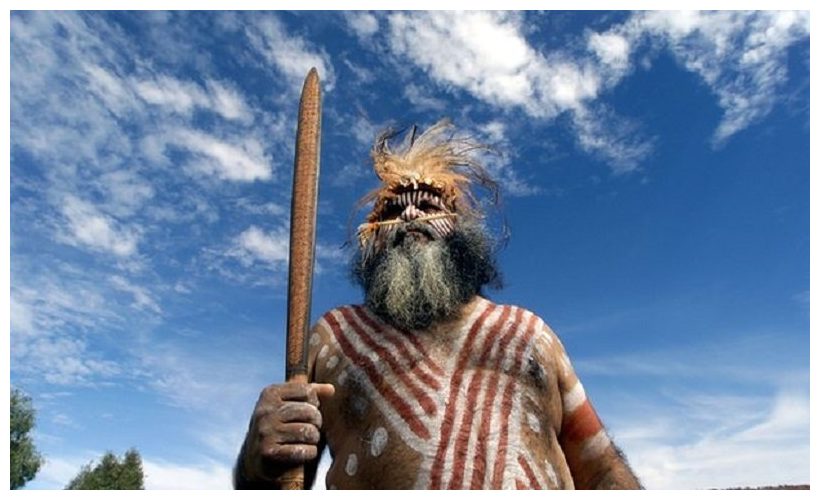
© Matt Turner/Getty Images A new population analysis of Indigenous Australians and Papuans shows they can trace their origins back to the very first arrivals on the continent about 50,000 years ago.
Scientists were able to trace the remarkable journey made by intrepid ancient humans by sifting through clues left in the DNA of modern populations in Australia and Papua New Guinea. The analysis shows that their ancestors were probably the first humans to cross an ocean, and reveals evidence of prehistoric liaisons with an unknown hominin cousin.
Prof Eske Willerslev, an evolutionary geneticist who led the work at the University of Copenhagen, said: "This story has been missing for a long time in science. Now we know their relatives are the guys who were the first real human explorers. Our ancestors were sitting being kind of scared of the world while they set out on this exceptional journey across Asia and across the sea."
The findings appear in one of four major human origins papers published in Nature this week, which together give an unprecedented insight into how humans first migrated out of the African continent, splintered into distinct populations and spread across the globe.
Willerslev's findings, based on a new population analysis of 83 Indigenous Australians and 25 Papuans, shows that these groups can trace their origins back to the very first arrivals on the continent about 50,000 years ago and that they remained almost entirely isolated until around 4,000 years ago. "They are probably the oldest group in the world that you can link to one particular place," said Willerslev.
En route to Australia, early humans would have encountered a motley assortment of other roving hominin species, including an unknown human relative who has now been shown to have contributed around 4% to the Indigenous Australian genome. Previously, scientists have discovered that prehistoric couplings have left all non-Africans today carrying 1-6% of Neanderthal DNA.











Comment: See also Famous Danish Bronze Age icon turns out not to be Danish