
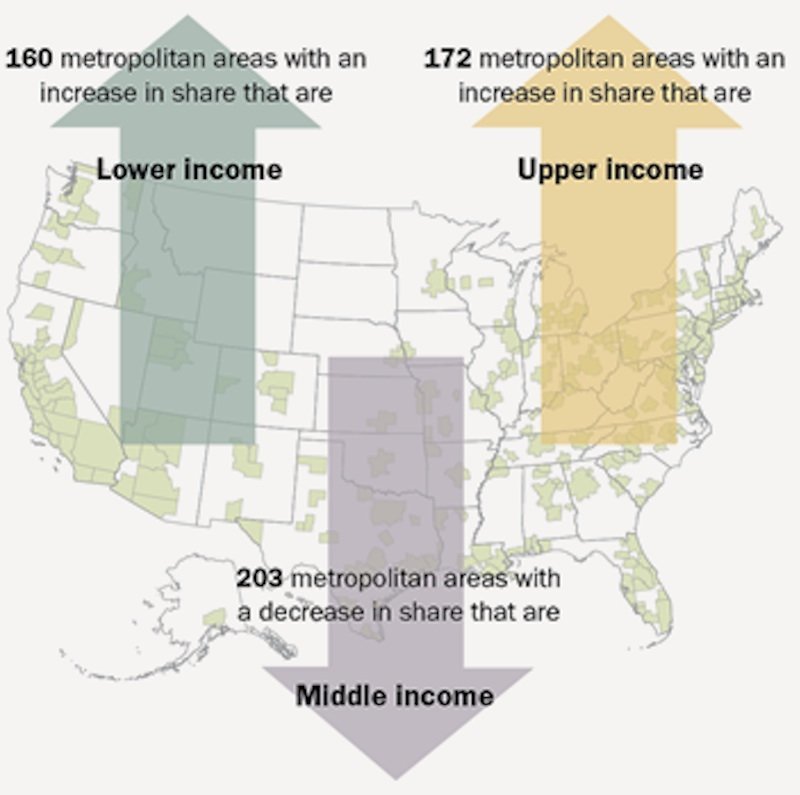
© PEW Research CenterHow the share of adults in lower-, middle and upper-income tiers changed in 229 metropolitan areas from 2000-2014.
Pew's America's Shrinking Middle Class shows that middle-class household income has declined throughout the population, while at the same time the gap between low- and upper-income households has grown, demonstrating a significant increase in income inequality across the US. A major contributor to economic decline and inequality has been the plunge in manufacturing jobs and wages.
The study analyzed data from 229 of the 381 metropolitan areas in the US, as defined by the Office of Management and Budget (OMB). These areas accounted for 76 percent of the US population in 2014. They included all those that could be identified in US Census Bureau data with statistics available for both 2000 and 2014. Middle-income households are defined as those with incomes of about $42,000 to $125,000, adjusted for a household of three. Pew found that the share of middle-income households fell in 203 of 299 metropolitan areas from 2000 to 2014. With household income falling in the middle-income tier in these areas, the shares of upper- and lower-income tiers have correspondingly grown.
Based on US Census figures, the share of middle-income adults also fell nationwide, while the shares in the lower- and upper-income tiers have increased. The national share of middle-income adults decreased from 55 percent in 2000 to 51 percent in 2014. At the other poles of society, the share of adults in the upper-income tier increased from 17 percent to 20 percent, and the share of adults in the lower-income tier increased from 28 percent to 29 percent.
US metropolitan areas with the lowest household incomes are mainly located in the South. Areas with the highest household incomes are concentrated along the Northeast corridor and mid-Atlantic, from Boston to the District of Columbia, and in Northern California, representing the proliferation and profits of the tech, insurance and finance industries, as well as high-paid government employees and politicians.



















Comment: One sector failing the middle class doesn't sound like an insurmountable problem if it is remedied and supported early on. When it has been neglected, or purposefully allowed to decline to the detriment of 80% of US cities, it is a societal and economic sink hole. Over 2 million manufacturing workers had enrolled in safety net programs from 2010-2014. Cost to the public: $10,222,000,000. This research was based ONLY on manufacturing. What other sectors have been hit? How worse are these statistics?
How do you get the middle class to bail out the middle class and kill two sectors with one blow? Eliminate unions; lower the income for blue collar jobs to below market levels with cheap imports and offer social services at taxpayer expense. The US has created a planned, systemic take-down of the middle class. And, if this trend was getting any better, this article would have a very different focus.