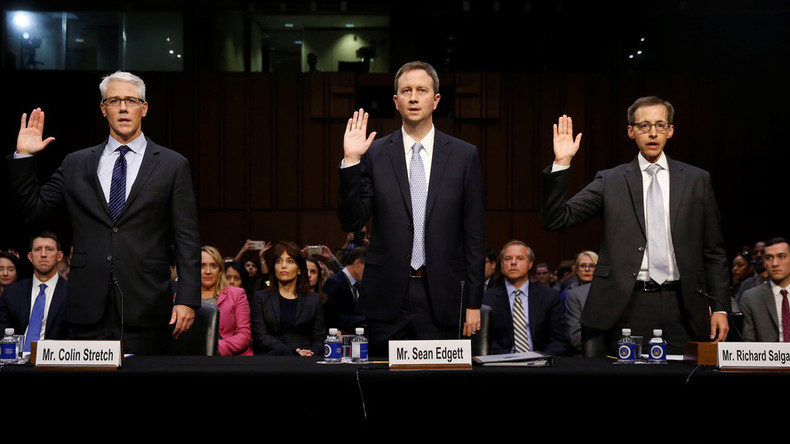
© Jonathan Ernst / ReutersFacebook General Counsel Colin Stretch, Twitter's acting General Counsel Sean Edgett and Google's Director of Law Enforcement and Information Security Richard Salgado during a U.S. Senate Judiciary Crime and Terrorism Subcommittee hearing , U.S., October 31, 2017
Yesterday representatives of Facebook, Google, and Twitter
testified before a Senate subcommittee about online "Russian disinformation," sounding a note of alarm that
echoed legislators' concerns and therefore grossly exaggerated the threat. "When it comes to the 2016 election,"
said Facebook General Counsel Colin Stretch, "the foreign interference we saw is reprehensible and outrageous and opened a new battleground for our company, our industry, and our society. That foreign actors, hiding behind fake accounts, abused our platform and other internet services to try to sow division and discord - and to try to undermine our election process - is an assault on democracy, and it violates all of our values."
The idea that Russian ads on Facebook, Russian tweets on Twitter, and Russian videos on YouTube "undermine our election process" and constitute "an assault on democracy" (let alone that such propaganda "violates all of our values") is hard to take seriously given what we know about the nature and scale of this operation. Social media platforms have every right to insist that users follow their terms of service, which in Facebook's case ban phony source descriptions (
falsely identifying a Russian's posts as an American's, for example).
But the expectation that Facebook, Twitter, and Google will police political discourse to minimize "Russian influence" is not just impractical but, if backed by the threat of legislation, contrary to the First Amendment.






Comment: A boon for personal creativity or a means of making populations so reliant on the state they'd never think of revolting?