
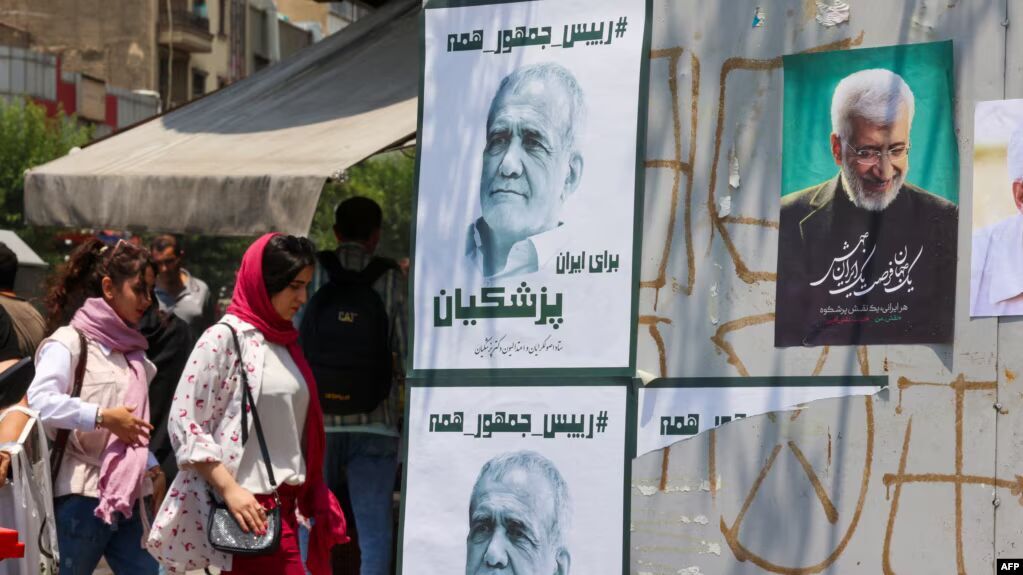
Young women flouting the mandatory Islamic head scarf walk past electoral posters of moderate candidate Masud Pezeshkian (left) and hard-line hopeful Saeed Jalili in Tehran.
Reformist lawmaker Masud Pezeshkian, who took 42.5 percent of the vote, and ultraconservative former nuclear negotiator Saeed Jalili, who won 38.6 percent,
will face off in a second round of voting on July 5 that will determine the next president of Iran.
The historic low turnout came despite calls by Supreme Leader Ayatollah Ali Khamenei for voters to show up in droves to cast their ballots, arguing that the "durability, strength, dignity, and reputation of the Islamic republic" were on the line.
Turnout in major elections has been declining since 2020, but opinion polls carried out in Iran had suggested that this election would not be as bad as the 2021 presidential election, which saw a then-record-low turnout of 48.8 percent.
The low turnout is "obviously a sign of the decreasing legitimacy of the Islamic republic," said Farzan Sabet, a senior research associate at the Geneva Graduate Institute.













Comment:
Update July 4, 2024 from Kenya News Agency
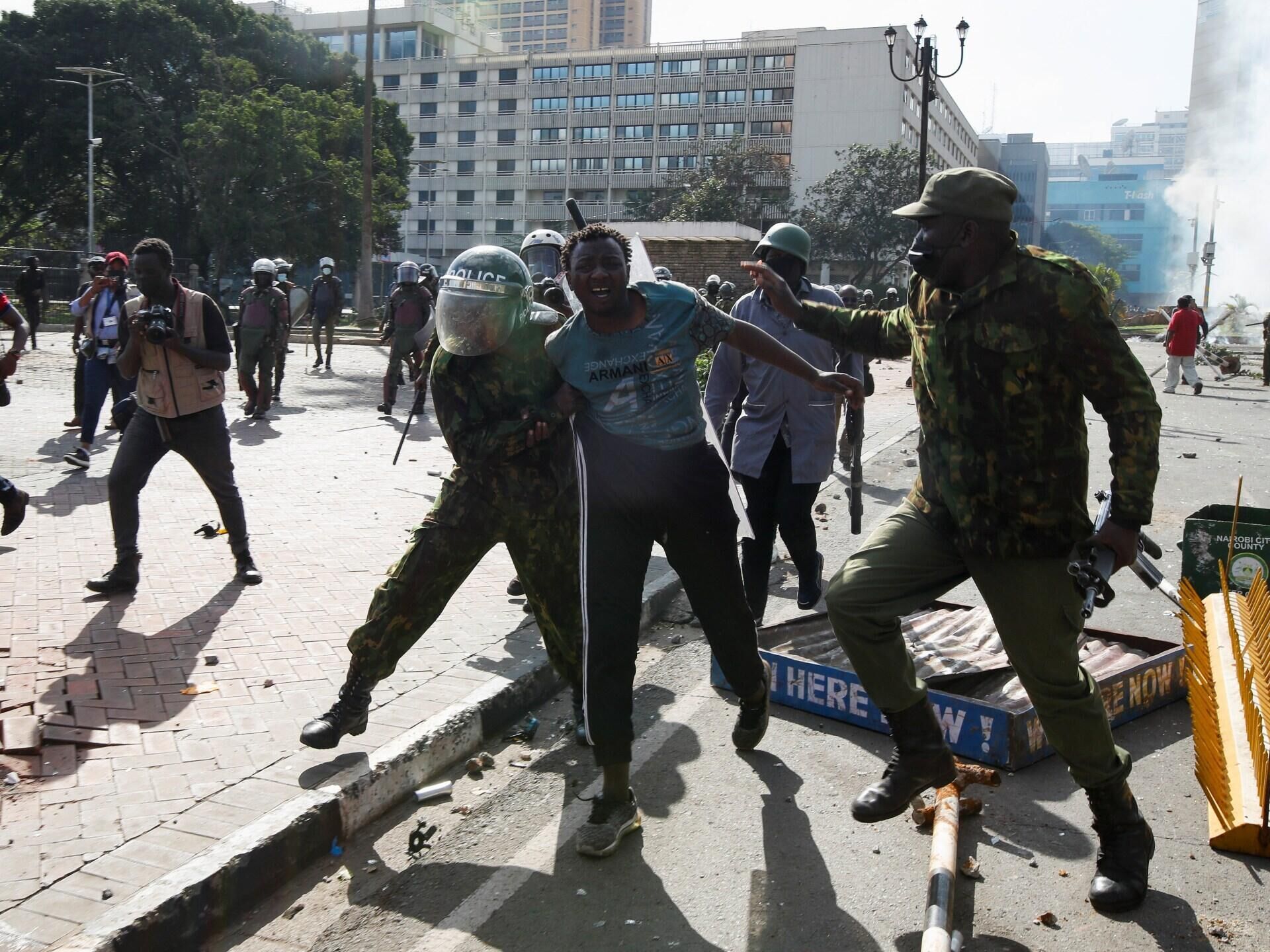
Deputy President Calls On The Youth To Call Off Protests In The Country It is far from unthinkable that some criminal elements if not hijacking the protest, at least made use of the occasion to do business of their own. This has been seen in other countries before, where there as a sideshow to protest is looting, violence and vandalism.
July 4, 2024
Normalcy Returning To Nyeri Town As Anti-Tax Demos Slowly Fizzle Out Sh 550 million is with 1000 Kenyan Shillings being equal to 7.18 Euro, close to 4 million Euro.
From RT:
3 Jul, 2024 10:22
Kenyan police declare zero tolerance on violent protests Kenya covers 580,367 km2 and is home to more than 50 million people. The demographics of Kenya shows the annual growth rate is a little above 2% with a declining trend. The capital of Kenya, Nairobi, has close to five million people, while Mombasa, on the shore of the Indian Ocean has close to 4 million people. More than 30 % live in cities, and of those 30 % (15 million), 70 % (more than 10 million) live in informal settlements, without basic infrastructure. Those between 15 and 29 make up roughly 30 %. Youth protests in a country like Kenya, can potentially include much more people than had it been in Europe or North America.
Some of the problems in Kenya are not unique. A screenshot from the 2023 UN Habitat report: