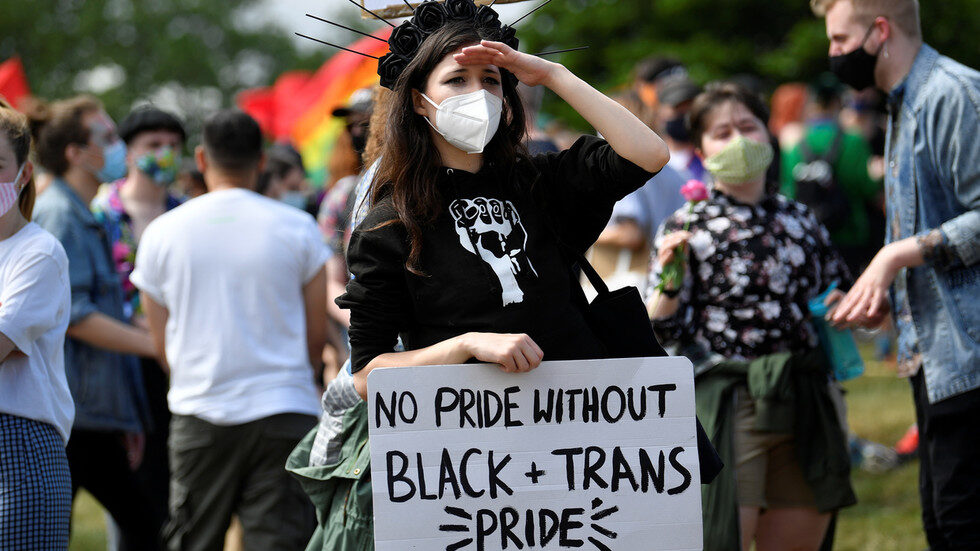
© REUTERS/Toby MelvilleA participant takes part in a Black Trans Lives Matter rally in London, UK.
A Princeton professor has deftly highlighted how modern social justice movements and their proponents are not comparable to their historic counterparts, and may, in fact, be the polar opposite.
In a time of mass protest against systemic racism, coupled with 'woke capitalists' cashing in on social justice for the sake of a quick buck, activism and opportunity seemingly go hand in hand, with those taking a stand, or a knee,
often being rewarding both socially and financially.
The risk-to-reward ratio is highly skewed
in their favor in this era of online 'slacktivism,' where posting a black square on Instagram can win you brownie points that can, and often do, turn into greenbacks.
But this was not always the case, as Robert P. George, a professor of jurisprudence at Princeton University points out in an enlightening Twitter thread.
George explains how, as expected, his students insist that they would have risked it all to abolish slavery if they were white and living in the South before abolition.
"Of course,
this is nonsense... Most of them - and us - would have gone along. Many would have supported the slave system and happily benefited from it," George continues.
He then unveils his gambit, offering to credit his students' claims if they can show that, "in leading their lives today they have stood up for the rights of
unpopular victims of injustice whose very humanity is denied, and where they have done so
knowing" that they would be abandoned by their friends, loathed and attacked by the powerful, and denied professional opportunities.




















Comment: See also: 'Jihadist drug': 137kg of Captagon seized at French airport, partly bound for Saudi Arabia