Puppet MastersS


Attention

Western media admits US steering weapons to ISIS militants through Turkey

safe zone syria
For months - if not years - those looking at ISIS and Al Qaeda territory in Syria can see, flowing like a river, their support has originated in NATO-member Turkey. The most recent Washington Post article all but admits that is the case, but claims it can only be stopped by holding Syrian territory. It is clear however, that NATO, Turkey, and the US possess the ability but intentionally lack the will to stop this flow before it enters Syria - specifically to create a pretext to invade.
With the announcement of US special forces joining Western-backed militants on the ground in Syria, many still appear confused as to exactly what the implications of this move are. As if to assure the public that indeed, the move is to use the so-called Islamic State (ISIS/ISIL) as a pretext to invade and occupy Syrian territory, the Washington Post has published an article explaining the move in detail titled, "Obama has strategy for Syria, but it faces major obstacles."

In it, it states openly that ISIS is being supplied via Turkey. It states specifically that:
They will increase air operations in northern Syria, particularly in the Turkish border area to cut the flow of foreign fighters, money and materiel coming in to support the Islamic State.
Of course, it should be noted that Turkey itself has been a NATO member since the 1950's, with a US airbase located on Turkish territory at Incirlik for nearly as long. Since the war started in Syria in 2011, the US has admittedly operated along the Turkish-Syrian border. The New York Times and the Washington Post itself has reported on numerous occasions regarding the US Central Intelligence Agency steering weapons to militant groups across this very border.

Red Flag

Authoritarian crackdown: Turkish magazine critical of President Erdoğan confiscated, editors arrested

nokta sign
© CİHAN photo
An Istanbul court has ordered the confiscation of the latest issue of Nokta magazine on the grounds that it "incites crime" due its cover, less than two months after it was first confiscated for "insulting the president." The magazine's editor-in-chief and chief news editor have been arrested.

The Istanbul Chief Public Prosecutor's Office opened an investigation into the 24th issue of Nokta, which showed a picture of President Recep Tayyip Erdoğan on its cover, alongside the headline "Nov. 2, Monday: The beginning of Turkey's civil war," on charges of "overtly inciting people to commit crime" and "sedition."

Comment: Clamping down on the media and dissent seems to be a growing theme for the newly reelected Erdoğan and his authoritarian followers:

And so it begins: Turkish journalists and political rivals arrested as Erdoğan crackdown widens
Turkish journalists condemn 'unprecedented' crackdown on media ahead of elections
Authoritarianism in action: Teenagers face 4 years in prison for ripping up posters of Turkish president
Age of Erdogan' - The supremacist and violent rise of Turkish fascism


Handcuffs

Drugs confiscated from Saudi prince may have been intended for ISIS militants

saudi prince drugs
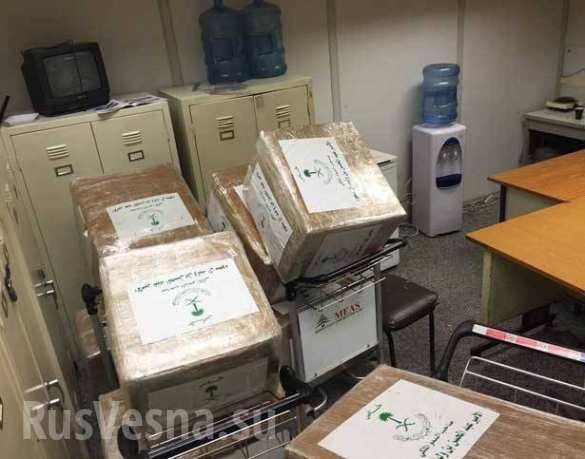
As reported by "Russian Spring" (Rusvesna) on October 26, 2015 security service of Rafic Hariri Beirut international airport arrested a Saudi Prince Abdel Mohsen bin Waleed bin Abdel Aziz, born in 1986, attempting to smuggle a large shipment of drugs.

According to Lebanese authorities, a member of the ruling dynasty of Saudi Arabia was detained in the business terminal during security inspection before boarding a private airline. Twelve million pills (approximately 2 tons) of Captagon were packaged in cardboard boxes and marked with the coat of arms of the Kingdom (see photo).

During many days of interrogation the detainee confessed that he had purchased the pills for $30 million in cash from the family of Ez Ed-Deen, living in the province of Arsal on the border with Syria. Family members of Ez Ed-Din are suspected by local security forces of belonging to a Lebanese cell of ISIS.

Comment: Captured ISIS militants have claimed that the fighters regularly use hallucinogenic drugs. There have been constant rumours of drug use within Islamic State ranks, and a recent discovery of cocaine in the home of an ISIS leader suggests widespread drug use within ISIS.

Saudi prince caught smuggling 2 tons of combat drugs (for ISIS?) on his private plane, arrested


Stormtrooper

Putin's strategy to subdue the West

Vladimir Putin
© MARIAJONER / Wikimedia (CC BY-SA 4.0)
Analysis

Since Vladimir Putin's annexation of Crimea in March 2014, the West has struggled mightily to isolate the Russian leader. So far, though, the crafty former intelligence officer has employed a range of clever strategies that have put him right at the center of the action.

His decision to bomb targets in Syria to support embattled President Bashar al-Assad not only caught the West off guard but it also made the Russian strongman into a bigger player with regard to the country's future.

The timing of his military intervention, on September 30, could hardly have been better. The refugee crisis has made Syria a top issue in Europe right now. And for the time being, any solution that will help stem the flow of refugees to the EU would have to involve Putin.

Putin's cut-rate variant on shock-and-awe is exemplified less by military muscle and more by the triumphant sarcasm of his foreign minister, Sergei Lavrov, who offered to provide air support for the moderate "patriotic opposition" on condition that the US identify those moderates on the ground.

Russia, which could not compete symmetrically with the US militarily, must rely on more subtle chessboard moves. One of the early effects of the Russian psychological operation has been to force into the open previously secret American operations in Syria, as well as the fact that much of the Syrian uprising has been taken over by extremists.

It all comes right out of the so-called Gerasimov Doctrine of non-linear war: Keep your opponents off balance and change tactics frequently, probing for weaknesses to exploit. Tactics-wise, Putin has pulled quite a few rabbits out of his hat: a no-fly zone of his own, sophisticated military hardware ranging from cruise missiles and fighter planes to powerful communications jammers, successful diplomatic initiatives — in 2013, he was instrumental in forging an agreement that resulted in the destruction of Syrian chemical weapons stockpiles — and most recently a surprise visit by Assad to Moscow.

Comment:


Propaganda

Anti-Assad propaganda falls apart at the seams amid massive popular support among Syrians

assad
© SANA / ReutersSyria's President Bashar al-Assad
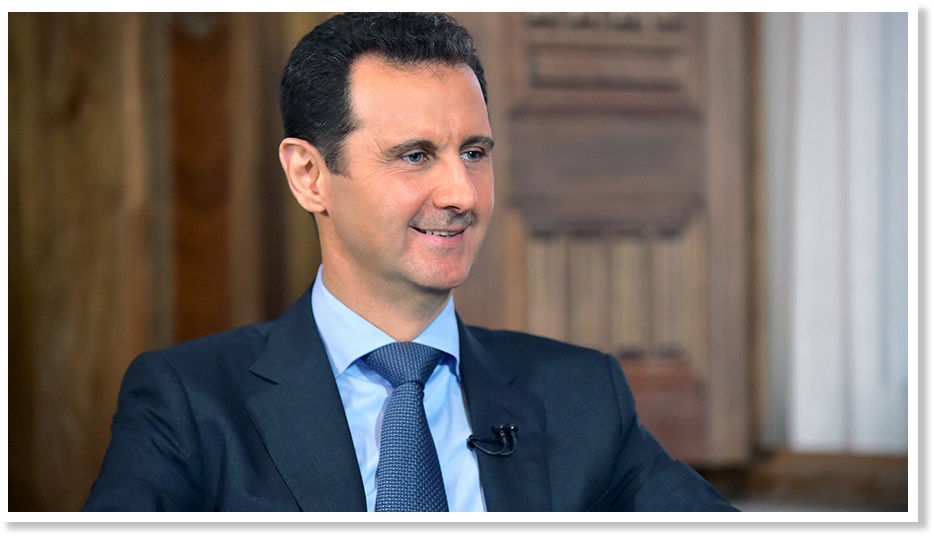
The Western media narrative about brutal "dictator" Bashar al-Assad is falling apart at the seams, Australian academic Tim Anderson underscores, adding that the leader still enjoys high public support in Syria. There is a huge gap between the Western ugly "caricature" of the Syrian President and the real political figure of Bashar al-Assad, Syria's popular secular leader, Tim Anderson, Senior Lecturer in Political Economy at the University of Sydney, notes.
"When I met President Assad, with a group of Australians, his manner was entirely consistent with the pre-2011 image of the mild-mannered eye doctor. He expressed deep concern with the impact on children of witnessing terrorist atrocities while fanatics shout 'God is Great.' The man is certainly no brute, in the manner of Saddam Hussein or George W. Bush," Anderson underscored in his article for Global Research.
If Bashar al-Assad were indeed a brutal tyrant, he and his army would have been abandoned by Syrians and defeated long ago. According to Western media reports, President Assad, the head of an 'Alawi regime,' has launched repeated bombings of civilian areas, gassed children and cracked down on the freedom-loving "moderate" opposition.
"Central to the Bashar myth are two closely related stories: that of the 'moderate rebel' and the story that conjures 'Assad loyalists' or 'regime forces' in place of a large, dedicated national army, with broad popular support," Anderson elaborated.

Dollars

Bill Gates, hypocritical fossil fuel investor, wants us all to pay carbon taxes

bill gates
Put aside whether or not you believe in man-made global warming for a second, and ask yourself, even as he calls once again for carbon taxes, whether or not Bill Gates actually believes in man-made global warming.

It's that time of year again, you see. Billionaire Bill Gates is once more calling for carbon taxes as the only way to stop the dreaded climate change.

Via the Daily Caller:

Comment: Man-made global warming is a complete and utter fraud and carbon credit schemes are a slap in the face for anyone with working brain cells.


Chess

Western propaganda machine uses children's book-style cartoons to promulgate lies about Syria

Assad quote us sponsored terrorism
© Unknown
"Wars are complex. They come out of nowhere and all of a sudden, people you've never heard of are killing each other on the evening news."
So begins this rather patronising piece on Upworthy that attempts to explain in a digestible format what is happening in Syria. Entitled 'Trying to follow what is going on in Syria and why? This comic will get you there in 5 minutes', the article presents a neat, but ultimately misleading and reductive narrative, which argues that drought caused by climate change is primarily responsible for the war in Syria. Somewhat regrettably, it has been shared widely over the internet since it was published last week. Presumably it is being read (and shared) by people who are confused by events in Syria and want to find an easy framework with which to understand them.

Even for a piece that is explicitly intended for the layman, it is highly simplistic, misleadingly so. There is no doubt that the major drought witnessed in Syria between 2006 and 2011 had a catastrophic environmental and societal impact on the country, but it is not the over-arching cause of the war. The article is also littered with inaccuracies and has many glaring omissions, including the central role of foreign powers in the war, notably the US. For instance, there is no mention of the US' long-standing effort (in co-ordination with Saudi Arabia) to encourage Islamic fundamentalism and sectarianism in Syria in order to weaken the Syrian Government at any cost (as revealed by WikiLeaks) and no mention of the CIA's enormous Syria operation that has cost at least $1bn and trained and armed nearly 10,000 fighters sent to fight in Syria since the war began. But it is something else in the piece that - due to personal experience - I found especially problematic. The piece claims that in response to the drought crisis, "Bashar Al Assad's Government offered little help" (the word Government is omitted in the article itself, this appears to be an editorial oversight).

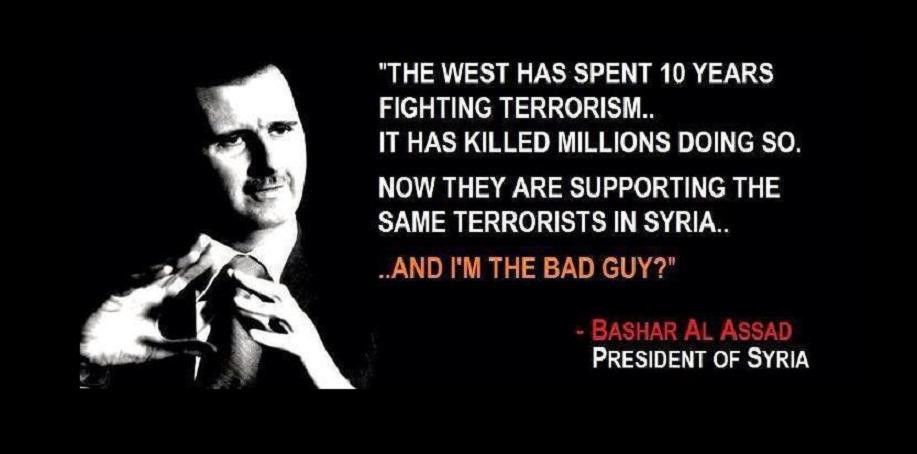
Comment: Of course the media's references to Assad and Syria obscure the reality that the Syrian government is more complex than just the one person: that's the entire point. The entire goal of the west's references to Syria and Assad are to demonize him and drum up support for their proxy army to overthrow him as a leader and replace him with a puppet leader. They've played this formula many times before, but it looks like this time, they didn't anticipate Putin.


Chess

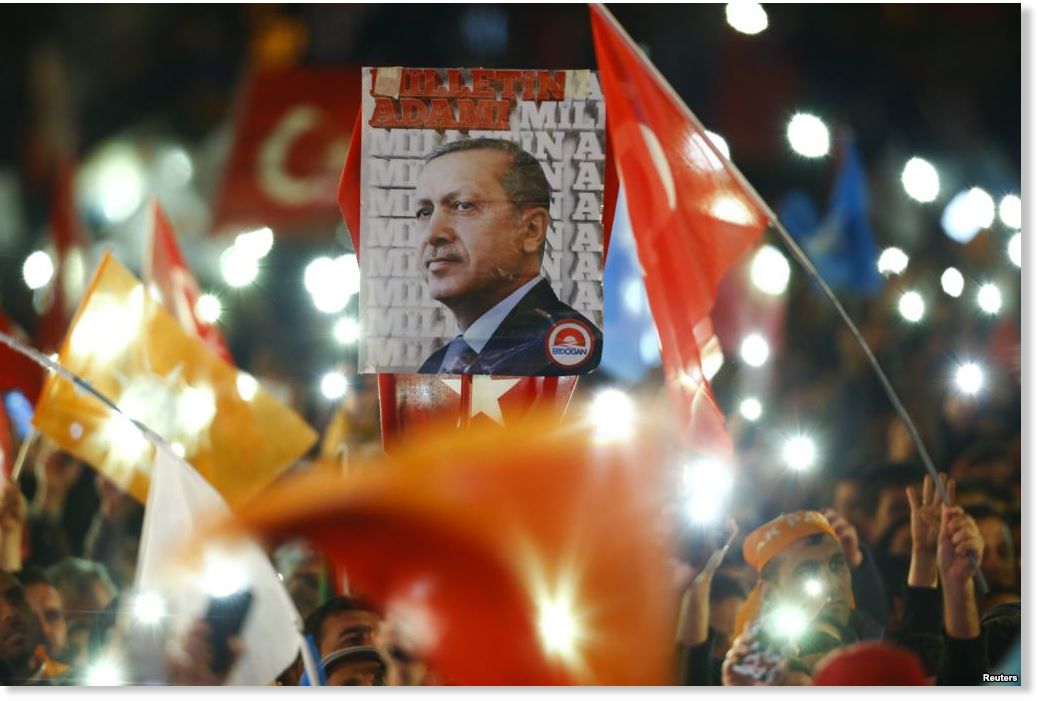
Surprising Turkish election result: Did Turks just vote to become an Islamic State?

Image
The most pivotal election in modern Turkish history was held on Sunday November 1st, and it has transformed Turkey from being the least religiously dominated of all Islamic-majority nations, as Turkey had been ever since Mustafa Kemal Ataturk had established Turkey's independence as a secular nation in 1922, to being now not only Islamic but Sunni Islamic, which means that it will be firmly allied with the Sunni Arabic oil-and-gas aristocracies, especially the Saud clan that owns Saudi Arabia, and the Thani clan that owns Qater. Both clans run Islamic states; the Thanis finance the jihadist Muslim Brotherhood, and the Sauds finance the jihadist Al Qaeda; both the Thanis and the Sauds finance ISIS and are helping ISIS to self-fund by assisting ISIS to sell on the black market the oil being pumped in ISIS's captured territories.

Approximately 90% of Turks are Sunni, but Ataturk had established Turkey as entirely secular; so, this huge Sunni Turkish majority was politically neutered from 1922 until the conservative Sunni President Recep Tayyip Erdoğan became elected Prime Minister in 2003. It could happen only because Ataturk hadn't really understood how to separate church and state, in any enduring way. As Alex Tate of Georgetown University has noted, the system in education in Turkey is that "religion classes are mandatory in schools and teach the tenets of Sunni Islam. The Ministry of Religious Affairs, a branch of the central government that is at least officially autonomous, oversees religious education as well as all of the mosques and imams in the country." In other words: Sunni propaganda is taught to Turkish children, even to non-Sunni children. This has continued to be the case even after Ataturk. Therefore, at the psychological level, Turkey has actually remained a Sunni Islamic state, even though at the political level, it hasn't been Islamic at all (after 1922). The nearly a century of generations of Sunni-propagandized Turks, even after 1922, have produced the cultural foundation on which Erdoğan has been skillfully building, to re-establish the Sunni Turkish Islamic state.

Erdoğan had actually entered politics during a time when the institutionally secular Turkish military was becoming increasingly worried about growing public demands for Turkey to return to religion-based rule. (After all of that pro-Sunni propaganda in Turkey, it's not hard to see why this sentiment was rising.)

Target

Best of the Web: Even the UN gets it: Ban Ki-moon condemns US position on Syria, endorses Putin

Image
Even Ban Ki-moon - usually solidly in US' pocket - thinks Washington's insistence that Assad 'must go' before a solution can be sought is mad

In an interview with Spanish newspapers that was published October 31st, U.N. Secretary General Ban Ki-Moon condemned U.S. President Barack Obama's demand that Syrian President Bashar al-Assad be removed from office, and Moon said: "The future of Assad must be determined by the Syrian people."

Here is the entire quotation:
"The future of President Assad must be decided by the Syrian people. Now, I do not want to interfere in the process of Vienna, but I think it is totally unfair and unreasonable that the fate of a person [diplomatese here for: U.S. President Barack Obama's demand that Assad be removed from the Presidency of Syria] to paralyze all this political negotiation.

This is not acceptable. It's not fair. The Syrian government insists that Assad should be part of the transition. Many Western countries oppose the Syrian government's position. Meanwhile, we lost years.

250,000 people have been killed. There are 13 million refugees or internally displaced. Over 50% of hospitals, schools and infrastructure has been destroyed in Syria.

You must not lose more time. This crisis goes beyond Syria, beyond the region. It affects Europe. It is a global crisis."
The U.N. Secretary General is here implicitly blaming all of this — lots of blood and misery — on U.S. President Obama, and on the "many Western countries" who ally with him and have joined with him in demanding regime-change in Syria.

Snakes in Suits

US media actively trying to use crashed flight A321 to make Putin look bad

Image
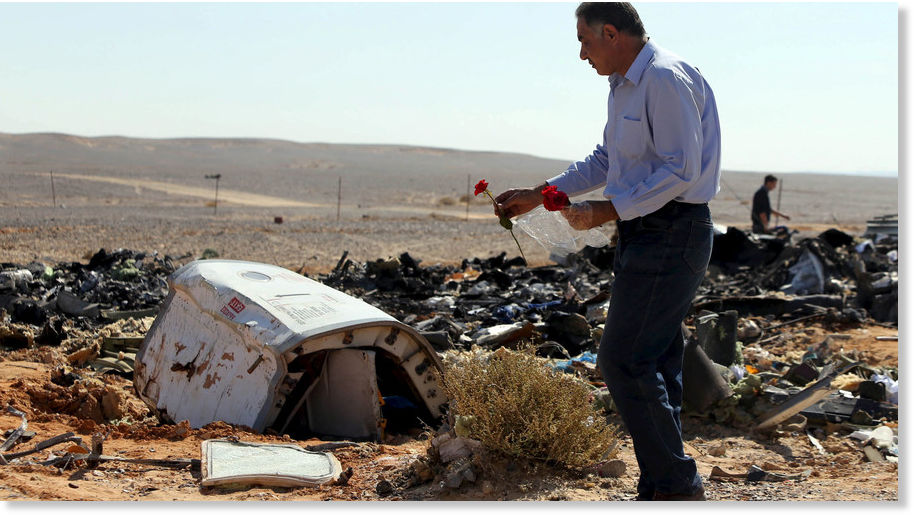
© Mohamed Abd El Ghany / ReutersAn Egyptian man puts flowers near debris at the crash site of a Russian airliner in al-Hasanah area at El Arish city, north Egypt, November 1, 2015.
The Western press is looking for the worst possible scenario for the Russians: something negative, someone to blame, or something to put Putin in a bad light, says Daniel Patrick Welch, writer and political analyst.

RT: The CIA says they don't have any evidence the plane was downed by terrorists yet. Are they suggesting they're expecting some? What do you make of the wording of the phrase?

Daniel Patrick Welch: The first thing is that the kind of point of coverage of Russia in the West and specifically in the US is to find something negative or something blaming, or something to cast Putin and Russia in a bad light. It is just like the DNA of how the Western press works. So whether or not they are expecting this or not, they are looking for the worst possible scenario for the Russians and it is kind of mean-spirited.