Welcome to Sott.net
Fri, 05 Nov 2021
The World for People who Think

Puppet Masters
Map

Info

Syrian progress: Several dozen militants in Aleppo's East lay down arms in past two days

Woman walking past Aleppo destruction
© REUTERS/ Abdalrhman Ismail
The militants were sent to intelligence services departments to undergo required procedures before returning to civilian life.

Dozens of militants in the eastern part of the Syrian city of Aleppo have laid down their arms and gave up in the last two days, a source in the Aleppo militia told RIA Novosti on Saturday.

"We cannot yet say that the militants are giving up en masse. But several dozens from Salaheddin and Sheikh Maqsood [neighborhoods] have given up in the last two days," the source said.

Network

Russian-Iranian relations reach all time high, major energy agreement signed

Iran flag oil
© Raheb Homavandi / Reuters
A five-year strategic cooperation plan was agreed on Friday between Moscow and Tehran during the visit by co-chair of the Russia-Iran Joint Economic Commission Mahmoud Vaezi's to the Russian capital. The sides signed a contract for the construction of a power station in Iran's Hormozgan province. The power plant's four generators will have a 1,400 megawatt capacity. Moscow has already approved a €2.2 billion loan for infrastructure projects in the Iran, including the construction of the power station.

During the meeting with Russian Energy Minister Aleksandr Novak, Vaezi said Tehran plans new energy contracts with Russia in the near future. According to him, in two or three months Iran will reach its pre-sanctions oil output level of four million barrels a day. Vaezi added that the country has already regained 80 percent of the market share it held before the US and EU imposed sanctions on its oil industry in 2012. Novak told the minister that almost all Russian oil and gas companies have shown an interest in energy exploration and production projects in Iran.

Wall Street

Still cleaning the mess: Ireland sentences 3 bankers to jail for role in 2008 crisis

Former group chief executive of Irish Life and Permanent (ILP), Denis Casey
© Clodagh Kilcoyne / Reuters
Former group chief executive of Irish Life and Permanent (ILP), Denis Casey, departs the Criminal Courts of Justice in Dublin, Ireland July 25, 2016.
On Friday, a Dublin court sentenced three senior bankers to up to 3.5 years in prison for conspiring to defraud investors during the 2008 banking crisis. The convictions were seemingly applauded by Irish taxpayers concerned over a lack of accountability.

Former Irish Life and Permanent Chief Executive Denis Casey received two years and nine months after being found guilty in the country's longest trial, which lasted 74 days.

The ex-finance director at the failed Anglo Irish Bank, Willie McAteer, got 42 months, while John Bowe, the bank's former-head of Capital Markets, was sentenced to 24 months.

The three were found guilty of conspiring to mislead investors, lenders, and depositors into believing the infamous bank was still afloat. The bankers set up a 7.2-billion-euro circular transaction scheme from March to September of 2008 to increase Anglo's balance sheet.

"By means that could be termed dishonest, deceitful and corrupt they manufactured 7.2 billion euros in deposits by obvious sham transactions," Judge Martin Nolan said, adding that this was a "very serious crime."

Bad Guys

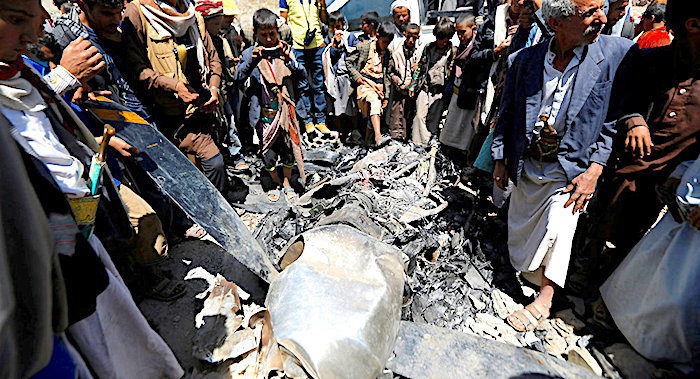
SOTT Exclusive: Houthis refuse to back down as US & Saudi atrocities continue in Yemen

yemen
© AP Photo/ Abdulnasser Alseddik
The world appears on the verge of a total meltdown as conflict and corruption erupts on a global scale. Wherever we look we see the US' hand in stoking flames of division and hatred.

Thanks to the 'US-Saudi coalition' genocide in Yemen rates of malnutrition and starvation have more than doubled into the millions. It is not uncommon for the Yemeni people to see marketplaces turned into an open-casket funeral, with 'blood and body parts everywhere.' The US has been drone bombing Yemen and murdering massive amounts of civilians for the past 14 years. Saudi Arabia has been furiously attempting to prevent an independent Yemen from choosing its own path, and thus cutting the Saudis out of critical shipping lanes. Britain, Israel, and the US have been pumping billions of dollars worth of weapons into the country, turning it into a nightmare. And it's all to prevent a popular uprising:
The House of Saud previously attacked the Houthis in 2009, at the behest of its long-time ally, Yemen's president Abdullah Saleh, who generally placated Riyadh since coming to power in 1994. Saleh and Saudi Arabia's joint attempt to suppress Yemenis' democratic demands by eradicating the Houthis was dubbed 'Operation Scorched Earth', a move that even US diplomats described at the time as "dangerous and delusional."

Never shy of behaving in a ruthless and delusional manner, the US nevertheless, under newly-elected president Barack Obama, participated in 'Scorched Earth' by carrying out 80 targeted operations - from drones, bombers and warships - in northern Yemen, and killing at least 473 people, according to Human Rights Watch. The justification for doing so was that a new terror organization named 'Al-Qaeda-in-the-Arabian-Peninsula' had suddenly sprung up in Yemen, from where it was somehow inducing the teenage sons of rich Nigerians to pack explosives into their underwear and board airplanes bound for the Land of the Free. Yes indeed, the 'underwear bomber' farce was actually about suppressing democracy in Yemen.
In this context, in April the Saudis agreed to a 'peace process'. Initiated between the Saudis' puppet leader in the country, President Abd Rabboh Mansour Hadi, and the Houthi revolutionaries who oppose his proxy rule, it has since fallen apart. It should come as no surprise.

Bad Guys

Islamist rebels make 'last-ditch' effort to turn table on Syrian Army in Aleppo

jaish al fatah nusra fsa

Jaish al-Fatah, FSA, al-Nusra. Can you tell the difference?
Jaish al-Fatah is withdrawing much of its fighting force from the Latakia governorate in a last-ditch effort to turn the tables on the Syrian Arab Army in Aleppo, the Al-Masdar Al-'Arabi information website reported on Friday. Al-Masdar Al-'Arabi claim that these reports are 'very credible'.

Islamist reinforcements were observed arriving in both western and southern Aleppo. Jaish al-Fatah is going to launch at least one major offensive on government positions in the province in the very near future, and hopes not only to relieve distressed and besieged rebels in Aleppo, but also to cut off the Syrian Arab Army's supply lines to the governorate's provincial capital.

On the other hand, the redeployment of the rebels significantly weakens their Latakia frontline, endangering Idlib from its western flank.

Comment: Further reading:
Syrian Army: Militants in Aleppo are trapped, it is time for them to surrender

And right on cue, the U.S. and EU are calling for a ceasefire. Kerry floated the idea of a "week-long regime of silence" in Syria in order to "separate the moderate opposition from terrorist groups" (translation: in order for the U.S.'s terrorists to change hats and pretend they've been 'moderate' the whole time). The EU's Federica Mogherini called for a "pause" in the fighting "to ensure medical evacuations and the delivery of medicine, food and water from and into Eastern Aleppo." Every time the West's proxy terrorists get in a bind, the cries for a "humanitarian ceasefire" come flying. If only these people cared as much for Syria's civilians as they did for these maniacal terrorists...


Chess

Putin reshuffles the deck: Why Russia chose a new ambassador to Ukraine

Putin
© Alexei Nikolsky | Reuters
On July 18th, Russian President Vladimir Putin signed a decree on the resignation of Russia's extraordinary and plenipotentiary ambassador to Ukraine, Mikhail Zubarov. Coincidentally or not, this decree was signed on the same day that a number of personnel changes were decreed at the highest echelons of power in Russia.

For 7 years, Zubarov was Russia's appointed ambassador to Ukraine. Many viewed his appointment as a sinecure for Zubarov and another one of Russia's larger mistakes in policy towards Ukraine. Ukraine has always occupied a central place in Moscow's foreign policy in the post-Soviet space. It is thus essential that Russia's diplomatic mission is headed by a respected politician or highly professional diplomat. But Zubarov did not meet any of these criteria. Not only was he one of the most unpopular ministers in Russia (during his time as Minister of Health), but he has also been accused of using his official position in the interests of his own business.

Critics turned out to be right: Zubarov had never shown himself worthy of the post of ambassador. The Russian Embassy passively watched as power in Ukraine came into the hands of Russophobes prepared by the West and supported by US and EU state structures and NGO's. I've had the opportunity to closely interact with the representatives of Russian organizations in these years, and all of them have noted Ambassador Zurabov's idleness in contrast to the high activity of Western diplomatic missions and public organizations.

Comment: Further reading: Someone is playing us: NATO's war on Russia


Clock

Trump: 'Sanders has lost control of supporters, sold out to the devil'

sanders_devil
© CNN
Donald Trump has decided to take off the gloves and come out swinging.

One day after the Democratic National Convention wrapped up in Philadelphia, Trump has vowed to blast Hillary Clinton in his quest to become the President of the United States.

Earlier, we posted about Trump already working the campaign trail in Colorado and announcing he is ok with Colorado's Marijuana laws and will allow states to decide how they handle the controversial plant.

After speaking about Marijuana, Trump was asked about Bernie Sanders. The reporter for NBC Affiliate Denver 9 News, Brandon Rittiman, asked:
RITTIMAN: Sanders has said his people aren't going to go for you. What do you say back to him?

TRUMP: Well, Bernie made a big mistake because Bernie made a deal and I think he's got buyers remorse... I think he's lost control of his people, He made a terrible mistake. He sold out to the devil and his people are very upset about it. And you saw that last night, and you even saw it with him, he's sitting there when they are talking about him and he looks like hes in a state of major depression.

Comment: Even a broken clock is accurate twice a day!


Bad Guys

Brexit increasing tensions in Franco-German relations

Merkel Cameron Hollande Brexit
© Reuters
(L-R) Germany's Chancellor Angela Merkel, Britain's Prime Minister David Cameron and France's President Francois Hollande attend a meeting during a European Union leaders summit.
Berlin and Paris have long been seen as the main political drivers for the European Union project. When Britain voted last month to quit the 28-member bloc, it was German Chancellor Angela Merkel and French President Francois Hollande to whom the leadership role beckoned for rallying a 'united Europe' and defending the core concept of the EU.

However, this circling of wagons by the EU's top two nations is prone to debilitating competing nationalist interests. And those diverging interests will tend to undermine the much-heralded unity of purpose between Berlin and Paris. What we can expect, in the aftermath of the Brexit, is increasing tensions between Germany and France that could, in turn, lead to further fracturing of the EU.

Already a notable divergence of positions has emerged. When Britain's new Conservative Prime Minister Theresa May embarked on her first foreign visit last week she was scheduled to meet Chancellor Merkel in Berlin, followed the next day by a reception with President Hollande at the Élysée Palace, Paris. May had to wait until the evening on the second day to be received by Hollande who had earlier that same day gone on an official visit to the Republic of Ireland. His strange absence looked like Hollande was sending the British leader a sly snub.

More substantively was the contrasting German and French positions on the Brexit process. The British premier had announced that there would be no formal commencement of Britain's departure from the EU until early next year. Britain, said May, needed to formulate suitable economic terms with the EU before it would sign Article 50 of the 2007 Lisbon Treaty, thus triggering the exit process.

Airplane

Greece's Air Force claims Erdogan's aircraft was never harassed by rebel F-16s on night of coup

Turkish President Recep Tayyip Erdogan
© Reuters
Greek Air Force claims that the Presidential aircraft carrying Recep Tayyip Erdogan from Marmaris to Istanbul on coup night was at no point harassed by rebels' F-16 fighter jets or any other aircraft.

High-ranking sources from the Greece's Air Force General Staff told private Skai TV, that Greek radars were monitoring the flight of the presidential aircraft until the moment it landed in Istanbul and that monitoring data showed that the business jet of Recep Tayyip Erdogan "was neither accompanied by Turkish F-16 nor harassed by any other aircraft. "

Turkish media and military sources had claimed that his plane was targeted by rebels' military air craft and that Erdogan escaping death was "a matter of just a couple of minutes."

Turkish military sources had claimed towards Turkish and international media that at the height of the attempt to overthrow Turkish President Tayyip Erdogan, the rebel pilots of two F-16 fighter jets had Erdogan's plane in their sights. And yet he was able to fly on.

Jet5

Prophets of War: There's no business like the arms business

Prophets of War

When American firms dominate a global market worth more than $70 billion a year, you'd expect to hear about it. Not so with the global arms trade. It's good for one or two stories a year in the mainstream media, usually when the annual statistics on the state of the business come out.


It's not that no one writes about aspects of the arms trade. There are occasional pieces that, for example, take note of the impact of U.S. weapons transfers, including cluster bombs, to Saudi Arabia, or of the disastrous dispensation of weaponry to U.S. allies in Syria, or of foreign sales of the costly, controversial F-35 combat aircraft. And once in a while, if a foreign leader meets with the president, U.S. arms sales to his or her country might generate an article or two. But the sheer size of the American arms trade, the politics that drive it, the companies that profit from it, and its devastating global impacts are rarely discussed, much less analyzed in any depth.

So here's a question that's puzzled me for years (and I'm something of an arms wonk): Why do other major U.S. exports — from Hollywood movies to Midwestern grain shipments to Boeing airliners - garner regular coverage while trends in weapons exports remain in relative obscurity? Are we ashamed of standing essentially alone as the world's number one arms dealer, or is our Weapons "R" Us role such a commonplace that we take it for granted, like death or taxes?

Comment: And who funds the Think Tanks and non-governmental organizations that design the foreign policy in the U.S.? The bottom line would seem to be that the trillions of dollars that get sucked up by these merchants of death, could (if we actually had it and it wasn't borrowed!) be used to vastly improve the quality of life for many hundreds of millions of people on the planet. Instead, we have what we have now - an industry that depends upon and helps foment global war just so that those who profit by it can wipe their asses with silk.