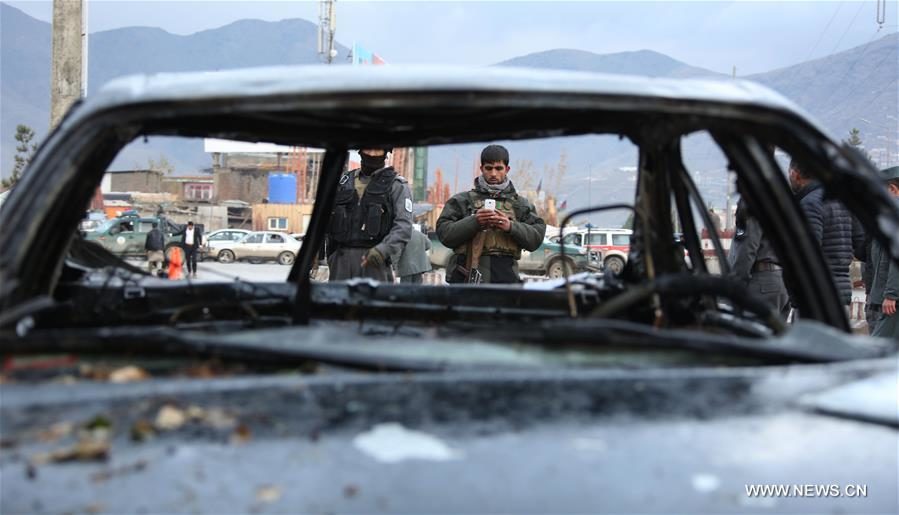
© Xinhua/Rahmat AlizadahAfghan security forces inspect the site of an attack in Kabul, Afghanistan, Nov. 16, 2017. At least 10 people were killed and nine others wounded after a suicide bombing ripped through a banquet hall in northern neighborhood of Afghanistan's capital of Kabul on Thursday, police and witnesses said.
Many previous columns in this
series focus on the transition in the western way of war since 9/11 from tens of thousands of "boots on the ground" to "remote warfare". This has mainly involved a much more intensive use of air-power, including armed-drones; the utilisation of long-range artillery and ground-launched ballistic-missiles; and the much wider use of special forces and privatised military corporations.
The change has been consistently analysed by a few non-government organisations, most notably the
Remote Control project and
Drone Wars UK, whose specific concern is armed drones.
The states pursuing this kind of offensive war see three advantages, two military and one political:
* Their own forces take minimal casualties, meaning fewer bodybags and funeral corteges
* They believe that the tactic works in practice
*
There is very little media coverage of this type of war, and in the case of some countries, most notably Britain, there has been a long-term political convention that the role of special Forces should not be subject to public debate or even scrutiny.
Warfare by "remote control" also seems to be working, not least in the three-year war against Islamic State. It is now clear that Donald Trump's policy of devolving more authority to the United States military in the wars it is fighting is having a much wider effect. For example, the Pentagon has quietly increasing its forces in Somalia by adding several hundred special-forces troops (as
Politico reports) and ratcheting up airstrikes (as
Military Times reports), while airstrikes against an al-Qaida offshoot in Yemen are
continuing.
















Comment: The mainstream media would have you believe that the US army and their NATO friends are able to target their enemy with such precision that no one gets hurt except the "bad guy". However, the reality is far from it.
B***s***!: British Airforce drops 3,400 bombs on Iraq and Syria - but says it has 'no evidence' of civilian casualties
America's drone wars, what do they really do?
Former drone operators say they were horrified by cruelty of assassination program
US drone assassinations probably violate international law
Conscience expressed: Drone strikes equal collateral massacres