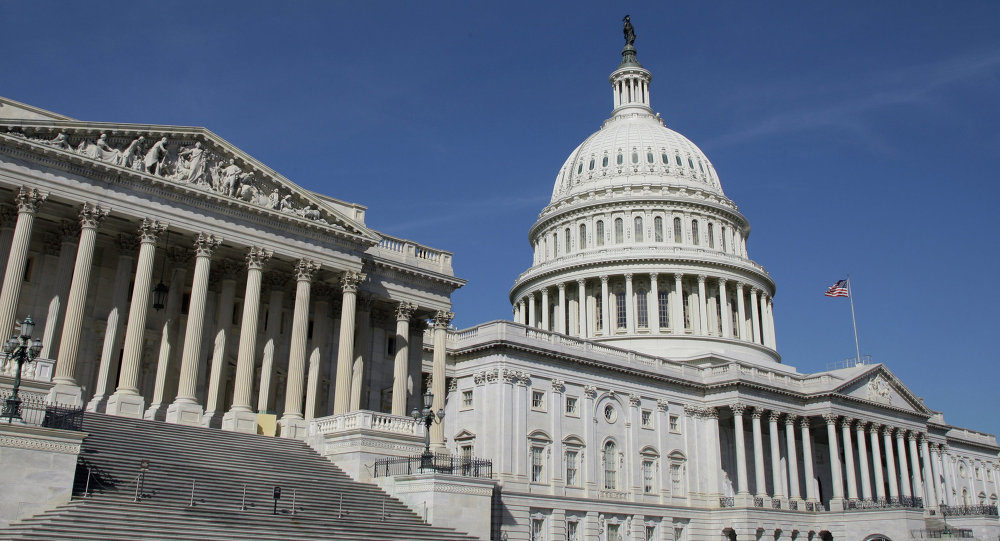
© Sputnik/ Igor Mikhalev
Congress has returned from recess to face a crowded legislative calendar, with little time to sort out how to keep the lights on at federal agencies next month.
Lawmakers must pass a spending deal by Dec. 8 to avert a government shutdown. Earlier this month, House Speaker Paul Ryan, R-Wis., said he expects Congress will approve a
short-term continuing resolution to keep the government open until the end of 2017, in order to give members additional time to work out a deal to fund the government through the end of fiscal 2018.
But the prospects for reaching agreement on a long-term spending bill remain uncertain. President Trump recently repeated his demand to Congress to fund initial payments toward the construction of a wall along the U.S.-Mexico border, and Republicans on the Senate Appropriations Committee last week rejected the White House's request for a
hiring spree at Immigration and Customs Enforcement.
Additionally, Democrats have vowed to oppose any long-term spending deal that does not include language codifying the Obama administration's Deferred Action for Childhood Arrivals program, which prevented the deportation of thousands of undocumented immigrants brought to the United States as children. In September, Trump rescinded the deferred action program, but said that implementation of that decision would be delayed by six months.
Further complicating the debate over a full-year spending measure is the need to change the spending caps set by the 2011 Budget Control Act, as a result of Republicans' push to increase defense spending while cutting appropriations for non-defense agencies. Democrats have argued that any adjustment to spending levels should affect defense and non-defense agencies equally.
Comment: So yet another "shutdown" is on the horizon. No surprise there. In fact it would be strange if they actually got something done.
Back in 2014:
The political class breathed a sigh of relief Saturday when the US Senate averted a government shutdown by passing the $1.1 trillion omnibus spending bill. This year's omnibus resembles omnibuses of Christmas past in that it was drafted in secret, was full of special interest deals and disguised spending increases, and was voted on before most members could read it.
The debate over the omnibus may have made for entertaining political theater, but the outcome was never in doubt. Most House and Senate members are so terrified of another government shutdown that they would rather vote for a 1,774-page bill they have not read than risk even a one or two-day government shutdown.
Those who voted for the omnibus to avoid a shutdown fail to grasp that the consequences of blindly expanding government are far worse than the consequences of a temporary government shutdown. A short or even long-term government shutdown is a small price to pay to avoid an economic calamity caused by Congress' failure to reduce spending and debt.
A little more recently, in
May 2017:
Congress ended the week by passing a continuing resolution keeping the government funded for one more week. This stopgap funding bill is designed to give Congress and the White House more time to negotiate a long-term spending bill. Passage of a long-term spending bill has been delayed over objections to Republican efforts to preserve Obamcare's key features but give states a limited ability to opt out of some Obamacare mandates.
This type of brinkmanship has become standard operating procedure on Capitol Hill. The drama inevitably ends with a spending bill being crafted behind closed doors by small groups of members and staffers and then rushed to the floor and voted on before most members have a chance to read it. These "omnibus" spending bills are a dereliction of one of Congress's two most important duties - allocating spending. Of course, Congress long ago abandoned another primary duty - preventing presidents from launching military attacks without first obtaining a congressional declaration of war.
That's congress for ya. Seems like the only thing they actually do is argue and
harass each other. See also:
20 trillion and rising - Does anyone in Washington even care?




















Comment: Hillary Clinton's "What Happened": Evasions, misleading statements, flat-out lies