Science & TechnologyS


Ice Cube

Q-carbon, a girl's new best friend?

Q-Carbon
Scientists have designed a new type of carbon that is harder and brighter than naturally formed diamonds.

For those who want to wear a one-of-a-kind sparkler on their fingers, the new material, called Q-carbon, also gives off a soft glow.

"This new phase is very unique," said study co-author Jagdish Narayan, a materials scientist at North Carolina State University. "It has novel electrical, optical and magnetic properties."

For instance, the material can act as either a metal or a semiconductor, and is magnetic at room temperature, he added.

Saturn

Scientists find evidence for explosive releases of energy in Saturn's magnetosphere

Saturn
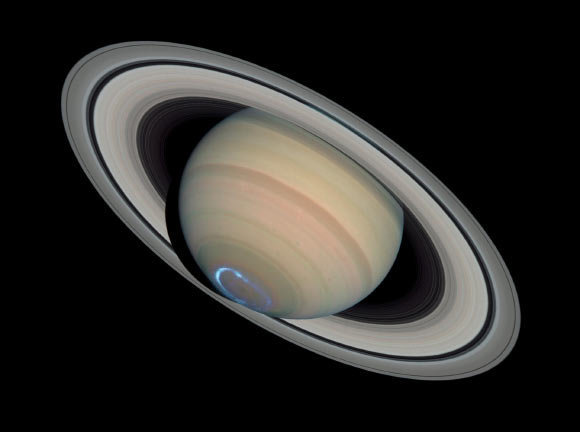
© NASA / ESA / J. Clarke, Boston University / Z. Levay, STScI.Photomontage of Saturn with a false-color image of UV aurora taken with Hubble’s Imaging Spectrograph on January 24, 2004, superimposed on an image of visible light taken with Hubble’s Advanced Camera for Surveys on March 22, 2004.
Planetary scientists using data from NASA's Cassini orbiter have found direct evidence for "explosions" in the magnetosphere of the gas giant Saturn.

These explosive releases of energy are produced in the process of magnetic re-connection - a fundamental process in our Solar System and astrophysical plasmas, through which stored magnetic energy associated with current sheets is converted into thermal, kinetic and wave energy.

This process is well studied at Earth and is an important part of space weather, involved in energizing the radiation belts and producing dazzling aurora borealis displays.

A team of planetary scientists, led by Dr Chris Arridge of Lancaster University, used data from Cassini to show that the orbiter had passed through the region at Saturn where magnetic re-connection was occurring, which has never before been observed.

Sun

Superflare: Sun could release flares 1000x greater than previously recorded

Superflare
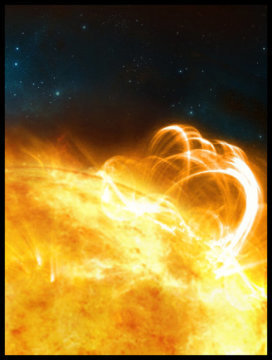
© University of Warwick/Ronald WarmingtonWhat the Sun might look like if it were to produce a superflare. A large flaring coronal loop structure is shown towering over a solar active region.
The Sun demonstrates the potential to superflare, new research into stellar flaring suggests.

Led by the University of Warwick, the research has found a stellar superflare on a star observed by NASA's Kepler space telescope with wave patterns similar to those that have been observed in solar flares.

Superflares are thousands of times more powerful than those ever recorded on the Sun, and are frequently observed on some stars.

Found in the Milky Way, the binary star, KIC9655129, is known to superflare. The researchers suggest due to the similarities between the superflare on KIC9655129 and the Sun's solar flares, the underlying physics of the flares might be the same, supporting the idea that our Sun could also produce a superflare.

Satellite

Faintest galaxy from the early universe, 400 million years after the big bang

cluster of galaxies
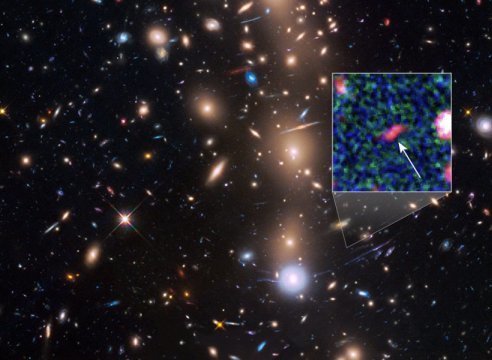
© NASA, ESA, and L. InfanteThis is a Hubble Space Telescope view of a very massive cluster of galaxies, MACS J0416.1-2403, located roughly 4 billion light-years away and weighing as much as a million billion suns. The cluster's immense gravitational field magnifies the image of galaxies far behind it, in a phenomenon called gravitational lensing. The inset is an image of an extremely faint and distant galaxy that existed only 400 million years after the big bang.
Astronomers harnessing the combined power of NASA's Hubble and Spitzer space telescopes have found the faintest object ever seen in the early universe. It existed about 400 million years after the big bang, 13.8 billion years ago.

The team has nicknamed the object Tayna, which means "first-born" in Aymara, a language spoken in the Andes and Altiplano regions of South America.

Though Hubble and Spitzer have detected other galaxies that are record-breakers for distance, this object represents a smaller, fainter class of newly forming galaxies that until now have largely evaded detection. These very dim objects may be more representative of the early universe, and offer new insight on the formation and evolution of the first galaxies.

"Thanks to this detection, the team has been able to study for the first time the properties of extremely faint objects formed not long after the big bang," said lead author Leopoldo Infante, an astronomer at Pontifical Catholic University of Chile (Pontificia Universidad Católica de Chile). The remote object is part of a discovery of 22 young galaxies at ancient times located nearly at the observable horizon of the universe. This research is a substantial increase in the number of known very distant galaxies.

Magnify

Brain activity reveals how detecting violations of social norms varies between cultures

Brain
© Human Brain Project
Social norms are a fundamental characteristic of human behavior, and they vary across cultures in interesting ways. It's even been suggested that the development of social norms and the punishment of norm violations are a uniquely human behavior. However, little research into the neural basis for the detection of social norm violations has been conducted to date.

From an adaptive perspective, the ability to detect violations of social norms may be critical for survival. Groups that have experienced outside threats and periods of resource scarcity develop stronger norms and harsher punishments for infractions in order to coordinate a social response to crisis. China is one example of a society with strong social norms. By contrast, groups in conditions of relatively low threat, such as the population of the United States, develop looser norms with more tolerance for deviations. Interestingly, "loose" societies tend to permit a higher degree of creativity, while "tight" societies prefer orthodox or conventional responses to problems.

A good deal of neurological research exists on other kinds of norm violation detection, such as linguistic/semantic violations, e.g., "She ordered a plate of spaghetti and footballs." Existing studies of such detections using EEG have reported a negative-going deflection with a peak at ~400 ms after detecting an unexpected linguistic stimulus. This component is referred to as N400. Additionally, N400 effects have been observed in response to other non-semantic detection activities, and it is considered to be a reliable index for the detection of surprising, anomalous stimuli and social incongruence.

Info

Doctors may be able to print micro-organs for transplants using 3D printing technology

stem cells, 3D printing
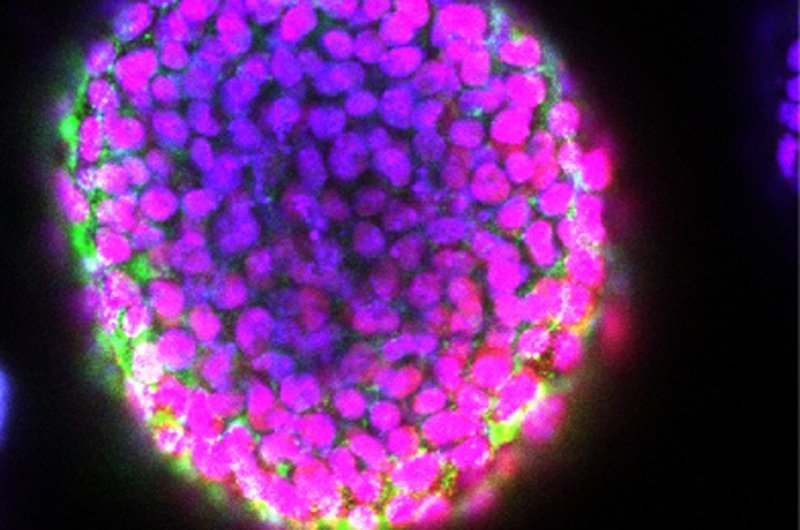
© Wei Sun/Drexel UniversityResearchers have figured out a way to print 3D blocks of living stem cells.
Gone are the days when 3D printers merely built plastic trinkets — scientists say 3D-printed structures loaded with embryonic stem cells could one day help doctors print out micro-organs for transplant patients.

Embryonic stem cells, obtained from human embryos, can develop into any kind of cell in the body, such as brain tissue, heart cells or bone. This property makes them ideal for use in regenerative medicine — repairing and replacing damaged cells, tissues and organs.

Scientists typically experiment with embryonic stem cells by dosing them with biological cues that guide them toward developing into specific tissue types — a process called differentiation. This process begins with the cells forming spherical masses called embryoid bodies — an activity that mimics the early stages of embryonic development.

Comment: See also:


2 + 2 = 4

Cannabis increases the noise in your brain

Cannabis plant
© olyas8 / FotoliaCannabis
Several studies have demonstrated that the primary active constituent of cannabis, delta-9-tetrahydrocannabinol (∆9-THC), induces transient psychosis-like effects in healthy subjects similar to those observed in schizophrenia. However, the mechanisms underlying these effects are not clear.

A new study, published in the journal Biological Psychiatry, reports that ∆9-THC increases random neural activity, termed neural noise, in the brains of healthy human subjects. The findings suggest that increased neural noise may play a role in the psychosis-like effects of cannabis.

"At doses roughly equivalent to half or a single joint, ∆9-THC produced psychosis-like effects and increased neural noise in humans," explained senior author Dr. Deepak Cyril D'Souza, a Professor of Psychiatry at Yale School of Medicine.

"The dose-dependent and strong positive relationship between these two findings suggest that the psychosis-like effects of cannabis may be related to neural noise which disrupts the brain's normal information processing," added first author Dr. Jose Cortes-Briones, a Postdoctoral Associate in Psychiatry at Yale School of Medicine.

Comment:


Magnify

Astronomers closer to explaining mysterious radio pulses from outer space

Fast Radio Burst
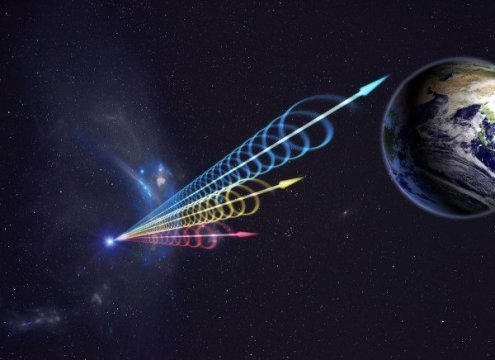
© Jingchuan Yu, Beijing PlanetariumArtist impression of a Fast Radio Burst (FRB) reaching Earth. The colors represent the burst arriving at different radio wavelengths, with long wavelengths (red) arriving several seconds after short wavelengths (blue). This delay is called dispersion and occurs when radio waves travel through cosmic plasma.
Astronomers have tied the origin of a Fast Radio Burst to a highly magnetized, gas-filled region of space, providing a new hint in the decade-long quest to explain the mysterious radio pulses.

"We now know that the energy from this particular burst passed through a dense magnetized field shortly after it formed," says Kiyoshi Masui, an astronomer with the University of British Columbia in Canada and lead author of the new findings published Wednesday in Nature.

"This significantly narrows down the source's environment and type of event that triggered the burst -- and means the source of the pulse likely resides within a star-forming nebula or the remnant of a supernova."

Fast Radio Bursts (FRBs) -- bursts of energy from space that appear as a short flashes of radio waves to telescopes on Earth -- have baffled astronomers since first detected a decade ago. While only 16 have ever been recorded, scientists believe there could be thousands of FRBs a day.

Galaxy

Earth may wear coat of dark matter 'hairs'

dark matter theory
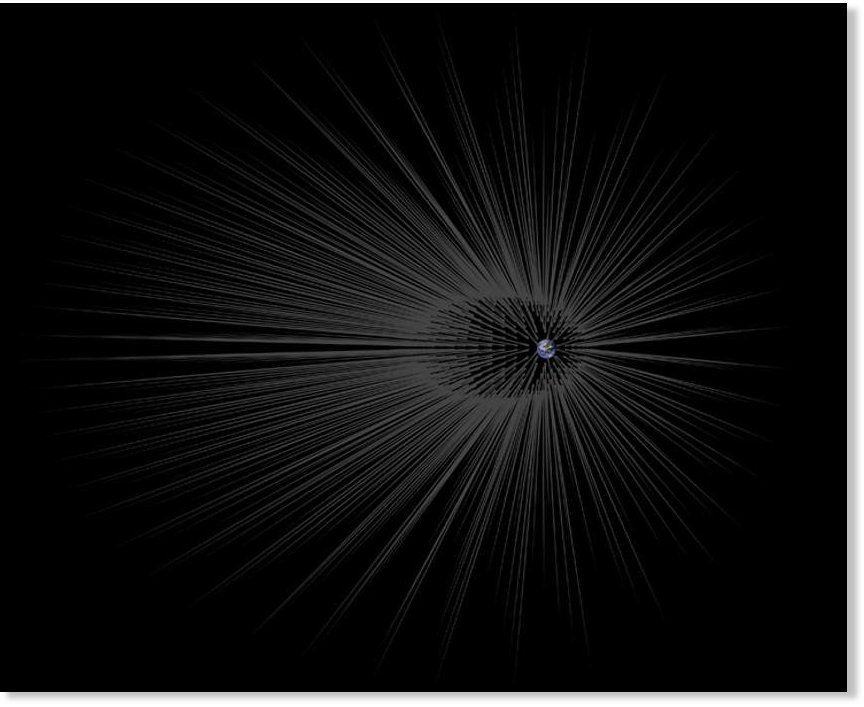
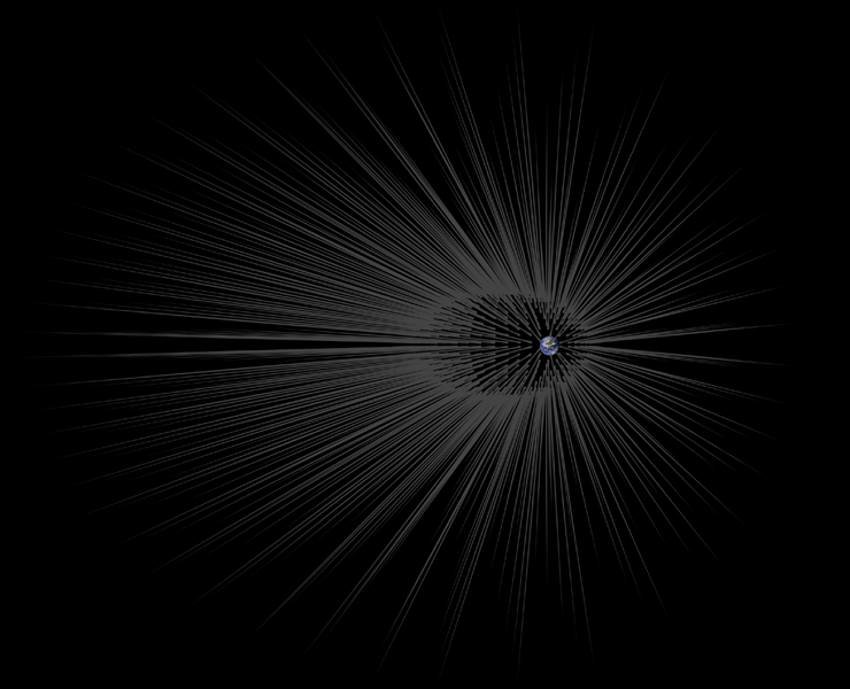
© NASA/JPL-CaltechThis artist’s illustration shows dark matter “hairs” surrounding Earth.
Earth may sport a thick coat of superlong dark matter "hairs," a new study suggests.

Astronomers think dark matter — a mysterious, invisible substance that neither emits nor absorbs light, and is about six times more common than "normal" matter — forms fine-grained but incredibly long streams throughout the universe.

"A stream can be much larger than the solar system itself, and there are many different streams crisscrossing our galactic neighborhood," study author Gary Prézeau, of NASA's Jet Propulsion Laboratory in Pasadena, California, said in a statement.

Prézeau performed computer simulations that looked at what happens when such streams go through Earth and other planets in the solar system. (Dark matter doesn't interact much with normal matter, so the mysterious stuff can zoom through planets' interiors.) He found that these worlds' gravity likely bends the streams into narrow hairs, complete with dense "roots" and more diffuse "tips."

In the case of Earth, the root of such hairs would lie about 600,000 miles (1 million kilometers) from the planet's surface, while the tip would be about twice as far away — 1.2 million miles (2 million km) from Earth. (For perspective, the moon orbits Earth at an average distance of 239,000 miles, or 385,000 km).


Comment: Other dark matter speculations:


Alarm Clock

Plankton growing rapidly in ocean seen as sign of carbon dioxide loading

coccolithophore
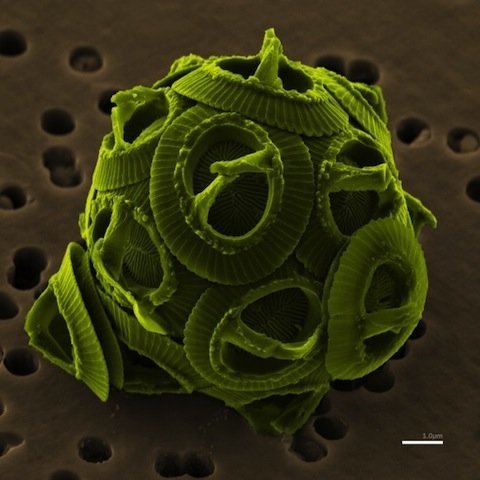
© NEON ja/Richard Bartz/CC BY-SA 2.5 via Wikimedia CommonsThe coccolithophore Gephyrocapsa oceanica.
A microscopic marine alga is thriving in the North Atlantic to an extent that defies scientific predictions, suggesting swift environmental change as a result of increased carbon dioxide in the ocean, a study led by a Johns Hopkins University scientist has found.

What these findings mean remains to be seen, as does whether the rapid growth in the tiny plankton's population is good or bad news for the planet.

Published today in the journal Science, the study details a tenfold increase in the abundance of single-cell coccolithophores between 1965 and 2010, and a particularly sharp spike since the late 1990s in the population of these pale-shelled floating phytoplankton.