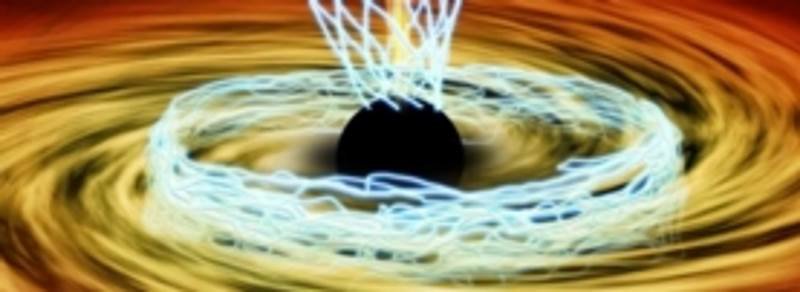
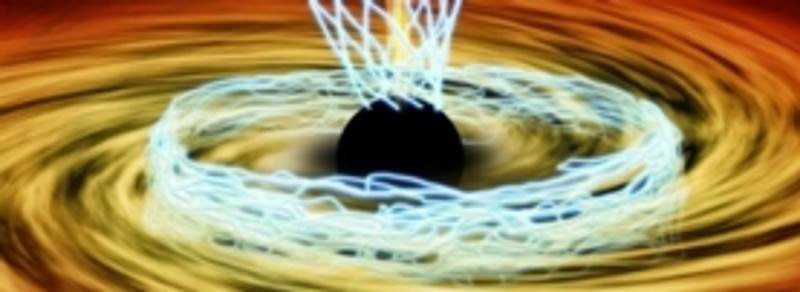
© M. Weiss/CfAMatter swirls around the supermassive black hole at the center of the Milky Way, where astronomers have observed magnetic fields (in blue in this illustration) using the Event Horizon Telescope.
The long list of unanswered questions about black holes contains one particularly surprising item: How do they eat? Unlike many of the riddles that black holes pose, this one seems so simple: What do you mean we don't know how things fall into a black hole?
The question makes sense when you stop thinking about black holes as cosmic vacuum cleaners—which they are not—and start seeing them as astrophysical objects that (in many cases) play by the same orbital rules as stars and planets. The earth doesn't fall into the sun. Likewise, all things being equal, an object orbiting a black hole at a safe distance should keep sailing peacefully and indefinitely along its path. And yet we know stuff falls into black holes all the time because as it does, its gravitational energy is converted to electromagnetic radiation—light—and the black hole shines.
Here's another way to think of the problem. "Black holes have this intense gravity, but they're trying to squeeze everything into this small volume," says Shep Doeleman, director of the Event Horizon Telescope (EHT), a project to observe near the boundary, or "event horizon," of the black hole at the heart of the Milky Way. "There are not very many ways to do that. You compress gas and it heats up. Take all this gas and it's streaming toward the event horizon and getting closer and closer together, it gets hotter and hotter and wants to fly away. Convincing all that gas to go through the event horizon is not a straightforward thing."
The astronomers of the Event Horizon Telescope (EHT) published results today in
Science showing that magnetic fields are essential to this process. In observations conducted in 2013, the astronomers found ordered magnetic fields near the event horizon, or boundary, of a black hole called Sagittarius A*, the 4-million-solar-mass giant at the center of the Milky Way.

















Comment: See also: