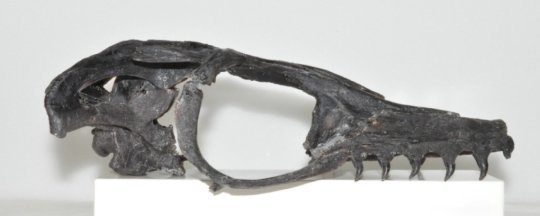
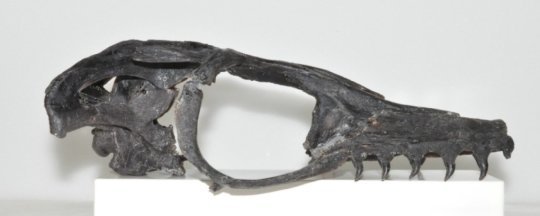
© Takuya KonishiInternational research partnership discovers rare mosasaur fossil, the first ancient marine reptile of its kind to be found in Japan.
Not only does the 72-million-year-old marine reptile fossil fill a biogeographical gap between the Middle East and the eastern Pacific, but also it holds new revelations because of its superior preservation. This unique swimming lizard, now believed to have hunted on glowing fish and squids at night, is detailed in an article led by Takuya Konishi, a University of Cincinnati assistant professor of biological sciences. The article is published in the
Journal of Systematic Palaeontology, a publication of the Natural History Museum in London.
The fossil marine reptile,
Phosphorosaurus ponpetelegans (a phosphorus lizard from an elegant creek), existed during the Late Cretaceous Period just before the last of the dinosaurs such as
Tyrannosaurus and
Triceratops. Compared with some of their mosasaur cousins that could grow as large as 40 feet, this species is relatively small, about 3 meters, or 10 feet long. This unique discovery in a creek in the town of Mukawa in northern Japan reveals that they were able to colonize throughout the northern hemisphere.
"Previous discoveries of this particular rare mosasaur have occurred along the East Coast of North America, the Pacific Coast of North America, Europe and North Africa, but this is the first to fill the gap between the Middle East and the Eastern Pacific," explains Konishi, a member of the research team that also was represented by the Royal Tyrrell Museum of Palaeontology (Canada), University of Alberta, Brandon University, Hobetsu Museum (Japan), Fukuoka University and the town of Mukawa.


















Comment: