Science & TechnologyS


Galaxy

New US space mining law set to spark interplanetary gold rush

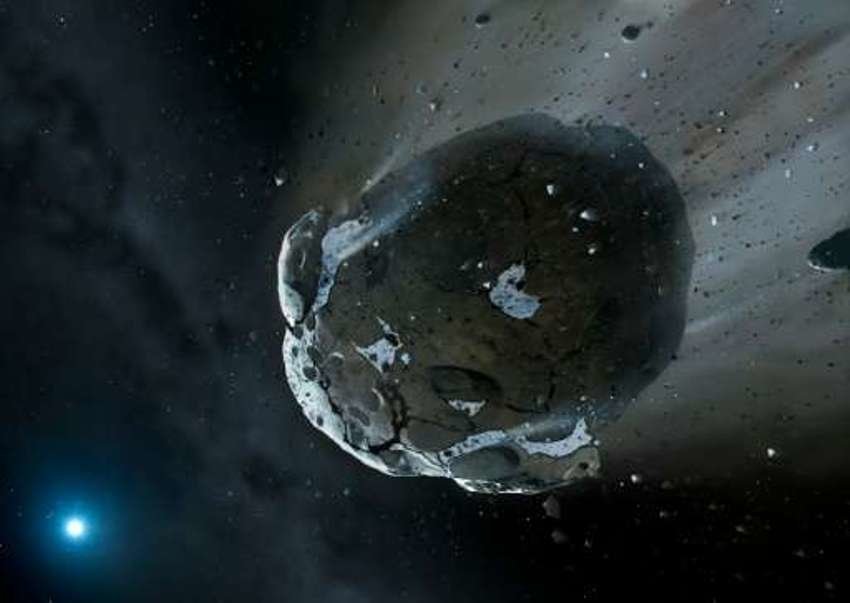
Illustration of a water-rich asteroid
Illustration of a water-rich asteroid - a new US law legalizes the extraction of minerals and other materials, including water, from asteroids and the moon
Flashing some interplanetary gold bling and sipping "space water" might sound far-fetched, but both could soon be reality, thanks to a new US law that legalizes cosmic mining.

In a first, President Barack Obama signed legislation at the end of November that allows commercial extraction of minerals and other materials, including water, from asteroids and the moon.

That could kick off an extraterrestrial gold rush, backed by a private aeronautics industry that is growing quickly and cutting the price of commercial space flight.

The US Commercial Space Launch Competitiveness Act of 2015 says that any materials American individuals or companies find on an asteroid or the moon is theirs to keep and do with as they please.

While the Space Act breaks with the concept that space should be shared by everyone on Earth for scientific research and exploration, it establishes the rights of investors to profit from their efforts, at least under US law.

Christopher Johnson, a lawyer at the Secure World Foundation, which focuses on the long-term sustainable use of outer space, said the law sets the basis for the next century of activity in space.

"Now it is permissible to interact with space. Exploring and using space's resources has begun," he said.

The US move conjured visions of the great opening of the United States' Western frontier in the 19th century, which led to the California Gold Rush of 1849.

But for the moment, the costs of pioneering the economic exploitation of space remain exorbitant and the risks high.

Large companies are still studying their options, but smaller startups are impatient to get going, like Planetary Resources, launched in 2012 by Google co-founder Larry Page.

Magnify

Researchers discover fossil samples of ancient, microscopic worms dating back 530 million years

Eokinorhynchus rarus
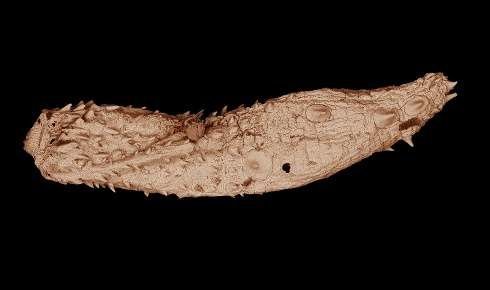
© Virginia TechDetails of the Eokinorhynchus rarus fossil, only a few millimeters in length, can be seen in this electron microscopic image. More than 530 million years old, the ancient worm was found in South China and is closely related to the ancestor of modern animal phylum kinorhyncha.
A team of Virginia Tech researchers have discovered fossils of kinorhynch worms - commonly known as mud dragons - dating back more than 530 million years.

The historic find - made in South China—fills a huge gap in the known fossil record of kinorhynchs, small invertebrate animals that are related to arthropods, featuring exoskeletons and segmented bodies, but not jointed legs. The first specimen was unearthed in rocks in Nanjiang, China, in 2013 and more fossils were found later that year and in 2014.

Helping lead the international team of scientists and biomedical engineers who unearthed, studied, and imaged the ancient, armored, worm-like creature is Shuhai Xiao, a professor of geobiology in the Department of Geosciences, part of the College of Science at Virginia Tech. Dubbed Eokinorhynchus rarus - or rare ancient mud dragon, the newly discovered animal dates back from the Cambrian period and contains five pairs of large bilaterally placed spines on its trunk. It is believed to be related to modern kinorhynchs.

The group's findings were published in Scientific Reports, a Nature family journal.

Info

Toxoplasma parasite hijacks human cells, altering behaviour

Toxoplasma parasite
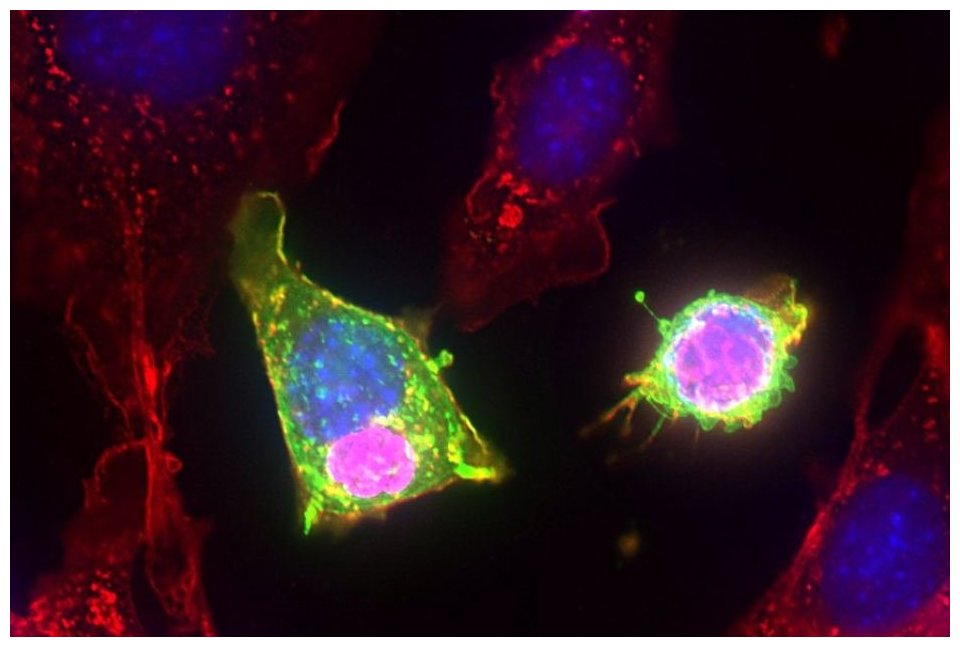
© Walter and Eliza Hall InstituteElectron microscope image visualising the Toxoplasma parasite modifying its host's cells. Toxoplasma parasites are purple, human cells are red. The modified cells are green.
Australian researchers have discovered how to kill a common parasite that can survive for decades undetected in humans and possibly change the brain's behaviour and personality.

The finding could lead to a vaccine that would prevent pregnant women being infected by the Toxoplasma gondii parasite, which can increase the risk of miscarriage or severe birth defects.

And it could have implications in the treatment of mental illnesses such as bipolar and lead to drug therapies for those with compromised immune systems such as HIV and cancer patients.

In a paper published in the journal Cell Host & Microbe and in eLife, the predominantly Melbourne-based research team details how the parasite stockpiles food, giving it an energy source that it can draw on for decades.

The study also reveals a potential mechanism the parasite may use to change brain cells that may contribute to mental illness.

Lead author Dr Chris Tonkin, from the Walter and Eliza Hall Institute of Medical Research, said Toxoplasma was a common parasite that was transmitted by cats and also found in raw or undercooked meat.

Once in humans, the parasite hijacks cells in the brain, heart, lungs and muscles.

Music

It's not just an earworm: Musical hallucinations exist and differ depending on disease state

music brain
© shutterstock
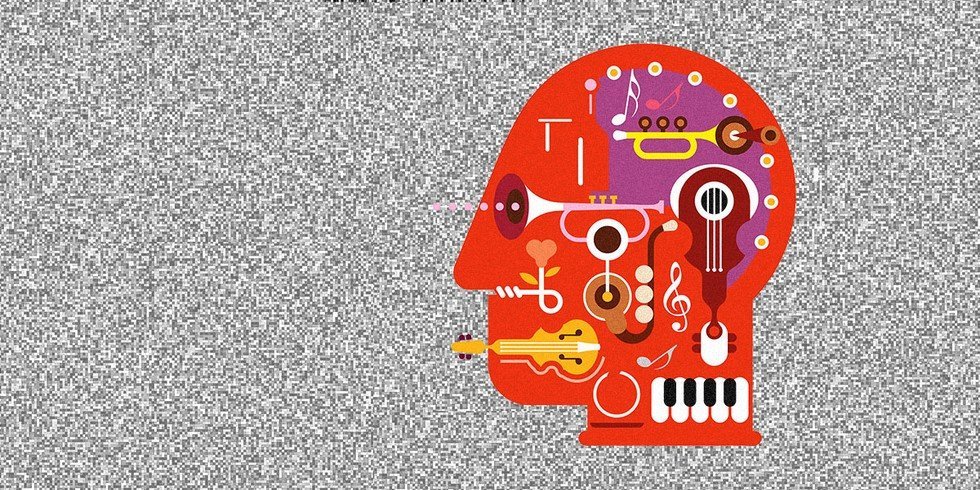
Most of us know what it's like to encounter an earworm, one of those songs that you just can't get out of your head. But as hard as it is to quell the echo of these songs in our minds, we aren't really hearing them. For some people who just can't stop the beat, though, the music playing in their minds is indistinguishable from reality—and sometimes very specific in genre.

In a recent review published in the journal Brain, researchers set out to figure out who has musical hallucinations and what conditions are most likely behind the phenomenon. The team combed through past reports of patients with musical hallucinations who were evaluated at the Mayo Clinic from 1996 to 2003 and found that musical hallucinations don't just crop up in connection to a bunch of different illnesses—they actually sound different depending on what condition is causing them. People with neurodegenerative diseases or hearing loss tend to hear religious or patriotic music, while those with brain damage hear modern music and people with psychiatric disorders hear different flavors of music depending on what mood they are in.

Bulb

Chinese researchers create mind controlled car

brain car
China's first mind-controlled car has been developed by researchers in the north-east port city of Tianjin.

Chinese researchers have developed what they say is the country's first car that uses nothing but brain power to drive.

The research team from Nankai University, in the north-eastern Chinese port city of Tianjin, has spent two years bringing the mind-controlled vehicle to reality.

By wearing brain signal-reading equipment a driver can control the car to go forward, backwards, come to a stop, and both lock and unlock the vehicle, all without moving their hands or feet.

Magnify

Physicists investigate unusual form of quantum mechanics

quantum mechanics
© Advexon
In a new study, physicists at Penn State University have for the first time proposed a way to test a little-understood form of quantum mechanics called nonassociative quantum mechanics. So far, all other tests of quantum mechanics have dealt with the associative form, so the new test provides a way to explore this relatively obscure part of the theory.

"Nonassociative quantum mechanics has been of mathematical interest for some time (and has recently shown up in certain models of String Theory), but it has been impossible to obtain a physical understanding," coauthor Martin Bojowald at Penn State told Phys.org. "We have developed methods which allow us to do just that, and found a first application with a characteristic and instructive result. One of the features that makes this setting interesting is that much of the usual mathematical toolkit of quantum mechanics is inapplicable."

Standard quantum mechanics is considered associative because mathematically it obeys the associative property. One of the fundamental concepts of standard quantum mechanics is the wave function, which gives the probability of finding a quantum system in a particular state. (The wave function is what determines the likelihood of Schrödinger's cat being dead or alive, before the box is opened.) Mathematically, wave functions are vectors, and the mathematical operations involving vectors and the operators that act on them always obey the associative property (AB)C=A(BC), where the way that the parentheses are set doesn't matter.

Sun

Another Kreutz comet vaporized by the sun

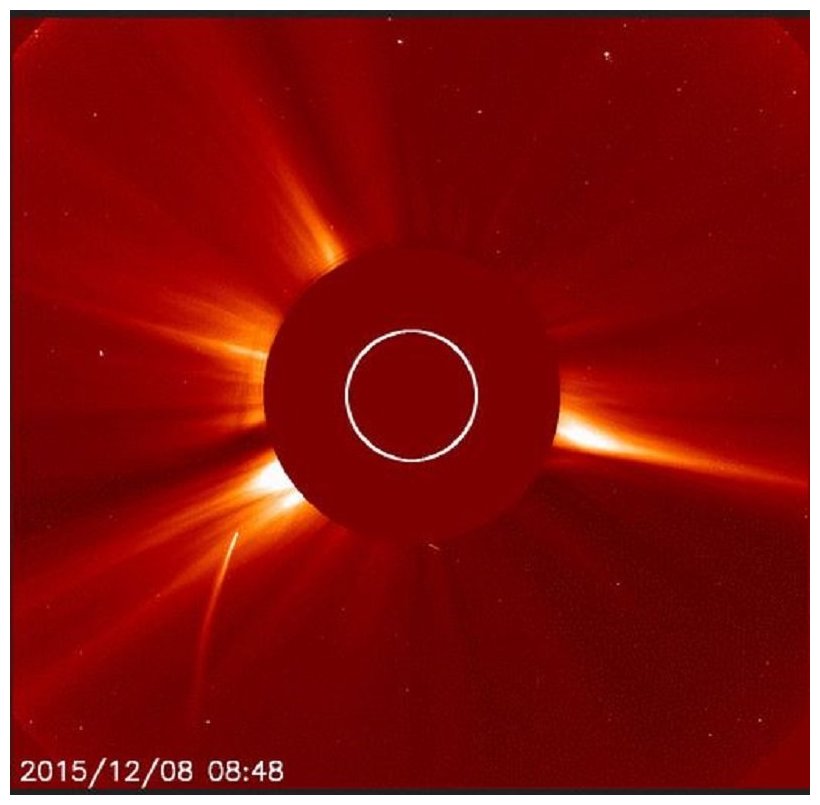
By the time you finish reading this news item, the solar system could have one less comet. Yesterday, Dec. 7th, the Solar and Heliospheric Observatory (SOHO) spotted a comet diving toward the sun. Today, Dec. 8th, it is vaporizing furiously in the solar corona:
Kreutz Comet
© ESA/NASA/SOHO/LASCO
The comet is a member of the Kreutz family--fragments from the breakup of a single giant comet many centuries ago. They get their name from 19th century German astronomer Heinrich Kreutz, who studied them in detail. Several Kreutz fragments pass by the sun and disintegrate every day. Most, measuring less than a few meters across, are too small to see, but occasionally a bigger fragment like this one (~10 m to 50 m) attracts attention.

The comet was first noticed in SOHO images by Polish amateur astronomer Szymon Liwo. Judging from the latest SOHO images, his discovery won't last much longer. In fact, the comet's nucleus may have already disintegrated, leaving only a disembodied tail.

Because of their common parentage, sungrazers often come in clusters. For this reason, it wouldn't be surprising to find yet another one in the offing. Monitor Karl Battam's Sungrazing Comet twitter feed for more sightings.

Headphones

Selective attention: Concentrating on visual tasks can make us momentarily deaf to sounds around us

inattention driving
Concentrating attention on a visual task can render you momentarily 'deaf' to sounds at normal levels, reports a new UCL study funded by the Wellcome Trust.

The study, published in the Journal of Neuroscience, suggests that the senses of hearing and vision share a limited neural resource. Brain scans from 13 volunteers found that when they were engaged in a demanding visual task, the brain response to sound was significantly reduced. Examination of people's ability to detect sounds during the visual demanding task also showed a higher rate of failures to detect sounds, even though the sounds were clearly audible and people did detect them when the visual task was easy.

"This was an experimental lab study which is one of the ways that we can establish cause and effect. We found that when volunteers were performing the demanding visual task, they were unable to hear sounds that they would normally hear," explains study co-author Dr Maria Chait (UCL Ear Institute). "The brain scans showed that people were not only ignoring or filtering out the sounds, they were not actually hearing them in the first place."

Magnify

Computing with time travel?

open timelike curves
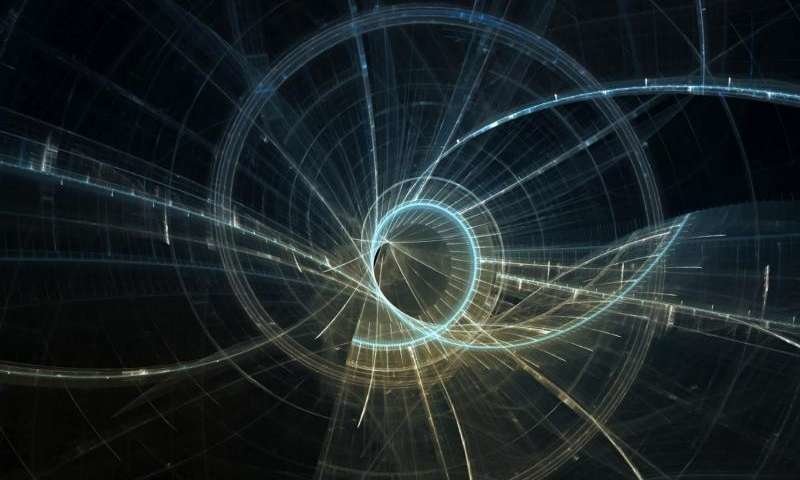
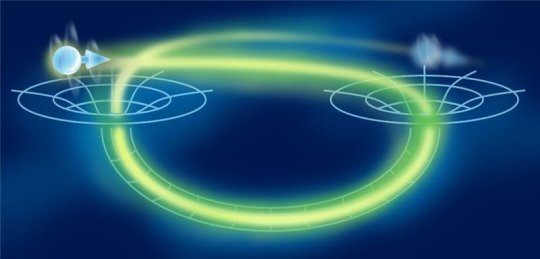
© npj Quantum InformationIf the universe allows 'open timelike curves', particles travelling back in time along them could help to perform currently intractable computations. Even though such curves don't allow for interaction with anything in the past, researchers writing in npj Quantum Information show there is a gain computational power as long as the time-travelling particle is entangled with one kept in the present.
Why send a message back in time, but lock it so that no one can ever read the contents? Because it may be the key to solving currently intractable problems. That's the claim of an international collaboration who have just published a paper in npj Quantum Information.

It turns out that an unopened message can be exceedingly useful. This is true if the experimenter entangles the message with some other system in the laboratory before sending it. Entanglement, a strange effect only possible in the realm of quantum physics, creates correlations between the time-travelling message and the laboratory system. These correlations can fuel a quantum computation.

Around ten years ago researcher Dave Bacon, now at Google, showed that a time-travelling quantum computer could quickly solve a group of problems, known as NP-complete, which mathematicians have lumped together as being hard.

The problem was, Bacon's quantum computer was travelling around 'closed timelike curves'. These are paths through the fabric of spacetime that loop back on themselves. General relativity allows such paths to exist through contortions in spacetime known as wormholes.

Magnify

Scientists discover "white whale" fossil

Albicetus
© A. Boersma; CCALIn this reconstruction, a pod of Albicetus travel together through the Miocene Pacific Ocean, surfacing occasionally to breathe. Modern sperm whales are also known for forming these tight-knit groups, composed mainly of females and their calves.
Researchers re-analyze 15-million-year-old sperm whale fossil, find 'white whale'

A 15 million year-old fossil sperm whale specimen from California belongs to a new genus, according to a study published December 9, 2015 in the open-access journal PLOS ONE by Alexandra Boersma and Nicholas Pyenson from the Smithsonian's National Museum of Natural History.

The authors of the study reanalyzed the large but incomplete Ontocetus oxymycterus fossil sperm whale specimen from the middle Miocene Monterey Formation of California, originally described in 1925 by Remington Kellogg. Kellogg put this species in the genus Ontocetus, that was originally thought to be a tooth taxon; however, it is now known that in this genus, species have walrus tusks instead of a cetacean teeth. Thus, the authors assigned this species to the new genus Albicetus, creating the new combination of Albicetus oxymycterus, gen. nov. The authors used the term "Albicetus," or "white whale," because they were inspired by the fossil's bone-white color, in homage to Melville's famous fictitious leviathan Moby Dick.