
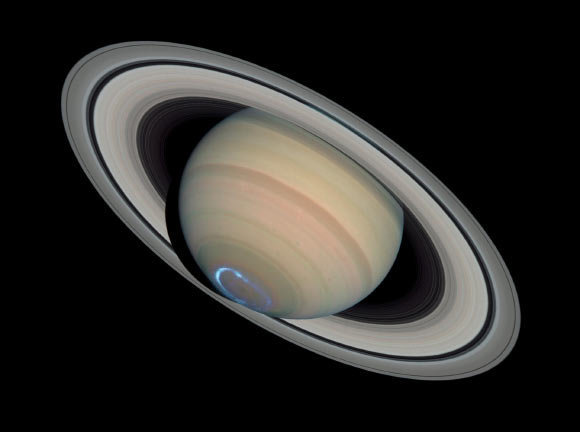
© NASA / ESA / J. Clarke, Boston University / Z. Levay, STScI.Photomontage of Saturn with a false-color image of UV aurora taken with Hubble’s Imaging Spectrograph on January 24, 2004, superimposed on an image of visible light taken with Hubble’s Advanced Camera for Surveys on March 22, 2004.
These explosive releases of energy are produced in the process of magnetic re-connection - a fundamental process in our Solar System and astrophysical plasmas, through which stored magnetic energy associated with current sheets is converted into thermal, kinetic and wave energy.
This process is well studied at Earth and is an important part of space weather, involved in energizing the radiation belts and producing dazzling aurora borealis displays.
A team of planetary scientists, led by Dr Chris Arridge of Lancaster University, used data from Cassini to show that the orbiter had passed through the region at Saturn where magnetic re-connection was occurring, which has never before been observed.
"One of the mysteries this gives us clues to answering is how Saturn's magnetosphere gets rid of gas from Saturn's moon Enceladus," Dr Arridge said.
"Through jets at its south pole, this small, icy moon ejects around 100 kg of water into space every second."
Water from the Enceladus plume is trapped in the magnetosphere of Saturn.
"We know it can't just stay there for ever and until now we have not been able to work out how it has been ejected from the magnetosphere," Dr Arridge said.
Previous study has suggested that magnetic re-connection can't allow all enough plasma to escape from the magnetosphere.
The new results, published online in the journal Nature Physics, show that this is indeed possible.
"These results, although directly relating to the magnetosphere of Saturn, have applications in the understanding of other rapidly rotating magnetospheres, including that of Jupiter and other astrophysical bodies," the scientists said.



was an Ice Planet as J Kirschvink has proposed in its early history, then perhaps Earth also offgassed hydrogen and oxygen (H2O) which produced a 'water veil' around the planet. The remnants of which are the rivers of air and the mile and one half of water that begins at the no oxygen zone in the deep ocean.