Science & TechnologyS


Attention

Rock salt used to contain radioactive waste may not be capable of isolating nuclear waste from groundwater

rock salt nuclear waste repository
Research from The University of Texas at Austin shows that rock salt, used by Germany and the United States as a subsurface container for radioactive waste, might not be as impermeable as thought or as capable of isolating nuclear waste from groundwater in the event that a capsule or storage vessel failed.

A team of researchers from the university has used field testing and 3-D micro-CT imaging of laboratory experiments to show that rock salt can become permeable. Their findings, published in the Nov. 27 issue of Science, has implications for oil and gas operations, and, most notably, nuclear waste storage. The team includes researchers from the university's Cockrell School of Engineering and Jackson School of Geosciences.

"What this new information tells us is that the potential for permeability is there and should be a consideration when deciding where and how to store nuclear waste," said Maša Prodanovic, assistant professor in the Department of Petroleum and Geosystems Engineering. "If it's an existing nuclear waste storage site, you may want to re-evaluate it with this new information."

Comment:


Evil Rays

Spire: Wearable tech from Stanford Researcher aims to reduce your stress

Image
© techcrunch.com
In the fast-paced Bay Area, where life has gotten so expensive, commutes seem to last a lifetime and smartphones blur the boundaries between work and life, who doesn't feel a little anxious and stressed?

Smartphones are not going away, but some scientists here have found way to take the technology to help chill us out.

It's a new type of wearable technology called Spire.

Bulb

Alternative energy: Filipino entrepreneur creates revolutionary lamp that runs on saltwater

Image
Meet Aisa Mijeno, a Filipino architect and scientist who invented a revolutionary lamp that runs on a glass of saltwater instead of batteries. Her vision in creating the SALt (Sustainable Alternative Lighting) lamp was to "light up the rest of the Philippines sustainably," by finding an environment-friendly alternative light source suitable for people in coastal areas. She came up with the idea after spending time with the locals of the Butbut tribe in the Kalinga Province of Philippines, who had no access to electricity.

The lamp can apparently run for eight hours on just two tablespoons of salt and a glass of water. "It is made of tediously experimented and improved chemical compounds, catalysts, and metal alloys that when submerged in electrolytes will generate electricity," Mijeno explained. The idea behind it is the chemical conversion of energy, but while it works on the scientific principle of the galvanic cell, it makes use of a harmless, non-toxic saline solution instead of hazardous electrolytes.

Rose

Scientists unveil the world's first cyborg plant

Image
The concept of "green energy" got a whole lot more literal this week, when scientists announced they'd successfully turned living roses into electronic circuits. That's right—cyborg flowers are now a thing.

Despite how it sounds, the aim isn't to create a race of leafy green borg that will one day rise up and enslave their human masters. Instead, think smart plants that can sense and display environmental changes, or crops whose growth can be regulated at the flick of a switch. Or plant-based fuel cells that convert the photosynthetic sugars into electricity. The very first electronic plant, developed by researchers at Linköping University in Sweden and described this week in Science Advances, is a step toward any one of those applications and many more.

"As far as we know, there are no previously published research results regarding electronics produced in plants," said study lead study author Magnus Berggren in a statement. "No one's done this before."

Alarm Clock

Dancing in time with others raises pain threshold, researchers report

Image
A team from the University's Experimental Psychology and Anthropology Departments wanted to see whether our feelings of social closeness when dancing with others might be linked to endorphins - the body's 'feel good' chemicals.

Endorphins are neurotransmitters that form part of the brain's pain control system, but they are also implicated in social bonding. Dr Bronwyn Tarr explained: 'Dance is an important activity around the world, and it could be a way to connect with other people and feel socially bonded. We wanted to see the effect of high and low energy, and synchronised and unsynchronised dancing had on both pain threshold and the sense of bondedness to fellow group-members.'

Comment: Mental and cognitive benefits of dancing makes you smarter


Mars

Mars to lose its largest moon, Phobos, but gain a ring

Image
© Tushar MittalMars could gain a ring in 10-20 million years when its moon Phobos is torn to shreds by tidal forces due to Mars' gravitational pull.
In 10-20 million years, the moon will get so close to Mars that it'll be shredded into a ring

Mars' largest moon, Phobos, is slowly falling toward the planet, but rather than smash into the surface, it likely will be shredded and the pieces strewn about the planet in a ring like the rings encircling Saturn, Jupiter, Uranus and Neptune.

Though inevitable, the demise of Phobos is not imminent. It will probably happen in 20 to 40 million years, leaving a ring that will persist for anywhere from one million to 100 million years, according to two young earth scientists at the University of California, Berkeley.

In a paper appearing online this week in Nature Geoscience, UC Berkeley postdoctoral fellow Benjamin Black and graduate student Tushar Mittal estimate the cohesiveness of Phobos and conclude that it is insufficient to resist the tidal forces that will pull it apart when it gets closer to Mars.

Music

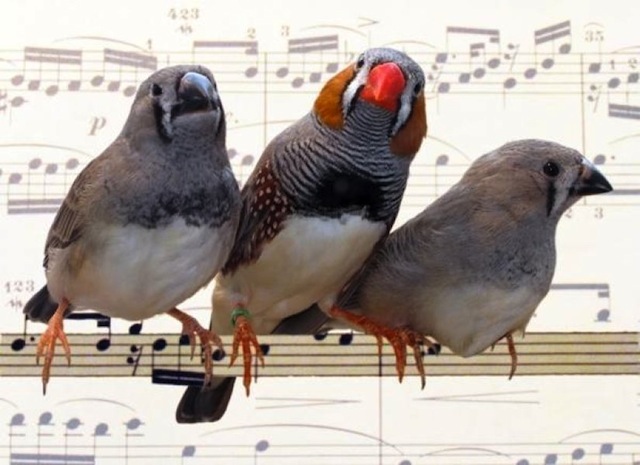
Birds and humans: Same physical mechanism for singing, talking

Image
© Aaron Andalman
When birds and humans sing it sounds completely different, but now new research reported in the journal Nature Communications shows that the very same physical mechanisms are at play when a bird sings and a human speaks.

Birds and humans look different, sound different and evolved completely different organs for voice production. But now new research published in Nature Communications reveals that humans and birds use the exact same physical mechanism to make their vocal cords move and thus produce sound.

"Science has known for over 60 years that this mechanism - called the myoelastic-aerodynamic theory, or in short the MEAD mechanism- drives speech and singing in humans. We have now shown that birds use the exact same mechanism to make vocalizations. MEAD might even turn out to be a widespread mechanism in all land-dwelling vertebrates", says lead author of the paper, Associate Professor Dr. Coen Elemans, Department of Biology, University of Southern Denmark. Co-authors of the paper are from Emory University, Max Planck Institute for Ornithology and Palacky University.

Over the last year Dr. Elemans and his colleagues studied six different species of bird from five avian groups. The smallest species, the zebra finch, weighs just 15 grams, and the largest one, the ostrich, weighs in at 200 kg. All studied birds were revealed to use the MEAD mechanism, just as humans do.

In the human voice box, or larynx, air from the lungs is pushed past the vocal cords, which then start moving back and forth sideways like a flag fluttering in the wind. With each oscillation the larynx closes and opens, making the airflow stop and start, which creates sound pulses. "Such vocal fold oscillations occur from about 100 times/sec in normal speech to one of the highest possible notes sung in opera at about 1400 times/sec, a F6 in Mozart's "Die Zauberflöte", adds voice expert and co-author Dr. Jan Švec of Palacky University in the Czech Republic.


Comment: Bird Brains Suggest How Vocal Learning Evolved


Snowflake Cold

Siberian cold: Yakutian horses adapted to -70C

Yakutian horses
© siberiantimes.comCold-adapted species survived Siberian extremes.
From an evolutionary perspective, it happened almost overnight. In less than 800 years Yakutian horses adapted to the extremely cold temperatures found in the environments of eastern Siberia. The adaptive process involved changes in the expression of a plethora of genes, including some also selected in human Siberian groups and the extinct woolly mammoth.

In a new scientific study, the comparison of the complete genomes of nine living and two ancient Yakutian horses from Far-East Siberia with a large genome panel of 27 domesticated horses reveals that the current population of Yakutian horses was founded following the migration of the Yakut people into the region in the 13-15th century AD. Yakutian horses, thus, developed their striking adaptations to the extreme cold climate present in the region in less than 800 years. This is one of the fastest examples of adaptation within mammals.

Comment: The Yakut horse is the only one that can survive within the Arctic Circle. The symbiosis of the Sakha people with their horses is one of the most perfect in existence. The horse isn't simply a tool or a friend, he is more than that. He is a free spirit, wild, who allows himself to serve Man so that the natural equilibrium can be maintained. The concept of man's domination of the animals simply isn't part of the Yakut's way of thinking.


Galaxy

Scientists witness black hole swallowing star for first time ever

black hole
© NASA/M. Weiss (Chandra X -ray Center)In this artist's illustration, turbulent winds of gas swirl around a black hole. Some of the gas is spiraling inward toward the black hole, but another part is blown away.

Black holes are known for their voracious appetites. These bodies -- formed when a massive star collapses upon itself -- have occasionally been described as the "vacuum cleaners" of the universe and are notorious for their tendency to wreak havoc on the usual laws of physics that govern the rest of the cosmos.

Now, for the first time ever, scientists have witnessed a black hole swallowing a star and ejecting a flare of matter moving at nearly the speed of light -- a rare event that occurs when a star stumbles across a black hole's gravitational well.

"It's the first time we see everything from the stellar destruction followed by the launch of a conical outflow, also called a jet, and we watched it unfold over several months," Sjoert van Velzen, a Hubble fellow at Johns Hopkins University, said, in a statement released Thursday. "Previous efforts to find evidence for these jets, including my own, were late to the game."


Evil Rays

Li-Fi could be replacing Wi-Fi in the near future

Li-Fi
© YouTube Screen Capture
Developments in wireless networking over the past few years have seen Wi-Fi become faster and more reliable than ever. It's still far from perfect though, and now new tech known as 'Li-Fi' threatens to supersede it, boasting 100 times greater performance.

Li-Fi replaces the radio waves of Wi-Fi with light signals. Wi-Fi typically uses the 2.4GHz or 5GHz radio bands, both of which have a tendency to slow down as more devices are added.

Li-Fi solves this problem by boasting 100 times greater performance than the typical Wi-Fi connection today. Pocket-Lint reports lab tests have pushed peak transfer rates to an astounding 224 gigabits per second. In a real-world experiment conducted this week, researchers saw 1GB per second being pushed through the network.

Li-Fi is based around a protocol known as Visible Light Communication (VLC). It essentially involves toggling a light switch thousands of times every second to create a stream of "on" and "off" pulses that can be interpreted as binary bits. It works in a similar fashion to Morse code and currently uses the 400 and 800 THz (terahertz) bands.