
© Ruptly
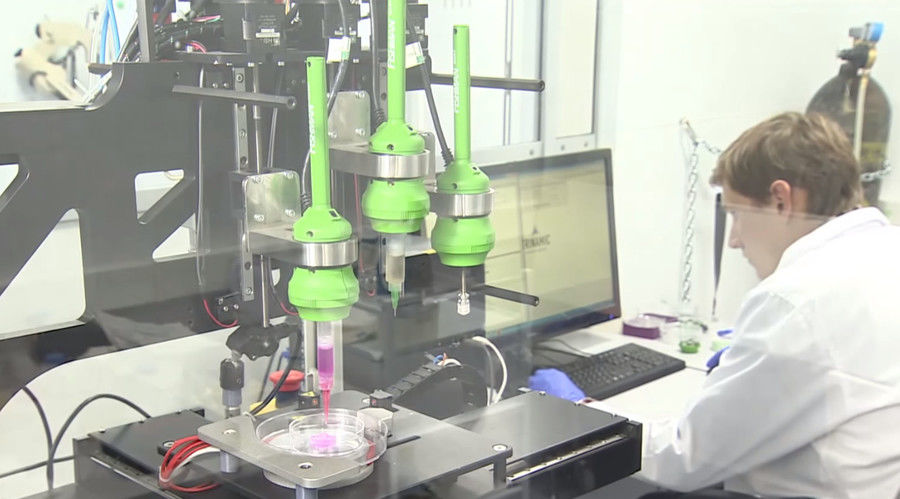
The thyroid, a butterfly-shaped gland in the neck, can have a dramatic impact on a huge variety of human bodily functions. The groundbreaking operation, thus far only in rodents, was performed by a team from the 3D Bioprinting Solutions Laboratory in the Russian capital some three months ago.
"Then we were monitoring them over eight weeks and the level of the hormone continued growing," said Elena Bulanova, 3D Bioprinting Solutions Laboratory Head.
The thyroid glands in mice were first killed by a radioactive iodine injection, before the research team transplanted newly-printed organs into their subjects.Three weeks into the experiment, the team, headed by Vladimir Mironov, observed "higher" levels of the hormone T4, which is responsible for growth and the metabolism, and measured higher body temperatures, Bulanova said.After 11 weeks of monitoring the subjects' 3D printed thyroid glands, they were fully functional with completely restored thyroid function.
"All in all we consider experiment to be successfully conducted because we managed to raise the level of hormone T4," Bulanova said.
The 3D-printed organ consists of several types of tissues, and features blood vessels to substitute the thyroid gland of a living organism. The lab's undertaking to transplant the thyroid first began in March 2015, when the organ was first printed using the Russian bio printer FABION.
In further experiments and in printing other organs, potentially human, researchers are planning to use undifferentiated stem cells taken from an adult organism, which are very similar to embryonary cells.
"There are many new and interesting but complicated tasks which need to be completed, but it is another level of the development of the industry," said 3D Bioprinting Solutions Executive Director Youssef Hesuani.
The breakthrough of 3D Bioprinting Solutions Laboratory was presented at a scientific conference in the Netherlands earlier this month. During the presentation the head of research, Vladimir Mironov told the scientific community that their 3D-printed organ is able to restore thyroid function in mice suffering from hypothyroidism — a condition where thyroid gland doesn't produce enough hormones.
Scientists hope that the new breakthrough will one day help millions of people with different thyroid disorders, as the thyroid gland influences almost all of the metabolic processes in human body.



Reader Comments
Putin's daughter Maria studies endocrinology? (And is busy with many other things and people too, according to Routers), and has also written a book: "She is also the co-author of a book about “Idiopathic stunting” in children, published earlier this year by Lambert Academic Publishing." [Link] -
Katerina is also thriving in academia and running publicly funded projects at Moscow State University. A Reuters examination of public documents shows that the president’s younger daughter has signed contracts worth several million dollars from state-owned organisations for work at the university to be carried out by organisations she directs. There is no indication she has made any personal financial gain from this work.
She holds a senior position at the university, and helps direct a $1.7 billion plan to expand its campus. Katerina’s official advisers at Moscow State University include five members of Putin’s inner circle – including two former KGB officers who knew her when she was a toddler. They served with her father in the 1980s when he was deployed to Dresden, East Germany.
Putin’s elder daughter, Maria, is linked to Moscow State University as well. She is a graduate of the school’s Fundamental Medicine Department and is forging a career in endocrinology, according to publicly available documents.
(...)
The stock acquisitions, state business deals, French property and oligarch connections offer a rare glimpse into the lives of Putin’s children. The president has been very protective of his private life and his daughters, who seldom appear in the media. The transactions also provide insight into the family finances of Russia’s most powerful man and the elite that has formed around him.
Katerina and Kirill, 33, are among a new generation of Russians enjoying a rapid rise in the wake of their well-connected parents. The phenomenon bears similarities to the “princelings” of China – the children and grandchildren of Communist Party leaders who have gone on to gain positions of power and amass great wealth.
“It’s more than just a dynastic succession. Children don’t just inherit their parents’ posts, but also the right to choose any other post they fancy.” Alexei Navalny, opposition leader Olga Kryshtanovskaya, a sociologist and former member of Putin’s United Russia political party, told Reuters that a “new aristocracy” was emerging in politics and state companies, with a second generation inheriting the status of the current circle around Putin. “Many in society think they haven't worked for it, and they question who these people really are,” she said.
(...)
Putin’s other daughter: a specialist in biomedical science
Vladimir Putin’s elder daughter, Maria, has kept out of the spotlight even more than her sister. Reuters was unable to find any recent, confirmed photographs of Maria. Born on Apr. 28, 1985, Maria studied biology at St. Petersburg University and medicine at Moscow State University.
According to Russian and Western media reports, she married a Dutch businessman called Jorrit Joost Faassen. Some reports claimed she lived in the Netherlands for a while, but this could not be confirmed.
Earlier this year, Putin said both his daughters were living in Moscow, but gave no further details.
Maria now uses the surname Faassen, and under that name she is pursuing a biomedical career specialising in the endocrine system, which controls the body’s hormones, according to academic listings and publications.
On the website of Istina, a directory of scholars and their work at Moscow State University, she is listed as co-author of five studies published in the past two years, with titles including “The status of blood antioxidant system in patients with active acromegaly.”
She is also the co-author of a book about “Idiopathic stunting” in children, published earlier this year by Lambert Academic Publishing.
Maria is a PhD candidate at the Endocrinology Research Centre in Moscow, which runs a charity project, Alfa-Endo, that helps children affected by endocrine ailments. The project’s website includes a presentation by Maria.
Maria told Reuters in an email that requests for information about the centre should be directed to its leadership. She did not respond to questions about when she was married or whether her father’s position had affected her career.
Alfa-Endo is funded by Alfa Bank, a large Russian bank with subsidiaries in the United States, Britain and Cyprus. The largest shareholder is Mikhail Fridman, a billionaire with interests in banking, energy and telecoms. An official at the bank said: “Alfa Bank, and broadly speaking Alfa Group, act as financial sponsors for the project and that’s it … We are not aware who else is participating in the project otherwise.”
Maria’s husband used to work for Gazprombank, a large lender with strong links to the elite around Putin. And until at least August this year, Jorrit Joost Faassen was listed on the website of MEF Audit, a Russian consulting group, as its deputy chairman. He no longer appears on the website and did not respond to requests for comment.