
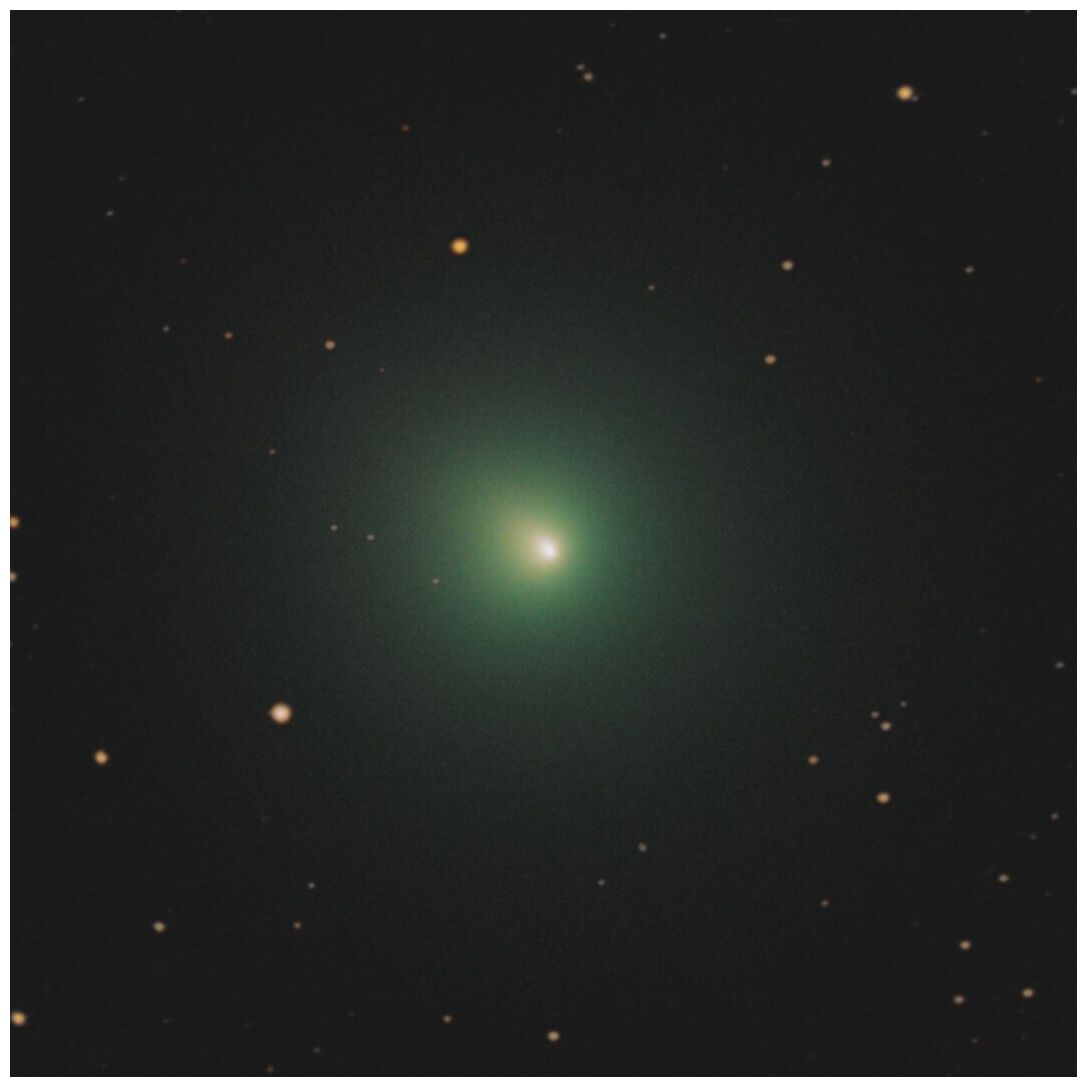
© Stub MandrelComet Wirtanen imaged using a 130P-DS Newtonian telescope on a guided HEQ5 mount and an astro modified and cooled Canon 450D. 45 two-minute images stacked using deep sky stacked to stack comet and stars separately before recombination topo remove blurring.
Comets (and some asteroids) leave a trail of debris behind them like a trail of celestial breadcrumbs. If the orbit of a comet crosses the orbit of the Earth then the particles from the debris (that are often no larger than grains of sand) collide with our atmosphere. At the immense speeds (of the order of 60 km per second, the particles falling through the atmosphere cause the gas to glow giving rise to the classic shooting star we see in the sky. Because the orbits of Earth and comets are relatively fixed, this process repeats itself every time we go through the same part of the orbit giving us the familiar annual meteor showers.
One such comet that it seems may become host to a new annual shower is Comet 46P/Wirtanen (46P). It nearly hit the headlines previously when it had been initially selected as the target for the Rosetta mission which, as you may recall, visited 67P/Churyumov-Gerasimenko instead. 46P is known as a short period comet taking 5.4 years to complete one orbit of the Sun. It is among the family of comets known as a Jupiter comet which has a most distant point from the Sun of between 5 and 6 astronomical units (1 AU is the average distance between the Sun and Earth). Observations have suggested it has a diameter of about 1.4km.
















Comment: See also: