
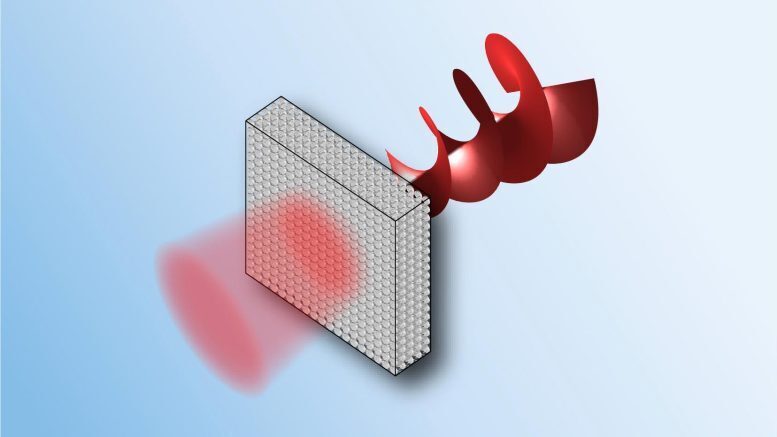
© Wang, S., Zhang, G., Wang, X. et al. / DOI number: 10.1038/s41467-021-26375-9Sound vortex generation enabled by the spin-orbit interaction in real space.
The research was initiated and co-led by Dr. Wang Shubo, Assistant Professor in the Department of Physics at CityU, and conducted in collaboration with scientists from Hong Kong Baptist University (HKBU) and the Hong Kong University of Science and Technology (HKUST). It was published in Nature Communications, titled "Spin-orbit interactions of transverse sound."
Beyond the conventional understanding of sound wave
The physics textbooks tell us there are two kinds of waves. In transverse waves like light, the vibrations are perpendicular to the direction of wave propagation. In longitudinal waves like sound, the vibrations are parallel to the direction of wave propagation. But the latest discovery by scientists from CityU changes this understanding of sound waves.
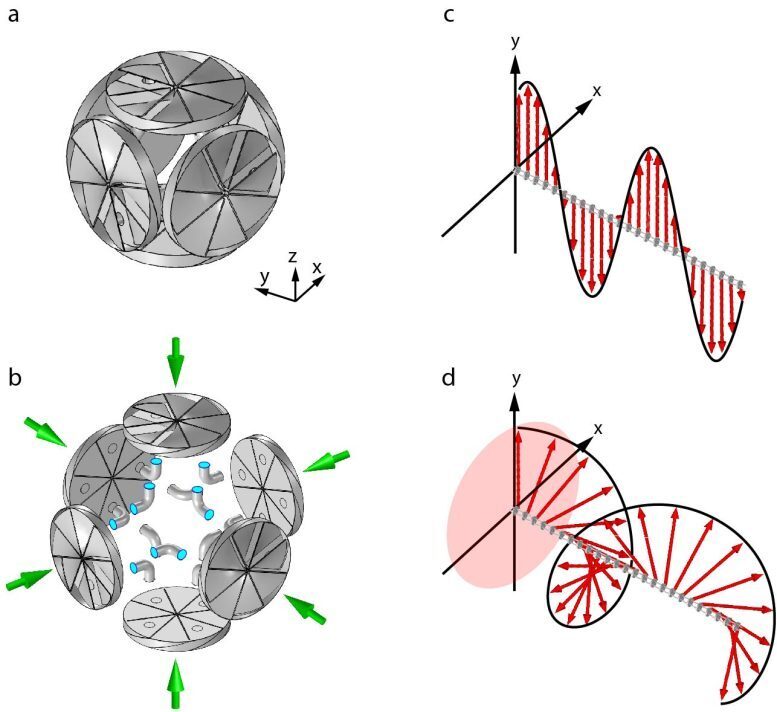
© Wang, S., Zhang, G., Wang, X. et al. / DOI number: 10.1038/s41467-021-26375-9Illustration of the "meta-atom" and transverse sound.
The absence of shear force in the air, or fluids, is the reason why sound is a longitudinal wave, Dr. Wang explained. He had been exploring if it is possible to realize transverse sound, which requires shear force. Then he conceived the idea that synthetic shear force may arise if the air is discretized into "meta-atoms," i.e. volumetric air confined in small resonators with size much smaller than the wavelength. The collective motion of these air "meta-atoms" can give rise to a transverse sound on the macroscopic scale.
Conception and realization of "micropolar metamaterial"
He ingeniously designed a type of artificial material called "micropolar metamaterial" to implement this idea, which appears like a complex network of resonators. Air is confined inside these mutually connected resonators, forming the "meta-atoms". The metamaterial is hard enough so that only the air inside can vibrate and support sound propagation. The theoretical calculations showed that the collective motion of these air "meta-atoms" indeed produces the shear force, which gives rise to the transverse sound with spin-orbit interactions inside this metamaterial. This theory was verified by experiments conducted by Dr. Ma Guancong's group in HKBU.
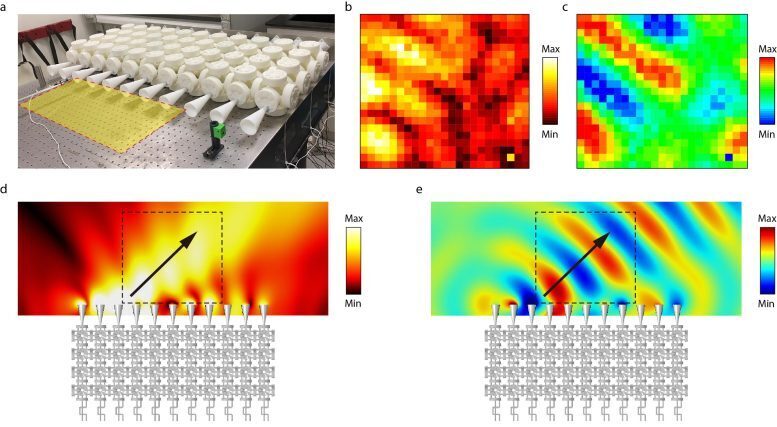
© Wang, S., Zhang, G., Wang, X. et al. / DOI number: 10.1038/s41467-021-26375-9Negative refraction induced by the spin-orbit interaction in momentum space.
The findings demonstrated that airborne sound, or sound in fluids, can be a transverse wave and carry full vector properties such as spin angular momentum the same as light does. It provides new perspectives and functionalities for sound manipulations beyond the conventional scalar degree of freedom.
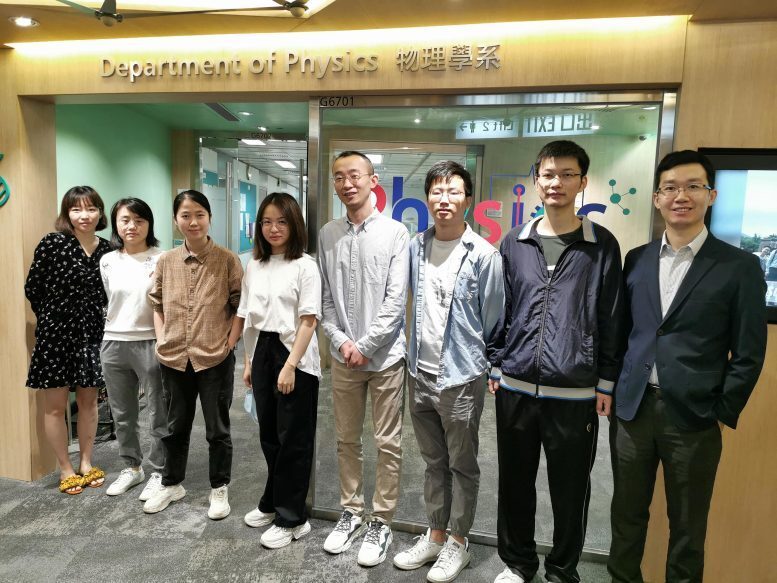
© City University of Hong KongDr Wang Shubo from City University of Hong Kong (first from right) and his research team. Ms Tong Qing (second from left) is a co-author of the paper.
The interaction of spin with orbital angular momentum enables unprecedented sound manipulations via its angular momentum. "The discovery may open an avenue to the development of novel applications in acoustic communications, acoustic sensing, and imaging," he added.
Reference: "Spin-orbit interactions of transverse sound" by Shubo Wang, Guanqing Zhang, Xulong Wang, Qing Tong, Jensen Li and Guancong Ma, 21 October 2021, Nature Communications.
DOI: 10.1038/s41467-021-26375-9
Dr. Wang is the first author and the corresponding author of the paper. Dr. Ma is another corresponding author. Collaborators include Professor Li Jensen from The Hong Kong University of Science and Technology, Ms. Tong Qing, a PhD student from CityU, and other researchers from HKBU.
The work was supported by the Research Grants Council in Hong Kong and the National Natural Science Foundation of China.







Comment: See also: Genes can respond to coded information in light signals - or filter them out entirely