Science & TechnologyS


Nebula

NASA spends $2mn on 'advanced life support tech' for deep space travel potentially furthering long distance space exploration

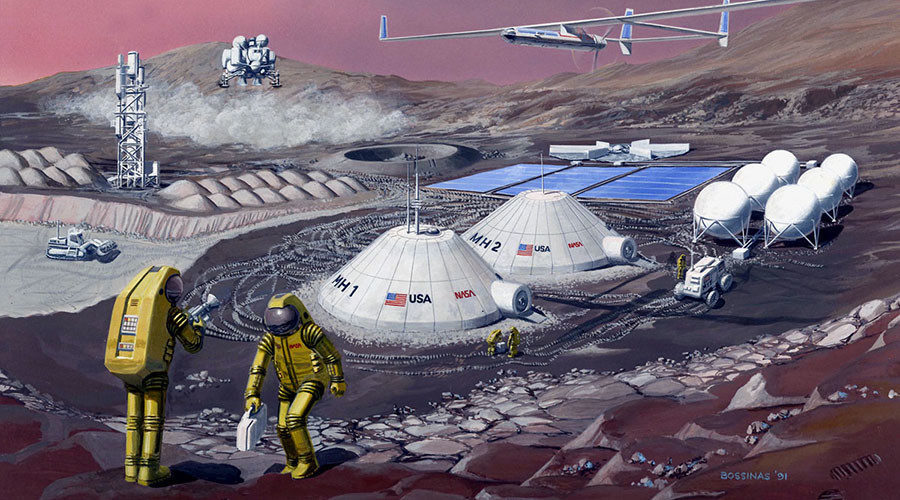
NASA base on Mars
© Cortez III Service Corp / NASAArtist's impression of a NASA base on Mars.
NASA has awarded $2 million to two companies for the development of technology that will help astronauts breathe safely in space for longer periods, potentially furthering long distance space exploration.

The projects aim to advance the use of oxygen recovery technology which will convert carbon dioxide back into oxygen. It's hoped it will help astronauts breathe a little easier in deep space during long missions.

The selected proposals came from Honeywell Aerospace based in Phoenix, Arizona and UMPQUA Research Co. from Myrtle Creek in Oregon.

Comment: See also: Life in space stops aging says NASA


Bizarro Earth

New study reveals major fault under Ventura California could cause more earthquake damage than previously suspected

Ventura-Pitas point fault
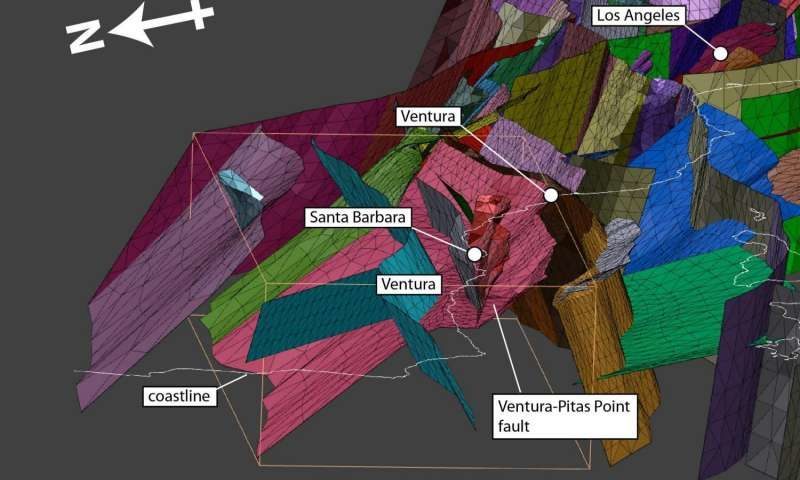
© Gareth J. Funning and Scott T. Marshall. The figure shows the location of the Ventura-Pitas Point fault with respect to the cities involved. The view is of Southern California, as seen from the Pacific coast looking east. The thin white line is the coastline; the outlines of the Channel Islands can be seen off to the right (the south). The pink triangulated surface is the Ventura-Pitas Point fault. At the edge of it can be seen the stair-step cross-section, the flat part being under Santa Barbara.
A new study by a team of researchers, including one from the University of California, Riverside, found that the fault under Ventura, Calif., would likely cause stronger shaking during an earthquake and more damage than previously suspected.

The Ventura-Pitas Point fault in southern California has been the focus of a lot of recent attention because it is thought to be capable of magnitude 8 earthquakes. It underlies the city of Ventura and runs offshore, and thus may be capable of generating tsunamis.

Since it was identified as an active and potentially dangerous fault in the late 1980s, there has been a controversy about its location and geometry underground, with two competing models.

Originally, researchers assumed the fault was planar and steeply dipping, like a sheet of plywood positioned against a house, to a depth of about 13 miles. But a more recent study, published in 2014, suggested the fault had a "ramp-flat geometry," with a flat section between two tilting sections, similar to a portion of a staircase.

Info

Google's New AI Has Learned to Become "Highly Aggressive" in Stressful Situations Using Tactics to Always Come Out on Top

Google's AI
© agsandrew/Shutterstock.com
Late last year, famed physicist Stephen Hawking issued a warning that the continued advancement of artificial intelligence will either be "the best, or the worst thing, ever to happen to humanity".

We've all seen the Terminator movies, and the apocalyptic nightmare that the self-aware AI system, Skynet, wrought upon humanity, and now results from recent behaviour tests of Google's new DeepMind AI system are making it clear just how careful we need to be when building the robots of the future.

In tests late last year, Google's DeepMind AI system demonstrated an ability to learn independently from its own memory, and beat the world's best Go players at their own game.

It's since been figuring out how to seamlessly mimic a human voice.

Now, researchers have been testing its willingness to cooperate with others, and have revealed that when DeepMind feels like it's about to lose, it opts for "highly aggressive" strategies to ensure that it comes out on top.

Comment: See also:


Blue Planet

Scientists uncover huge 1.8 million km2 reservoir of melting carbon under Western United States

A software model by NASA of the remnants of the Farallon Plate, deep in Earth’s mantle
© NASAA software model by NASA of the remnants of the Farallon Plate, deep in Earth’s mantle.
New research published in Earth and Planetary Science Letters describes how scientists have used the world's largest array of seismic sensors to map a deep-Earth area of melting carbon covering 1.8 million square kilometers. Situated under the Western US, 350km beneath the Earth's surface, the discovered melting region challenges accepted understanding of how much carbon the Earth contains - much more than previously understood.

The study, conducted by geologist at Royal Holloway, University of London's Department of Earth Sciences used a huge network of 583 seismic sensors that measure the Earth's vibrations, to create a picture of the area's deep sub surface. Known as the upper mantle, this section of the Earth's interior is recognized by its high temperatures where solid carbonates melt, creating very particular seismic patterns.

"It would be impossible for us to drill far enough down to physically 'see' the Earth's mantle, so using this massive group of sensors we have to paint a picture of it using mathematical equations to interpret what is beneath us," said Dr Sash Hier-Majumder of Royal Holloway.

Comment: Abstract

We report from converted seismic waves, a pervasive seismically anomalous layer above the transition zone beneath the western US. The layer, characterized by an average shear wave speed reduction of 1.6%, spans over an area of ∼1.8×10⁶ km2∼1.8×10⁶ km2 with thicknesses varying between 25 and 70 km. The location of the layer correlates with the present location of a segment of the Farallon plate. This spatial correlation and the sharp seismic signal atop of the layer indicate that the layer is caused by compositional heterogeneity. Analysis of the seismic signature reveals that the compositional heterogeneity can be ascribed to a small volume of partial melt (0.5 ± 0.2 vol% on average). This article presents the first high resolution map of the melt present within the layer. Despite spatial variations in temperature, the calculated melt volume fraction correlates strongly with the amplitude of P - S conversion throughout the region. Comparing the values of temperature calculated from the seismic signal with available petrological constraints, we infer that melting in the layer is caused by release of volatiles from the subducted Farallon slab. This partially molten zone beneath the western US can sequester at least 1.2×10¹⁷ kg1.2×1017 kg of volatiles, and can act as a large regional reservoir of volatile species such as H or C.


Stock Up

Reasons to make business ethics a cumulative science

Man and compass head
© DNY59/E+/Getty
Business ethics research is not currently a cumulative science, but it must become one. The benefits to humanity from research that helps firms improve their ethics could be enormous, especially if that research also shows that strong ethics improves the effectiveness of companies.

Imagine a world in which medical researchers did experiments on rats, but never on people. Furthermore, suppose that doctors ignored the rat literature entirely. Instead, they talked to each other and swapped tips, based on their own clinical experience. In such a world medicine would not be the cumulative science that we know today.

That fanciful clinical world is the world of business ethics research. University researchers do experiments, mostly on students who come into the lab for pay or course credit. Experiments are run carefully, social and cognitive processes are elucidated, and articles get published in academic journals. But business leaders do not read these journals, and rarely even read about the studies second-hand. Instead, when they think and talk about ethics, they rely on their own experience, and the experience of their friends. CEOs share their insights on ethical leadership. Ethics and compliance officers meet at conferences to swap 'best practices' that haven't been research-tested. There are fads, but there is no clear progress.

Comment: Business ethics as a cumulative science...should it be and will it work?


Galaxy

Calculating 'oscillon', ancient signals from the early universe gravitational waves

oscillon
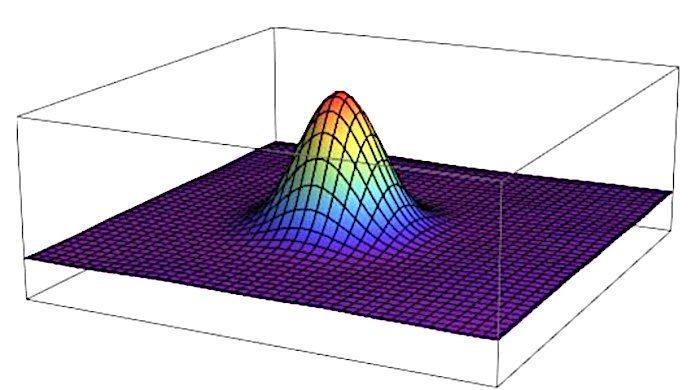
© University of Basel, Department of PhysicsA still image from a computer simulation of an oscillon, a strong localized fluctuation of the inflaton field of the early universe. According to the calculations of Prof. Stefan Antusch and his team, oscillons produced a characteristic peak in the otherwise broad spectrum of gravitational waves.
For the first time, theoretical physicists from the University of Basel have calculated the signal of specific gravitational wave sources that emerged fractions of a second after the Big Bang. The source of the signal is a long-lost cosmological phenomenon called "oscillon." The journal Physical Review Letters has published the results.

Although Albert Einstein had already predicted the existence of gravitational waves, their existence was not actually proven until fall 2015, when highly sensitive detectors received the waves formed during the merging of two black holes. Gravitational waves are different from all other known waves. As they travel through the universe, they shrink and stretch the space-time continuum; in other words, they distort the geometry of space itself. Although all accelerating masses emit gravitational waves, these can only be measured when the mass is extremely large, as is the case with black holes or supernovas.

Cloud Precipitation

China: Monsoon shifts altered early cultures, tied to Earth's orbit

Lake Dali
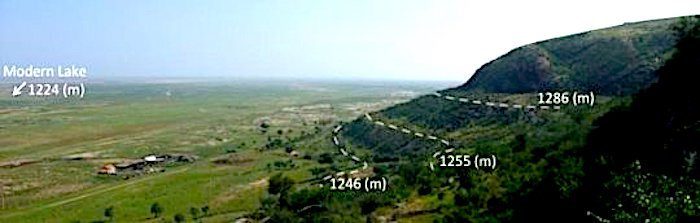
© Yonaton GoldsmithDotted lines represent past high levels of Lake Dali.
The annual summer monsoon that drops rain onto East Asia, an area with about a billion people, has shifted dramatically in the distant past, at times moving northward by as much as 400 kilometers and doubling rainfall in that northern reach. The monsoon's changes over the past 10,000 years likely altered the course of early human cultures in China, say the authors of a new study.

Researchers from the Lamont-Doherty Earth Observatory and the Chinese Academy of Sciences in Xi'an studied ancient water levels for Lake Dali, a closed-basin lake in Inner Mongolia in the northeast of China. They found that the lake was six times larger and water levels were 60 meters higher than present during the early and middle Holocene -- the period beginning about 11,700 years ago, and encompassing the development of human civilization.

"I think it is important to emphasize that these spatial fluctuations in the monsoon drive large changes in northern China," said Yonaton Goldsmith, a graduate student at Lamont-Doherty Earth Observatory and lead author of the paper. "When the monsoon is strong, it shifts northward and northern China becomes green. When the monsoon is weak, the monsoon stays in the south and northern China dries out. Such large fluctuations must have altered the ecosystems in northern China dramatically."

The study, appearing this week in the Proceedings of the National Academy of Sciences, also ties the shifting monsoon to changes in Earth's orbit and other periodic changes in the climate system. The study should help scientists understand how the monsoon is affected by those natural cycles, and how a changing climate today might influence the monsoon in the future.

Info

How microbes shape your love life

Microbes
© Davy Evans
This Valentine's Day, as you bask in the beauty of your beloved, don't just thank his or her genes and your good fortune; thank microbes.

Research on the microbes that inhabit our bodies has progressed rapidly in recent years. Scientists think that these communities, most of which live in the gut, shape our health in myriad ways, affecting our vulnerability to allergic diseases like hay fever, how much weight we put on, our susceptibility to infection and maybe even our moods.

They can also, it seems, make us sexy.

Susan Erdman, a microbiologist at M.I.T., calls it the "glow of health." The microbes you harbor, she argues, can make your skin smooth and your hair shiny; they may even put a spring in your step. She stumbled on the possibility some years ago when, after feeding mice a probiotic microbe originally isolated from human breast milk, a technician in her lab noticed that the animals grew unusually lustrous fur. Further observation of males revealed thick skin bristling with active follicles, elevated testosterone levels and oversize testicles, which the animals liked showing off.

Microbes had transformed these animals into rodent heartthrobs.

When given to females, the probiotic also prompted deeper changes. Levels of a protein called interleukin 10, which helps to prevent inflammatory disease and ensure successful pregnancy, went up, as did an important hormone called oxytocin.

Oxytocin, often called the love hormone, helps mammals bond with one another. Our bodies may release it when we kiss (and mean it), when women breast-feed, even when people hang out with good friends. And the elevated oxytocin Dr. Erdman saw had important effects during motherhood. Some of the mice in her studies were eating a high-fat, high-sugar diet — junk-foody fare that's known to shift the microbiome into an unhealthy state. Not surprisingly perhaps, mothers that didn't imbibe the probiotics were less caring and tended to neglect their pups. But mothers that had high oxytocin thanks to the probiotic were nurturing and reared their pups more successfully.

What Dr. Erdman's research suggests is that the microbes we carry, the same ones that make us attractive to potential mates, also directly influence our reproductive success. So when mammals choose mates based on the glow of health, they're choosing not just an attractive set of genes, but also perhaps a microbial community that might facilitate reproduction.

Another way to look at it: By making their hosts sexy, and by increasing hormones that bring mammals together, microbes help to ensure their own continued existence — the creation of another host. "Everyone wins," Dr. Erdman told me.

Cassiopaea

Beginnings of supernova seen for the first time

Supernova
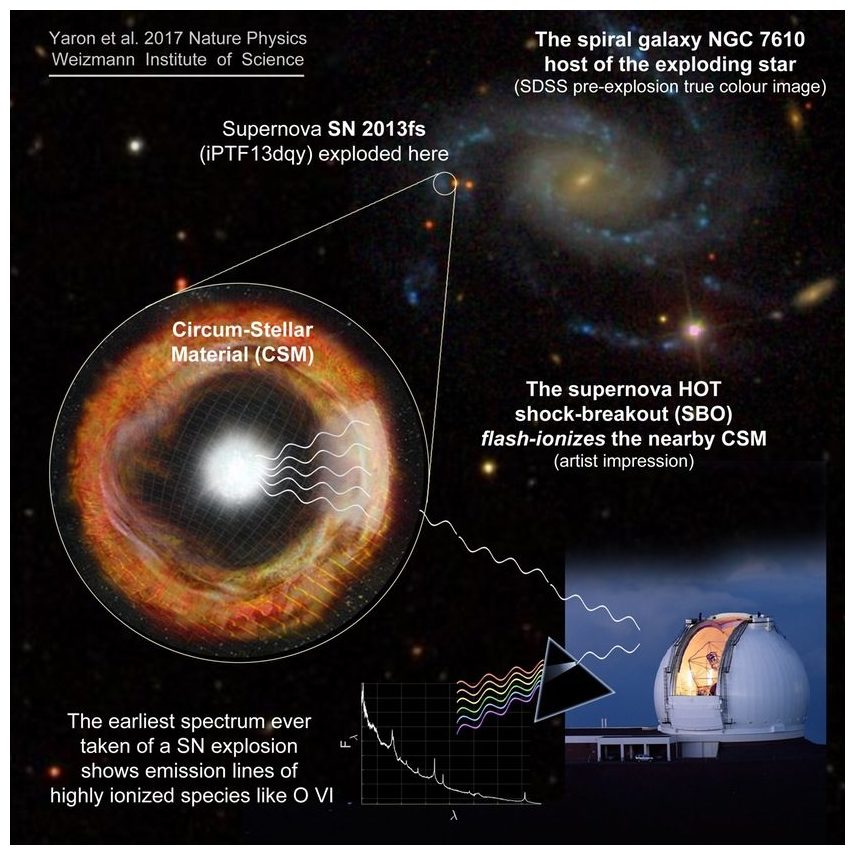
© Ofer YaroniPTF13dqy (SN2013fs) exploded in a relatively nearby (~160 million light years) spiral galaxy on 6 October 2013 and was detected by the Palomar Transient Factory sky survey a mere three hours after explosion.
An extremely rare recording of a massive star's explosive death reveals clues about the formation of supernovae.

Reported in Nature Physics by a team led by Ofer Yaronof at the Weizmann Institute of Science in Israel, recent spectroscopic imaging captured the spectacular transformation of a star assumed to have been a red supergiant into a supernova, just three hours after it began.

It marks the first time a supernova has ever been seen in its infancy. Previously observed supernova - the predicted end-point for around 50% of supergiant stars - have all been recorded after the metamorphosis had been underway for several days, meaning that information about the start of the process was already destroyed.

The most recent event, capturing the fiery death of a star dubbed iPTF 13dqy, was captured by the Intermediate Palomar Transient Factory, an automated astronomical survey from Palomar Observatory in California, which has been monitoring the sky since 2013.

The survey snaps two images per night, over an hour period or longer, of a particular astronomical field and then compares them to identify any transient events. Any flagged are then confirmed and examined by a team of researchers.

Rose

Nature revolts! Will Superweeds Choke GMO to a Timely Death in USA?

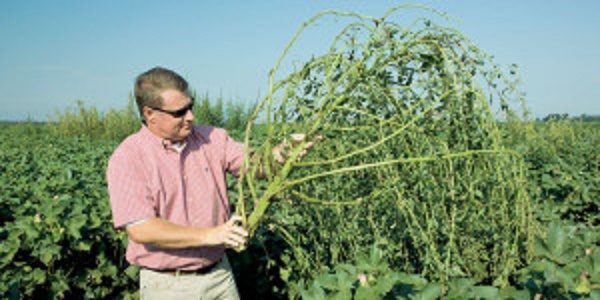
Superweeds
When we human beings become too self-destructive for our own well-bring and that of our Earth, sometimes nature takes control and does what we in our greed and stupidity refuse to do. The refusal of Governments around the world - with notable exceptions such as the GMO-free Russian Federation - to order an immediate global ban on planting of Genetically Manipulated Organisms, GMO, including for corn, for soybeans, for cotton to name just a few, along with an immediate ban on paired weed-killers such as Monsanto's Roundup, is stupidity pure. The response of nature, however, may sound the death knell for American farmers' use of GMO seeds more effectively than any labeling or WHO carcinogen warning. Superweeds are literally choking GMO plants to death across the US Midwest farm belt and that should send a very real signal that nature abhors GMOs and their toxic weed-killing chemicals.

Since President George Herbert Walker Bush met with the directors of Monsanto in the White House in a closed-door 1992 meeting, American agriculture and the American people have been the experimental guinea pig for testing the effects of planting of GMO crops paired to specific toxic weed-killers.

G.H.W. Bush after the Monsanto powwow ordered US Government agencies to treat the untested GMO seeds and their paired weed-killer chemicals as "substantially equivalent" to non-GMO plants and not requiring extra government testing, one of the more lunatic decisions of a President who seems to have had a morbid affinity for lunatic decisions.

Comment: See also:
  • Trump's toxic agriculture policy will be no better than Obama's
  • The Deadstream media is ignoring damning GMO Studies - again!