
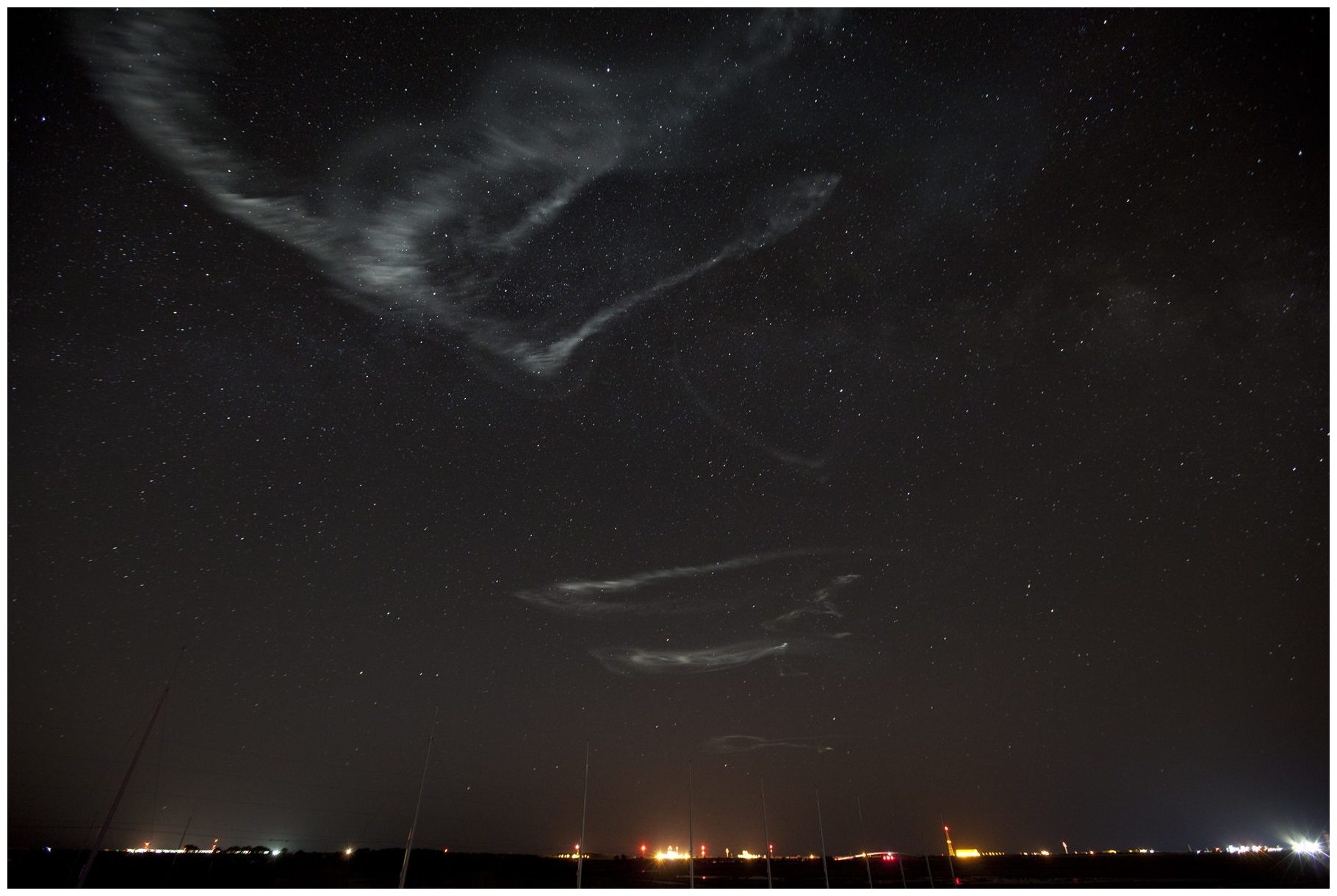
© NASA
The rocket is one of five being launched January through March, each carrying instruments to explore the aurora and its interactions with Earth's upper atmosphere and ionosphere. Scientists at NASA's Goddard Space Center in Greenbelt, Maryland, explain that electric fields drive the ionosphere, which, in turn, are predicted to set up enhanced neutral winds within an aurora arc. This experiment seeks to understand the height-dependent processes that create localized neutral jets within the aurora.
For this mission, two 56-foot long Black Brant IX rockets will be launched nearly simultaneously. One rocket is expected to fly to an apogee of about 107 miles while the other is targeted for 201 miles apogee. Only the lower altitude rocket will form the white luminescent clouds during its flight.
Flying the two similar payloads simultaneously to different altitudes will provide researchers unprecedented vertical measurements within an aurora.
The launches will occur between 7 pm and midnight AKST. The launch decision is dependent on clear skies and auroral activity.
During the flight, a vapor tracer cloud of trimethyl aluminum or TMA will be deployed to allow scientists on the ground to be able to visually track the winds within the aurora.














Comment: See also: