
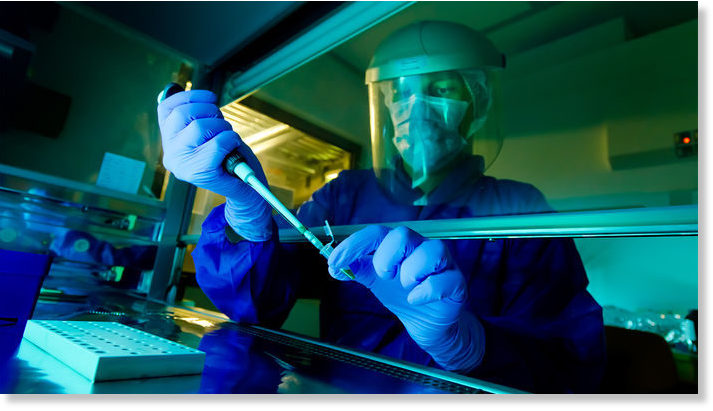
© Max Planck Institute for Evolutionary AnthropologyMatthias Meyer, shown working in a clean room, helped find a way to fish out human DNA from ancient soils.
"It's a great breakthrough," says Chris Stringer, an anthropologist at the Natural History Museum in London. "Anyone who's digging cave sites from the Pleistocene now should put [screening sediments for human DNA] on their list of things that they must do." Adds Svante Pääbo, the head of the Max Planck Institute for Evolutionary Anthropology in Leipzig, Germany, where the work was done: "I think this will become a standard tool in archaeology, maybe even like radiocarbon dating."


















Comment: See also: Hacking your brain: Experts warn of growing threat from monitoring and controlling neural signals