Science & TechnologyS


Satellite

SpaceX successfully lands first launch of top-secret military satellite

Spacex launches military payload
© Spaces / Instagram
SpaceX successfully launched and landed its Falcon 9 rocket in the fifth of 20 scheduled launches in 2017. This was a landmark event for the company, as it was the first launch of a military satellite in its 15-year history.

The Falcon 9 rocket lifted off from Cape Canaveral Air Force Station at 7:15am local time near the famous NASA launch site. Just nine minutes later, the rocket's main section touched back down on the launch pad.

Today's launch was the first time the National Reconnaissance Office (NRO) has entrusted anyone other than the United Launch Alliance (ULA) with one of its top-secret payloads.

Evil Rays

Stray Wi-Fi signals allow spies to see inside closed rooms

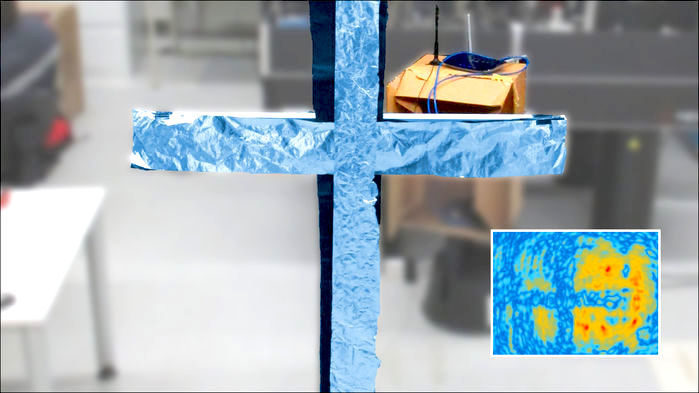
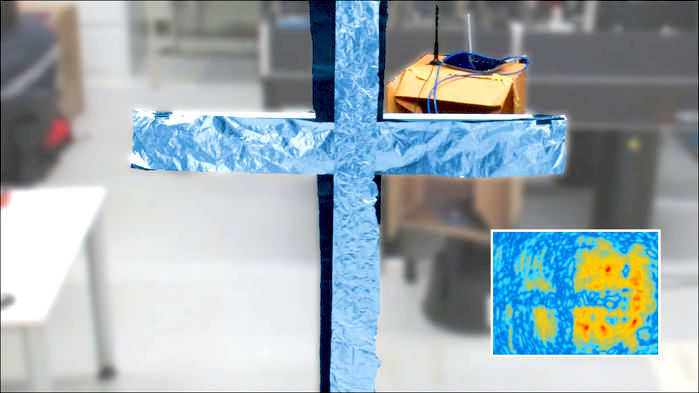
blue cross thingy
© P. M. Holl and F. Reinhard, Physical Review Letters
Your wireless router may be giving you away in manner you never dreamed of. For the first time, physicists have used radio waves from a Wi-Fi transmitter to encode a 3D image of a real object in a hologram similar to the image of Princess Leia projected by R2D2 in the movie Star Wars. In principle, the technique could enable outsiders "see" the inside of a room using only the Wi-Fi signals leaking out of it, although some researchers say such spying may be easier said than done.

The idea came about a few years ago, says Friedemann Reinhard, an expert on quantum sensors at the Technical University of Munich (TUM) in Germany. "At lunch we had a discussion about what the world would look through Wi-Fi eyes," he says, "and it became clear that if you want to see the world through Wi-Fi, you could make a hologram."

A camera makes an image by collecting light reflected from an object and focusing it onto a screen to create a 2D pattern of greater or lesser intensity: the image. In contrast, a hologram more fully exploits the wave nature of light. Typically, lasers are used. The laser beam is split, and half of it reflects off the object and onto a photographic plate. The other half—the reference beam—shines directly on the plate. Like evenly spaced water waves lapping on a beach, the light waves in the reference beam arrive in flat wave fronts. In contrast, those reflected by the object are modified by it, and so some parts of the wave front arrive at the plate earlier and others later, depending on where they bounced off the object. The interference of the two sets of waves creates a pattern of bright and dark spots—the hologram.


Comment: More beaming in our future...'Room Wars?'


Sherlock

Study finds bonobos may be more closely linked to human ancestors than common chimpanzees

bonobos
© iStockA new study examining the muscular system of bonobos provides firsthand evidence that the rare great ape species may be more closely linked to human ancestors than common chimpanzees.
A new study examining the muscular system of bonobos provides firsthand evidence that the rare great ape species may be more closely linked, anatomically, to human ancestors than common chimpanzees. Previous research suggested this theory at the molecular level, but this is the first study to compare in detail the anatomy of the three species.

"Bonobo muscles have changed least, which means they are the closest we can get to having a 'living' ancestor," said Bernard Wood, professor of human origins at the GW Center for the Advanced Study of Human Paleobiology.

Scientists believe that modern human and common chimpanzee/bonobo lineages split about 8 million years ago with the two great ape species splitting about 2 million years ago. As common chimpanzees and bonobos evolved after their split, they developed different traits and physical characteristics, even though they remained geographically relatively close, with their main division being the Congo River. Because of this, researchers have been curious as to what those differences are and how they compare to humans. By studying the muscles of bonobos (which indicates how they physically function), the team was able to discover that they are more closely related to human anatomy than common chimpanzees, in the sense that their muscles have changed less than they have in common chimpanzees.

Comment:


Brain

Targeted Neuroplasticity Training program - DARPA wants to hack your brain to make you learn faster

the matrix
© Warner Brothers
If the brain is just a bunch of wires and circuits, it stands to reason that those components can simply be re-wired in order to create a better, smarter us. At least, that's the theory behind a new project from the military's secretive DARPA research branch announced on Wednesday, which aims to enhance human cognitive ability by activating what's known as "synaptic plasticity."

Recent research has suggested that stimulating certain peripheral nerves—those that relay signals between the brain, the spinal cord and the rest of the body—can enhance a person's ability to learn, by triggering the release of neurochemicals that reorganize connections in the brain. Through its new Targeted Neuroplasticity Training program, DARPA is is funding eight different research efforts that seek to enhance learning by targeting those nerves with electrical stimulation. The end goal is to translate those findings into real-world applications that boost military training regimens—allowing a soldier, to say, soak up a new language in months instead of years. Should DARPA figure out a way to do that, its efforts will likely go on to impact all of us.

Sheeple

Dr. Gary G. Kohls: Propaganda and the war on science

propaganda
© The Daily Omnivore
Propaganda: "a message designed to persuade its intended audience to think and behave in a certain manner. Thus advertising is commercial propaganda. Or institutionalized and systematic spreading of information and/or disinformation, usually to promote a narrow political or religious (or commercial) viewpoint."

Mercenary: "a person primary concerned with making money at the expense of ethics."
"The conscious and intelligent manipulation of the organized habits and opinions of the masses is an important element in democratic society. Those who manipulate this unseen mechanism of society constitute an invisible government which is the true ruling power of our country. We are governed, our minds are molded, our tastes formed, and our ideas suggested, largely by men we have never heard of...It is they who pull the wires that control the public mind." — Edward L. Bernays, the Father of Propaganda in America and Sigmund Freud's nephew, from his seminal book Propaganda (1928).
"Entire populations, which were undisciplined or lacking in intellectual or definite moral principles, were vulnerable to unconscious influence and thus susceptible to wanting things that they do not need. This is achieved by manipulating desires on an unconscious level." - Edward Bernays, From the Annals of the American Academy of Political and Social Science (March 1947)

Network

Researchers' first map of the 'dark web' shows an incredibly antisocial corner of the internet

dark web
© DragonImages/iStockThe dark web is not much of a web at all.
Most of the world wide web is invisible. Beyond the "surface web"—the parts accessible to search engines—there is a "deep web" containing (by one estimate) 500 times the content, secured in databases and hidden behind login screens. And within this deep web is a tiny corner known as the "dark web," which requires special, anonymizing software such as the Tor Browser to access and contains everything from black markets selling drugs and counterfeit IDs to whistleblowing forums.

Binoculars

Satellite helps confirm unprecedented rise in noctilucent clouds, caused by meteor dust

Noctilucent clouds seen over Vantaa in Finland in 2009.
© Mika-Pekka MarkkanenNoctilucent clouds seen over Vantaa in Finland in 2009
Tuesday marked the 10-year mission mark of a NASA satellite, named AIM for Aeronomy of Ice in the Mesosphere, whose purpose was to study noctilucent clouds and the data has proven invaluable.

Noctilucent clouds, also known as "night-shining" clouds, form on the edge of space about 50 miles high off the surface. They're made of ice crystals, which reflect sunlight to give off the clouds' signature blueish glow, according to NASA.

They're mainly seen in the summer just after sunset and before sunrise. Greg Johnson with SkunkbayWeather.com caught a display over Hansville, Wash. last summer with his nighttime time lapse video camera:


The clouds are usually spotted about 30-60 minutes after sunset when the sun is between 6 and 16 degrees below the horizon, according to SpaceWeather.com. That's because the clouds are so high they can still "see" the sun from that altitude but it's dark enough on the surface to spot their cool, blue glow. Typically these clouds are brightest in late June and July.

Scientists had thought the clouds were actually the result of "meteor smoke" and it turns out, the satellite data confirmed they're on the right track.

Network

'Curating' the news: Tech firms training AI software to block social media violence

Tech companies training AI spot violent videos
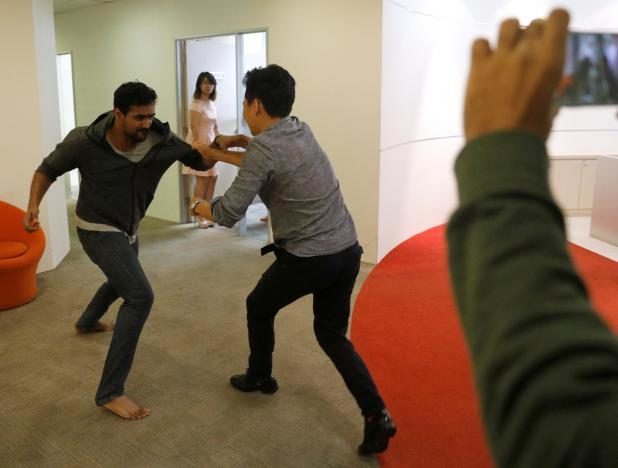
© Reuters / Edgar SuGraymatics employees pretend to fight as they record footage to be used to 'train' their software to watch and filter internet videos for violence, at their office in Singapore April 27, 2017
Companies from Singapore to Finland are racing to improve artificial intelligence so software can automatically spot and block videos of grisly murders and mayhem before they go viral on social media.

None, so far, claim to have cracked the problem completely.

A Thai man who broadcast himself killing his 11-month-old daughter in a live video on Facebook this week, was the latest in a string of violent crimes shown live on the social media company. The incidents have prompted questions about how Facebook's reporting system works and how violent content can be flagged faster.

A dozen or more companies are wrestling with the problem, those in the industry say. Google - which faces similar problems with its YouTube service - and Facebook are working on their own solutions.

Most are focusing on deep learning: a type of artificial intelligence that makes use of computerized neural networks. It is an approach that David Lissmyr, founder of Paris-based image and video analysis company Sightengine, says goes back to efforts in the 1950s to mimic the way neurons work and interact in the brain.


Robot

Artificial intelligence to take over half of all jobs in next decade, says China's top techie

Pepper the robot
© Francois Lenoir / ReutersNew recruit "Pepper" the robot, a humanoid robot designed to welcome and take care of visitors and patients, Ostend, Belgium, 2016
Robots and artificial intelligence (AI) will replace humans in 50 percent of all jobs in just ten years, says Kai-Fu Lee, founder of venture capital firm Sinovation Ventures and a reputable Chinese technologist.

Comment: Automation, economic collapse, basic income slavery: Our dystopic future?


Heart - Black

Female dragonflies fake being dead to avoid male advances

Dragonflies
© Janet Ridley/Alamy Stock PhotoPlaying dead is a favored ploy.
Female dragonflies use an extreme tactic to get rid of unwanted suitors: they drop out the sky and then pretend to be dead.

Rassim Khelifa from the University of Zurich, Switzerland, witnessed the behavior for the first time in the moorland hawker dragonfly (Aeshna juncea). While collecting their larvae in the Swiss Alps, he watched a female crash-dive to the ground while being pursued by a male.

The female then lay motionless on her back. Her suitor soon flew away, and the female took off once the coast was clear.

"I was surprised," says Khelifa, who had never previously seen this in 10 years of studying dragonflies.