
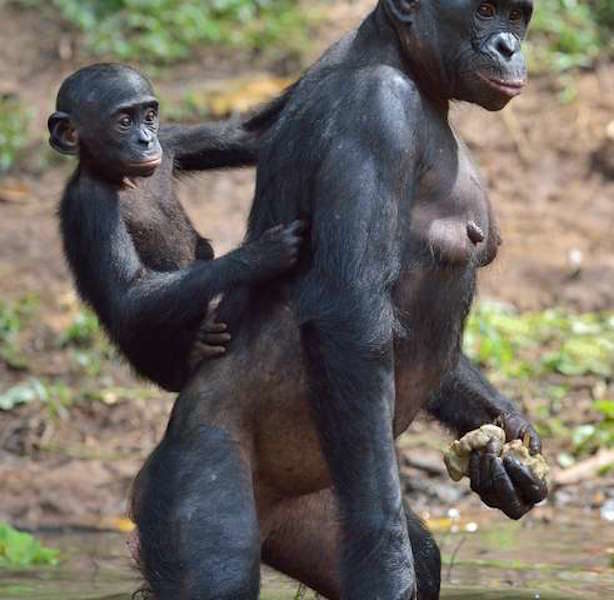
© iStockA new study examining the muscular system of bonobos provides firsthand evidence that the rare great ape species may be more closely linked to human ancestors than common chimpanzees.
"Bonobo muscles have changed least, which means they are the closest we can get to having a 'living' ancestor," said Bernard Wood, professor of human origins at the GW Center for the Advanced Study of Human Paleobiology.
Scientists believe that modern human and common chimpanzee/bonobo lineages split about 8 million years ago with the two great ape species splitting about 2 million years ago. As common chimpanzees and bonobos evolved after their split, they developed different traits and physical characteristics, even though they remained geographically relatively close, with their main division being the Congo River. Because of this, researchers have been curious as to what those differences are and how they compare to humans. By studying the muscles of bonobos (which indicates how they physically function), the team was able to discover that they are more closely related to human anatomy than common chimpanzees, in the sense that their muscles have changed less than they have in common chimpanzees.
Earlier studies examined the DNA similarities and differences between bonobos and common chimpanzees, but this was the first study to compare the muscles of the three species.
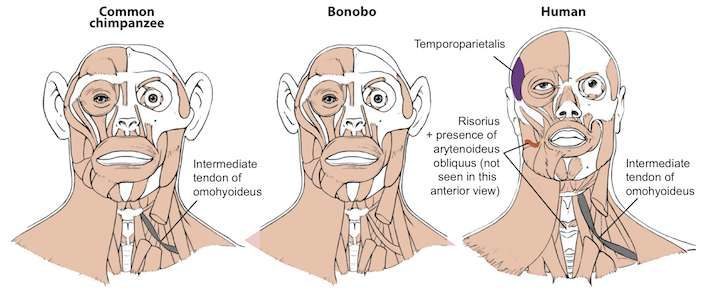
© Julia Molnar These are differences between head muscles of common chimpanzees, bonobos and modern humans. There are no major consistent differences concerning the presence/absence of muscles in adult common chimpanzees (left) and bonobos (center), the only minor difference (shown in grey in the common chimpanzee scheme) being that the omohyoideus has no intermediate tendon in bonobos, contrary to common chimpanzees (and modern humans). In contrast, there are many differences between bonobos and modern humans (right) concerning the presence/absence of muscles in the normal phenotype (shown in colors and/or with labels in the human scheme).
The researchers led a team that examined seven bonobos from the Antwerp Zoo that had died and were being preserved. Researchers said this was an extremely rare opportunity given bonobos' status as an endangered species.
The scientists note that having a clear understanding of what makes humans different from our closest living relatives might lead to new breakthroughs or understandings of human health.
The paper, "Bonobo anatomy reveals stasis and mosaicism in chimpanzee evolution, and supports bonobos as the most appropriate extant model for the common ancestor of chimpanzees and humans," published in Scientific Reports, a Nature publication, this month.
More information: Rui Diogo et al. Bonobo anatomy reveals stasis and mosaicism in chimpanzee evolution, and supports bonobos as the most appropriate extant mode l for the common ancestor of chimpanzees and humans, Scientific Reports (2017).





Their uncle was a monkey whoever did this study lol.