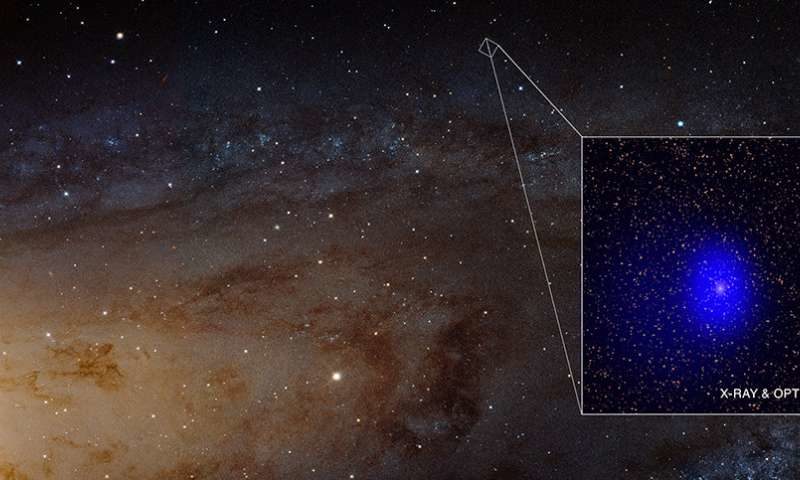
© X-ray: NASA/CXC/Univ. of Washington/T.Dorn-Wallenstein et al.; Optical: NASA/ESA/J. Dalcanton, et al. & R. Gendler
It seems like even black holes can't resist the temptation to insert themselves unannounced into photographs. A cosmic photobomb found as a background object in images of the nearby Andromeda galaxy has revealed what could be the most tightly coupled pair of supermassive black holes ever seen.
Astronomers made this remarkable discovery using X-ray data from NASA's Chandra X-ray Observatory and optical data from ground-based telescopes, Gemini-North in Hawaii and the Caltech's Palomar Transient Factory in California.
This unusual source, called LGGS J004527.30+413254.3 (J0045+41 for short), was seen in optical and X-ray images of Andromeda, also known as M31. Until recently, scientists thought J0045+41 was an object within M31, a large spiral galaxy located relatively nearby at a distance of about 2.5 million light years from Earth. The new data, however, revealed that J0045+41 was actually at a much greater distance, around 2.6 billion light years from Earth.
"We were looking for a special type of star in M31 and thought we had found one," said Trevor Dorn-Wallenstein of the University of Washington in Seattle, WA, who led the paper describing this discovery. "We were surprised and excited to find something far stranger!"
Even more intriguing than the large distance of J0045+41 is that it likely contains a pair of giant black holes in close orbit around each other. The estimated total mass for these two
supermassive black holes is about two hundred million times the mass of our Sun.




















Comment: Who would've thought?