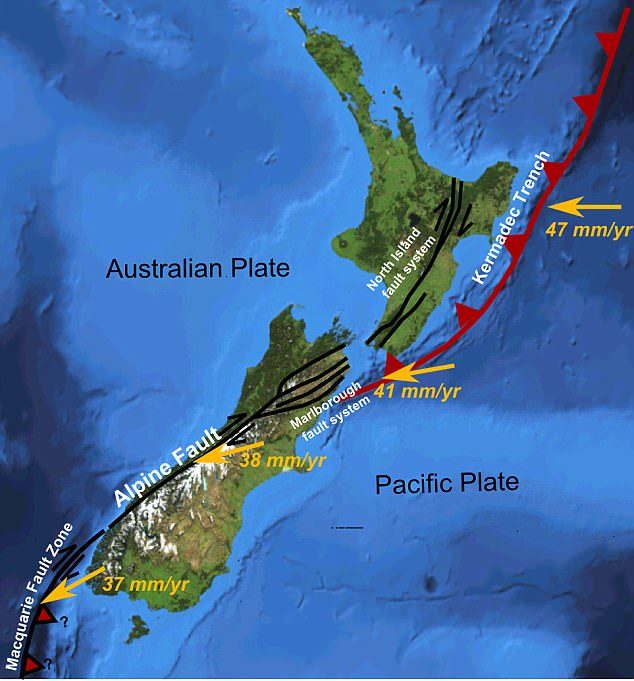
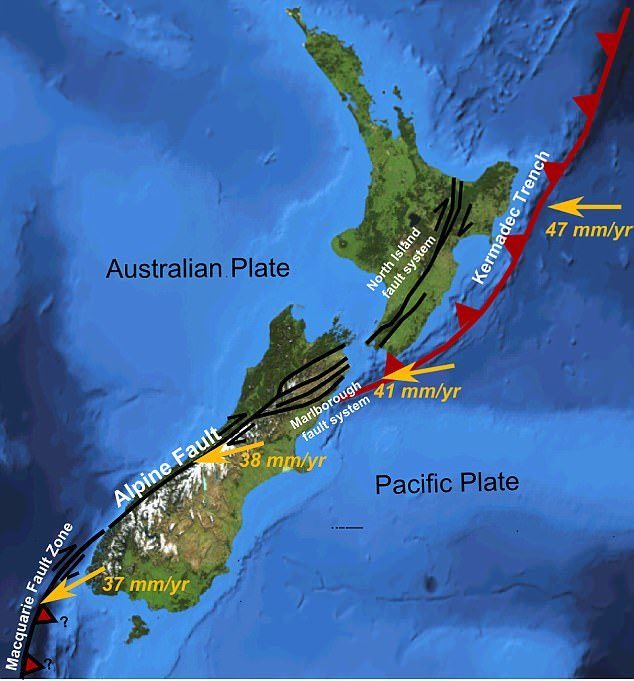
Geologists claim the dangerous Hikurangi subduction zone - running offshore from the top of the South Island to Gisborne in the north - has begun to move
New Zealand could be potentially hit by a massive magnitude 9.0 earthquake followed by a "towering" tsunami, scientists warn. According to the researchers, a 2016 quake that hit the area reawakened a hazardous fault that was believed to be dormant.
The Hikurangi subduction zone - a deep trench in the Earth's crust running along the eastern shore of New Zealand's North Island - is now active and could trigger magnitude 8.5 earthquakes, which would be far more devastating that the one that hit the islands in 2016, a group of scientists from the GNS research institute warn. The earthquakes are also likely to be followed by tsunamis that could reach New Zealand's coast within mere minutes, the geologists add.
"We need to think Japan 2011, basically, because if our whole plate boundary ruptured, it would be a magnitude 9 earthquake," Ursula Cochran, an earthquake geologist at the GNS, told the local media.
"The Hikurangi subduction zone is potentially the largest source of earthquake and tsunami hazard in New Zealand, but there is still much to learn about it," GNS Science
said in a statement earlier.
Subduction zones similar to the one located near New Zealand are areas in which tectonic plates collide, with one being forced over the top of one another, creating what the geologists call a "megathrust." In case of the Hikurangi subduction zone, the Australian plate is overhanging the Pacific one.
Earlier earthquakes that took place in such zones include the devastating 2011 earthquake followed by tsunami in Japan that claimed lives of thousands of people and triggered the Fukushima nuclear disaster, as well as a 2004 Indonesia magnitude 9.0 earthquake that left as many as 250,000 people dead.
A disaster that could potentially hit New Zealand would affect many heavily populated areas, such as Napier, Gisborne, Nelson, Wellington, Blenheim and Palmerston North. All those areas are located too close to the Hikurangi subduction zone for the scientists to issue a timely warning.















Comment: Nice idea! Too bad the Russians thought of it first! And since they mentioned the Death Star, it looks like that's not far off either.
See also: