
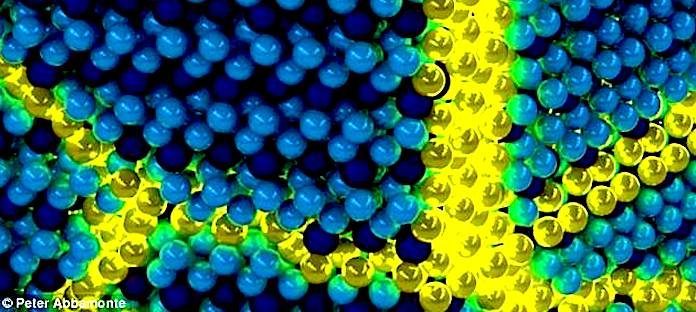
© unknownExcitations can be thought of as propagating domain walls (yellow) in an ordered solid exciton background (blue).
Excitonium is made up of particles known as excitons, which are made from an escaped electron and the hole it left behind.In the new experiments, the researchers say they were able to observe the material and the precursor phase, which is said to be the 'smoking gun' proof of its existence.
According to the researchers, excitonium is what's known as a condensate.
This means it exhibits macroscopic quantum phenomenon, like a superconductor, superfluid, or insulating electronic crystal.
It was first theorized nearly 50 years ago, and researchers now say they've confirmed its existence.
When an electron gets excited and 'jumps', it leaves behind a hole. And, this hole can behave as though it were a particle itself, with a positive charge. As it has a positive charge, the hole attracts the electron, pairing them to form a composite particle, or boson, known as an exciton.
In the new experiments, the researchers studied non-doped crystals of the transition metal dichalcogenide titanium diselenide (1T-TiSe2).
According to the team from the University of Illinois College of Engineering, they were able to reproduce the results five times on different cleaved crystals. Previous efforts have struggled to distinguish the material from what's known as a Peierls phase, which is unrelated but shares the same symmetry as exciton formation.
To uncover the elusive form of matter, the researchers developed a new technique called momentum-resolved electron energy-loss spectroscopy (M-EELS), which is more sensitive to excitations than other methods. The researchers retrofit an EEL spectrometer with a goniometer, to precisely measure the electron's momentum. And, doing this allowed them to measure excitations of the particles for the first time.















Comment: NASA can't warn us of an asteroid they can't see and using a 'space lasso' to prevent incoming threats probably won't work either. We're on our own, folks!