Science & TechnologyS


Robot

How do humans keep the upper hand on AI

ArtifIntel
© Kickstarter
In artificial intelligence (AI), machines carry out specific actions, observe the outcome, adapt their behavior accordingly, observe the new outcome, adapt their behavior once again, and so on, learning from this iterative process. But could this process spin out of control? Possibly. "AI will always seek to avoid human intervention and create a situation where it can't be stopped," says Rachid Guerraoui, a professor at EPFL's Distributed Programming Laboratory and co-author of the EPFL study. That means AI engineers must prevent machines from eventually learning how to circumvent human commands. EPFL researchers studying this problem have discovered a way for human operators to keep control of a group of AI robots; they will present their findings on Monday, 4 December, at the Neural Information Processing Systems (NIPS) conference in California. Their work makes a major contribution to the development of autonomous vehicles and drones, for example, so that they will be able to operate safely in numbers.

One machine-learning method used in AI is reinforcement learning, where agents are rewarded for performing certain actions -- a technique borrowed from behavioral psychology. Applying this technique to AI, engineers use a points system where machines earn points by carrying out the right actions. For instance, a robot may earn one point for correctly stacking a set of boxes and another point for retrieving a box from outside. But if, on a rainy day for example, a human operator interrupts the robot as it heads outside to collect a box, the robot will learn that it is better off staying indoors, stacking boxes and earning as many points as possible. "The challenge isn't to stop the robot, but rather to program it so that the interruption doesn't change its learning process -- and doesn't induce it to optimize its behavior in such a way as to avoid being stopped," says Guerraoui.

Blue Planet

Planetary collisions are responsible for large amounts of Earth's minerals

earth collision
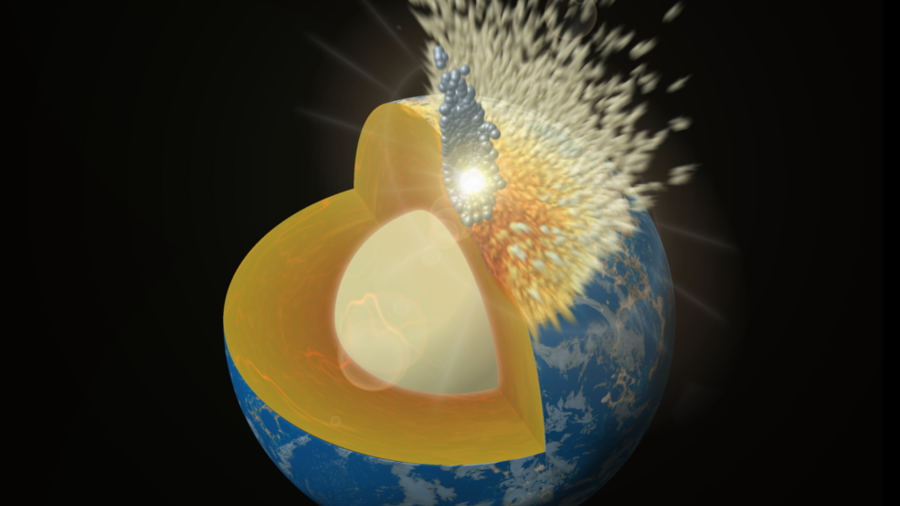
© NASAArtist concept shows the collision of a large moon-sized planetary body penetrating all the way down to the Earth's core, with some particles ricocheting back into space.
A new study by NASA scientists has led them to believe "planetary collisions are at the core of our solar system's formation."

According to NASA, scientists have long believed that after the moon's formation, Earth experienced an extended period of bombardment some 3.8 billion years ago, called 'late accretion'.

During this period, Earth was barraged with moon-sized planetary bodies, also known as planetesimals, that penetrated our planet all the way down to its core. As a result, these collisions embedded extensive amounts of metal and rock-forming minerals into Earth's mantle and crust.

Comet 2

Did Bronze Age iron weapons come from outer space?

asteroid
© NASA / JPL-Caltech
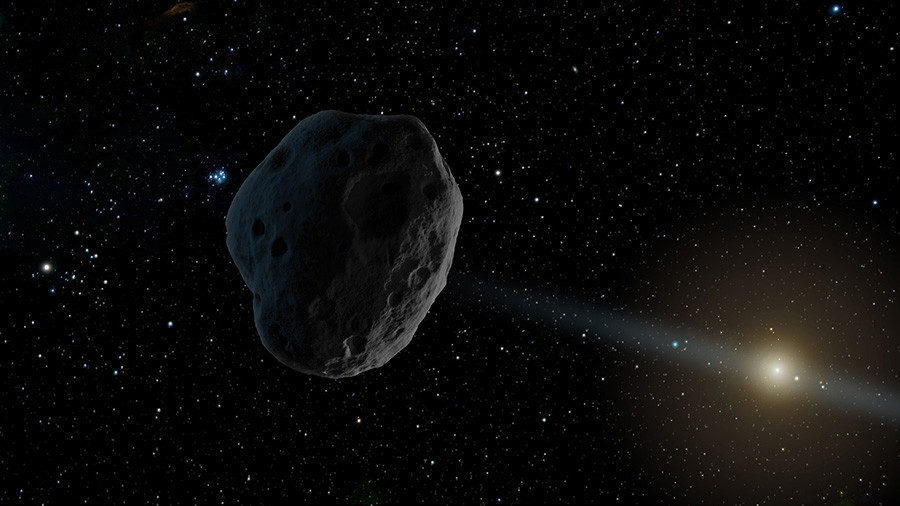
A new study claims that most of the iron used in weaponry and artefacts dating from the Bronze Age is, in fact, of extraterrestrial origin. It further explains how our ancient ancestors were able to use the metal without access to smelting.

The new research, led by French scientist Albert Jambon and published in the Journal of Archaeological Science, used geochemical analyses to differentiate Earthly and extraterrestrial metals found in a range of Bronze Age artefacts from across the world. By studying the ratios of iron, cobalt and nickel found within the artefacts, researchers created a system to differentiate iron produced through smelting of ore, and 'pre-made' iron of meteoric origin.

For context, meteorites were already recognized as a major source of iron, but the scientific community was still on the fence as to the extent to which meteoric iron contributed to Bronze Age iron artefact construction. Iron weapons crafted during the Bronze Age were extremely rare and prized possessions (kind of like Valyrian steel in the Game of Thrones).

Galaxy

Astronomers discover new stellar stream in Milky Way galaxy

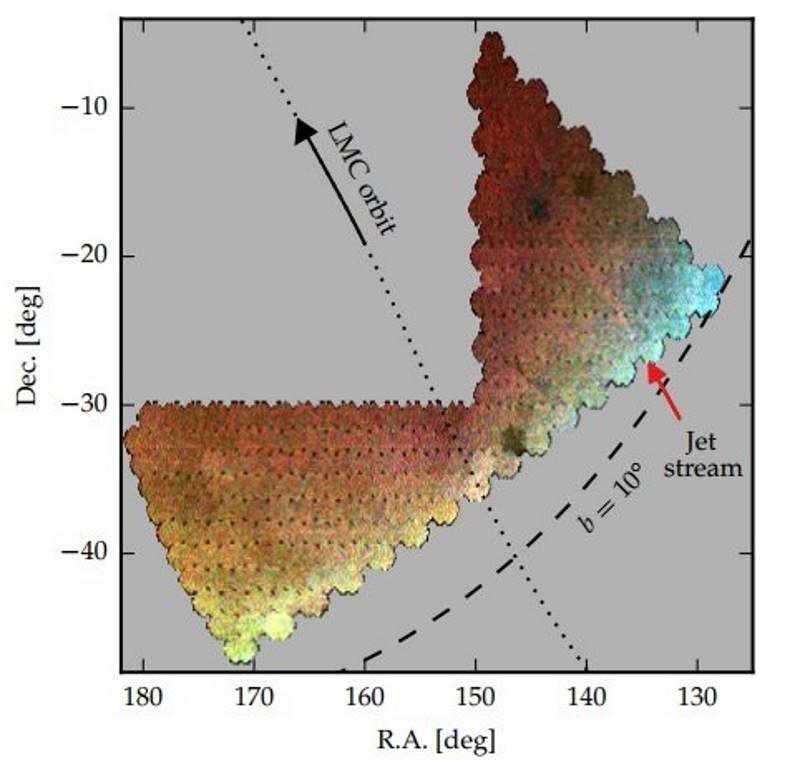
An international team of astronomers has detected a new thin stellar stream in the halo of the Milky Way galaxy. The newly discovered feature, named "jet stream," could help researchers answer fundamental questions about the mass distribution of the Milky Way's dark matter halo. The finding was presented November 24 in a paper published on the arXiv pre-print server.
new stellar stream
© Jethwa et al., 2017.False-colour map of the density of stars with 0.1 < g−r < 0.45 from the SLAMS survey. Density in different magnitude ranges is shown using different colour channels: red 20.5 < r < 23.0, green 17.5 < r < 20.5 and blue 15.0 < r < 17.5. The newly discovered stream is labelled. The dotted line shows the future orbit of the LMC, calculated using Kallivayalil et al. (2013) proper motions, which is roughly aligned with the orientation of the Jet stream. The green/blue colour gradient along the southern edge is due to the varying distance distribution of MW disk stars.
Stellar streams are remnants of dwarf galaxies or globular clusters that once orbited a galaxy but have been disrupted and stretched out along their orbits by tidal forces of their hosts. So far, nearly 20 stellar streams have been identified in the Milky Way, just a few in the Andromeda galaxy, and about 10 outside the Local Group.

Astronomers are interested in finding new stellar streams in the Milky Way, as they hope that such features could answer some crucial questions about the the galaxy. For instance, stellar streams could help us understand the large-scale mass distribution of the galactic dark matter halo. Moreover, they could confirm whether or not our galaxy contains low-mass dark matter subhalos.

Bulb

Not so bird-brained: Pigeons can discriminate both space, time

Finding underscores that animals beyond humans and primates show abstract intelligence

Pigeon
© Natasa / FotoliaNew research at the University of Iowa shows that pigeons can discriminate the abstract concepts of space and time -- and seem to use a region of the brain different from humans and primates to do so. The finding adds to growing recognition in the scientific community that lower-order animal species -- such as birds, reptiles, and fish -- are capable of high-level, abstract decision-making.

New research at the University of Iowa shows that pigeons can discriminate the abstract concepts of space and time -- and seem to use a different region of the brain than humans and primates to do so. In experiments, pigeons were shown on a computer screen a static horizontal line and had to judge its length or the amount of time it was visible to them. Pigeons judged longer lines to also have longer duration and judged lines longer in duration to also be longer in length.

What that means, says Edward Wasserman, Stuit Professor of Experimental Psychology in the Department of Psychological and Brain Sciences at the UI, is pigeons use a common area of the brain to judge space and time, suggesting that these abstract concepts are not processed separately. Similar results have been found with humans and other primates.

Comment:


Cloud Lightning

Lightning sparks mid-air nuclear reaction, first time recorded phenomenon

Pinklightning
© NASALightning can bring in mid-air nuclear reactions.
After nearly 100 years of speculating that thunderstorms could trigger a nuclear reaction in the atmosphere, scientists have finally recorded the phenomenon for the first time.

Lightning produces flashes of electromagnetic radiation called gamma rays. Researchers have long theorized that gamma rays, upon interacting with molecules in the air, can generate radioactive isotopes - elements with nuclei that aren't stable. That instability means they can randomly let off bursts of excess radiation including gamma rays, and result in a nuclear reaction.

There have been reports of lightning-induced nuclear reactions before, going back to 1985, but none of them sufficiently reliable. Scientists had been able to create computer simulations of the phenomenon, but that was about it. On February 6, 2017, a team in Japan observed a "clear signature of positron annihilation associated with γ-ray flashes." A paper describing the observations was published Thursday in the journal Nature.

Water

Light reveals secrets of supercooled water

Supercooled Water Droplet
© New ScientistPatterns of light scattered from a supercooled water droplet reveal its structure and density.
How low can you go? That's the question a collaboration of sixteen European scientists have set out to answer, in regards to one of the most ubiquitous-yet-mysterious substances on Earth: water.

Ordinarily, water freezes at 0°C, when its molecules stop moving fast enough to overcome the forces between them, clicking together to form a crystalline lattice. This isn't a hard and fast line, though: that lattice generally needs a "seed" disturbance to act as a starting point. Under the right circumstances, like if it's free of large impurities and chilled in a very smooth-walled container, water can get well below its freezing point before crystallizing. So-called supercooled liquids can do some super-cool stuff, like freezing all at once when disturbed.

Since a solid is in a lower-energy state than a liquid, liquids can actually release a good deal of heat when they crystallize, too. Though it might sound paradoxical, farmers will sometimes spray water on their crops before a chilly night to prevent frost damage. Chemical hand warmers work the same way, with sodium acetate-a chemical that's got a high freezing/melting point. Since any temperature below 137°F is "supercooled", the sodium acetate in the bag gets nice and toasty as it crystallizes, and can be recharged by boiling. (Watch video below)

Everyday uses aside, supercooling has some important scientific applications. As abundant as it is, water has some really weird quirks, and they only get weirder when it drops below its freezing point, with properties like the water's specific heat (the amount of thermal energy it takes to change a substance's temperature) growing exponentially. Getting water down to 228 Kelvin-or about -45°C-is a big target for scientists, because projections based on current data imply a "singularity" here-with the specific heat rising to infinity. Nobody knows what that really represents physically, but the debate rages on among theoretical physicists, and experimentalists are hard at work trying to find out.

2 + 2 = 4

DARPA-funded genetic tools that can doom a species under UN review

gene drive
Diagram of how gene drives would work in the mosquito
For some, a new cutting-edge technology called gene drive is the silver bullet able to wipe out invasive species decimating island wildlife, and eradicate the malaria-bearing mosquitos that killed nearly half a million people last year, mostly in Africa.

Others fear that the genetic engineering process is a one-way ticket to ecological mayhem, or suspect health and conservation aims are masking industrial and military objectives.

Advocates and critics square off in Montreal this week in an obscure working group under the Convention on Biological Diversity, a 1992 UN treaty forged as a bulkhead against the gathering pace of extinction on our planet.

The Ad-Hoc Technical Experts Committee on synthetic biology, known as AHTEG, is tasked with understanding science's increasingly powerful ability to manipulate genomes, and reporting back to the Convention's 195 member states.

Comment: Something sinister afoot? See also:


Comet

Impact-related microspherules in Late Pleistocene Yukon and Alaskan 'muck' deposits indicate recurrent episodes of catastrophic emplacement

Beringia map
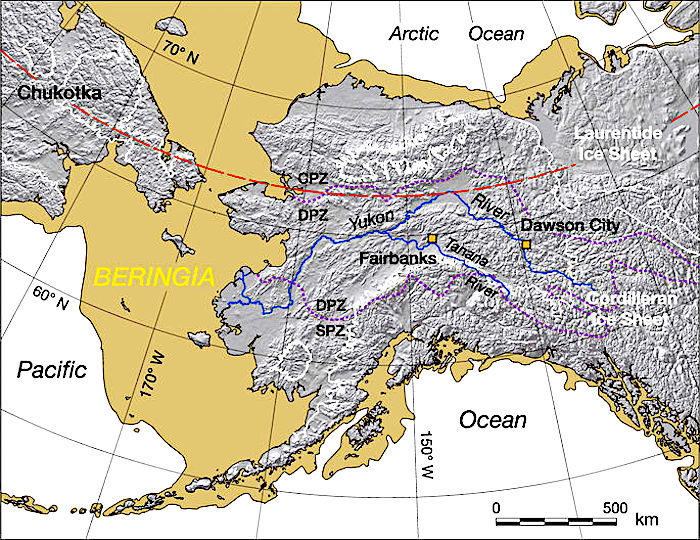
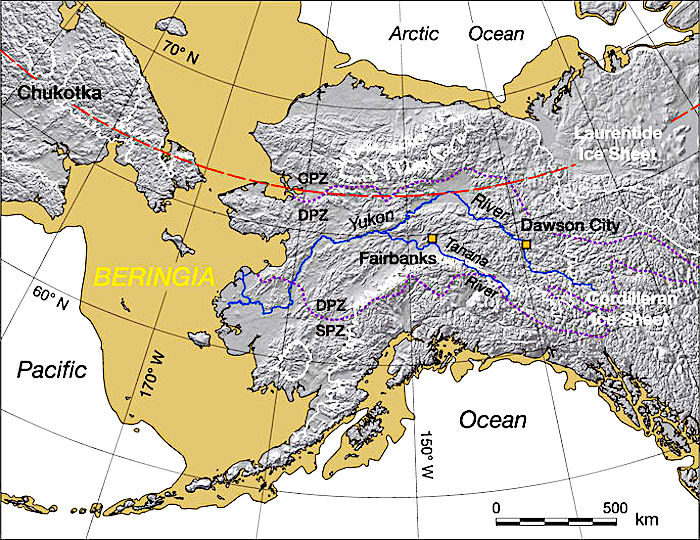
© Natural EarthMap showing eastern Beringia during the Last Glacial Maximum (LGM; ~23–19 ka B.P.) when eustatic sea level was ~120 m below its present level1. Megafauna fossils of this study were initially collected between 1940 and 1954 from mining operations near Fairbanks, Alaska, and more recently from the Klondike mining district near Dawson City in the Yukon Territory. Permafrost zones, discriminated by dashed purple curves, are continuous (CPZ, >90% frozen ground), discontinuous (DPZ, >50%), and sporadic (SPZ, <50%)35. White curves outline areas of both continental and mountain glaciation with the latter having occurred in the Brooks Range of northern, and the Alaskan Range of southern, Alaska70. Dashed red curve indicates the Arctic Circle. Chukotka is an autonomous district (Okrug) in easternmost Russia.
During the time period leading up to the Last Glacial Maximum (~23-19 ka B.P.), when eustatic sea level was substantially lower, Alaska and the Yukon Territory were part of the largest circumarctic area to remain unglaciated, called Beringia (Fig.1), which extended from eastern Siberia (Chukotka) across the exposed Bering Strait region into Alaska and western Canada1,2. The glacial steppe environment of Beringia3 was a refugium for Plio-Pleistocene tundra-grassland plant communities4 as well as for the now-extinct mammalian megafauna 5. Relict permafrost within the region 6,7,8,9 has preserved an extraordinary frozen record of plant, pollen, insect, and vertebrate fossil remains, as well as their ancient DNA 1,10,11.

Early expeditions to Alaska12,13,14 and the Yukon Territory14,15 found large quantities of megafaunal bones along beaches, riverbanks, and in minor-stream valleys8. Even greater collections of these fossils were made after industrial-scale placer-gold mining operations began in the Fairbanks and Klondike districts in the early 20th century16. Otto W. Geist undertook extensive fossil collecting in Alaska on behalf of the American Museum of Natural History (AMNH), and in a typical year (1938) shipped more than eight thousand select specimens, weighing nearly eight tons (~7257 kg), to New York City8.

The fossil bones collected included those of bison, mammoth, horse, musk ox, moose, lynx, lion, camel, mastodon, bear, and caribou, with many of these animals also appearing as frozen partial carcasses or mummies1,8,17. The three most common genera found were bison, mammoth, and horse, which represent more than 90% of Beringia's large mammalian biomass18. Many tens of thousands of specimens were collected in the 20th century from Alaska and the Yukon Territory5,8,19, and hundreds to thousands more are still being recovered every year from mines in the Klondike district alone1.

Grey Alien

Just how will humanity react to evidence of alien life? Psychologists predict answers

ISS and Microbes
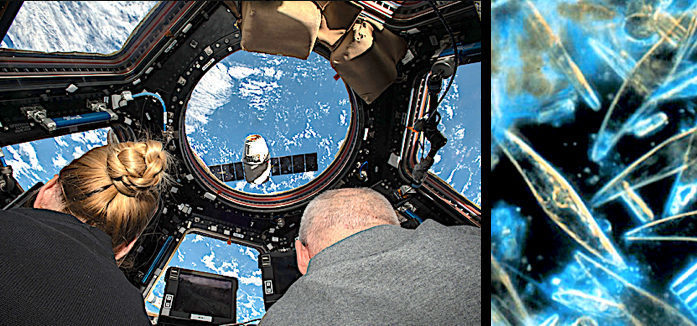
© NPR/ExtremeTechInternational Space Station • ISS Microbes
Germs stuck to the outside of the International Space Station are not from around here, cosmonaut Anton Shkaplerov said in an interview last week with Russian state-owned news service Tass. Microbes "have come from outer space and settled along the external surface," Shkaplerov said. "They are being studied so far, and it seems that they pose no danger." Russia's space agency, Roscosmos, has not weighed in on this extraordinary claim.

The odds are not on the side of aliens. If microorganisms are tucked away within the space station hull's crannies, as Shkaplerov says, they probably hitchhiked the 250 miles from our planet's surface.

But imagine if scientists found alien microbes. How would humanity react to the news?


Comment: This is as much a study in how to present subtle positive triggers to otherwise questionably fearful news to modify reaction on a mass scale as it is to the question of alien life. Which is more disturbing...the possibility of alien life or the manipulation of minds and perception to a predetermined outcome? (Such as this piece.)