Science & TechnologyS


Family

Having older brothers increases likelihood of males being gay, study suggests

gay rainbow flag homosexual
New findings reveal that the more older brothers a man has, the more likely he is to be gay. Scientists believe this is due to the "fraternal birth order effect," which involves the development of certain antibodies in a mother's immune system.

According to research led by Anthony Bogaert at Brock University in Canada, women who become pregnant with boys also develop antibodies that specifically target a protein that is made by the Y chromosome - one of the two sex chromosomes in mammals.

The study, titled "Male Homosexuality and Maternal Immune Responsivity to the Y-Linked Protein NLGN4Y," was published Monday in the Proceedings of the National Academy of Sciences journal.

Sun

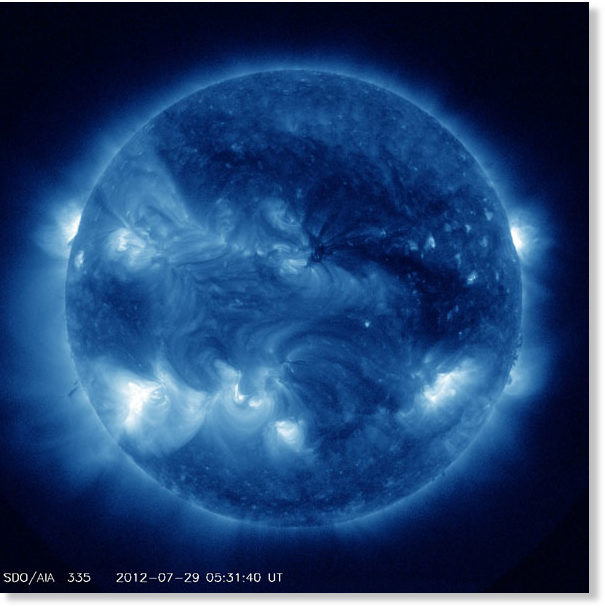
Study finds solar amplification mechanism by which climate is controlled by the level of solar activity & cosmic rays

Tormenta solar de rayos X
© Observatorio SDO
The HockeySchtick writes: A paper published today in the Journal of Atmospheric and Solar-Terrestrial Physics finds another potential solar amplification mechanism mediated by galactic cosmic rays [GCRs] (and distinct from Svensmark's cosmic ray theory of climate). The author demonstrates:
  • Solar modulation of GCR [Galactic Cosmic Rays] is translated down to the Earth climate.
  • The mediator of solar influence are energetic particles.
  • GCR impacts the O3 [ozone] budget in the lower stratosphere.
  • O3 influences the temperature and humidity near tropopause, and greenhouse effect.
  • Effectiveness of this mechanism depends on geomagnetic field intensity.
"In this paper we show that bi-decadal variability of solar magnetic field, modulating the intensity of galactic cosmic ray (GCR) at the outer boundary of heliosphere, could be easily tracked down to the Earth's surface. The mediator of this influence is the lower stratospheric ozone, while the mechanism of signal translation consists of: (i) GCR impact on the lower stratospheric ozone balance; (ii) modulation of temperature and humidity near the tropopause by the ozone variations; (iii) increase or decrease of the greenhouse effect, depending on the sign of the humidity changes. The efficiency of such a mechanism depends critically on the level of maximum secondary ionisation created by GCR (i.e. the Pfotzer maximum) − determined in turn by heterogeneous Earth's magnetic field..."
The paper adds to over 100 potential solar amplification mechanisms described in the literature.

Laptop

Security researcher uncovers keylogging software in hundreds of HP laptop models

HP Hewlett-Packard Co. logo
© Bloomberg / Gettyimages.ruHewlett-Packard Co. logo is displayed on the back of the Envy x2 laptop
A security researcher has revealed that some HP laptops have hidden software which can log everything typed on its keypads. More than 460 models have been affected, dating back to 2012, according to the list released by HP.

The discovery was made by researcher Michael Myng who found the keylogging code in the pre-installed Synaptics Touchpad software on HP laptops.

Keyloggers record every key that is pressed on a keyboard. This means HP laptop users are at risk of having their passwords, bank details, private communications and search history recorded without their knowledge. The keylogger is disabled by default but there's risk it can be enabled by a hacker.

Chalkboard

Pure math and physics: An unusual connection

Mathematician Minhyong Kim
© Tom Medwell for Quanta MagazineMinhyong Kim, a mathematician at the University of Oxford, has long kept his vision to himself. "Number theorists are a pretty tough-minded group of people."
An eminent mathematician reveals that his advances in the study of millennia-old mathematical questions owe to concepts derived from physics.

Mathematics is full of weird number systems that most people have never heard of and would have trouble even conceptualizing. But rational numbers are familiar. They're the counting numbers and the fractions - all the numbers you've known since elementary school. But in mathematics, the simplest things are often the hardest to understand. They're simple like a sheer wall, without crannies or ledges or obvious properties you can grab ahold of.

Minhyong Kim, a mathematician at the University of Oxford, is especially interested in figuring out which rational numbers solve particular kinds of equations. It's a problem that has provoked number theorists for millennia. They've made minimal progress toward solving it. When a question has been studied for that long without resolution, it's fair to conclude that the only way forward is for someone to come up with a dramatically new idea. Which is what Kim has done.

Galaxy

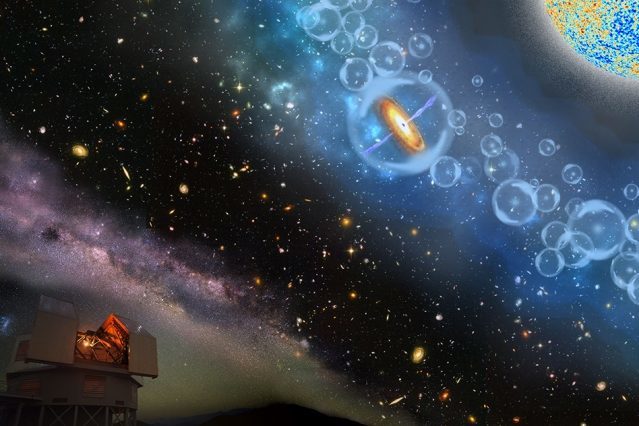
Astronomers have detected the most distant supermassive black hole ever observed

supermassive black hole
© Robin DienelArtist’s conceptions of the most-distant supermassive black hole ever discovered, which is part of a quasar from just 690 million years after the Big Bang. It is surrounded by neutral hydrogen, indicating that it is from the period called the epoch of reionization, when the universe's first light sources turned on.
A team of astronomers, including two from MIT, has detected the most distant supermassive black hole ever observed. The black hole sits in the center of an ultrabright quasar, the light of which was emitted just 690 million years after the Big Bang. That light has taken about 13 billion years to reach us - a span of time that is nearly equal to the age of the universe.

The black hole is measured to be about 800 million times as massive as our sun - a Goliath by modern-day standards and a relative anomaly in the early universe.

"This is the only object we have observed from this era," says Robert Simcoe, the Francis L. Friedman Professor of Physics in MIT's Kavli Institute for Astrophysics and Space Research. "It has an extremely high mass, and yet the universe is so young that this thing shouldn't exist. The universe was just not old enough to make a black hole that big. It's very puzzling."


Archaeology

3.6-million-year-old human skeleton excavated in Africa, 'most complete ever found'

Africa have unveiled what they call
© AP Photo/Themba HadebeThe virtually complete Australopithecus fossil "Little Foot" is displayed at the University of the Witwatersrand in Johannesburg, South Africa, Wednesday, Dec. 6, 2017. Researchers in South Africa have unveiled what they call "by far the most complete skeleton of a human ancestor older than 1.5 million years ever found."
Researchers in South Africa have unveiled what they call "by far the most complete skeleton of a human ancestor older than 1.5 million years ever found."

The University of the Witwatersrand displayed the virtually complete Australopithecus fossil on Wednesday.

The skeleton dates back 3.6 million years. Its discovery is expected to help researchers better understand the human ancestor's appearance and movement. The researchers say it has taken 20 years to excavate, clean, reconstruct and analyse the fragile skeleton.

Fireball 3

Russian govt suggests satellite re-entry behind elevated levels of Ruthenium-106 across Europe

nuclear radiation
© Sergei Konkov/TASS
Ruthenium-106 is used, in particular, in radiation therapy and can also be released in nuclear fuel reprocessing

A satellite that burnt in the atmosphere could have been the source of the radioactive isotope ruthenium-106, whose traces were registered in Russia and some European countries, according to the materials of a probe into the incident released on Friday.

"The source could be attributed, among other things, to the burning in the atmosphere of an artificial satellite or its fragment, on the board of which there was a source of ruthenium-106 with high total activity," says the document released by the inter-departmental commission probing the discharge of the radioactive isotope into the atmosphere.

Archaeology

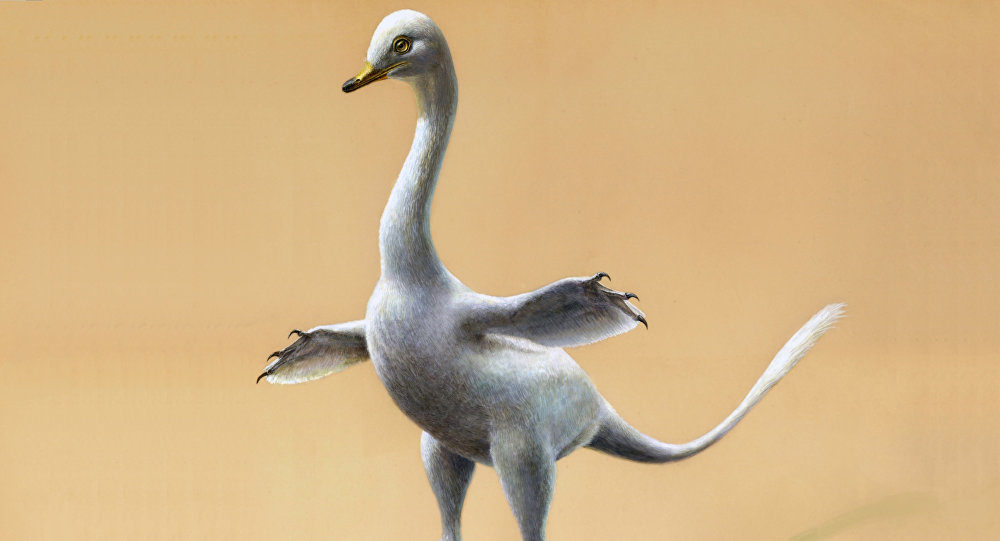
Newly discovered dino leaves researchers in cold sweat

© AP Photo/ Lukas Panzarin"Halszkaraptor escuilliei"
A newly discovered dinosaur has made headlines, mostly due to its literally nightmarish appearance, as it turns out to have a bill like a duck and teeth like a croc, coupled with a swanlike neck and double claws - on its hands and feet.

This tiny, turkey-sized dinosaur, dubbed "Halszkaraptor escuilliei" after the late Polish paleontologist Halszka Osmolska, roamed more than 75 million years ago in what is currently Mongolia, a study in the journal Nature suggested.

Dig

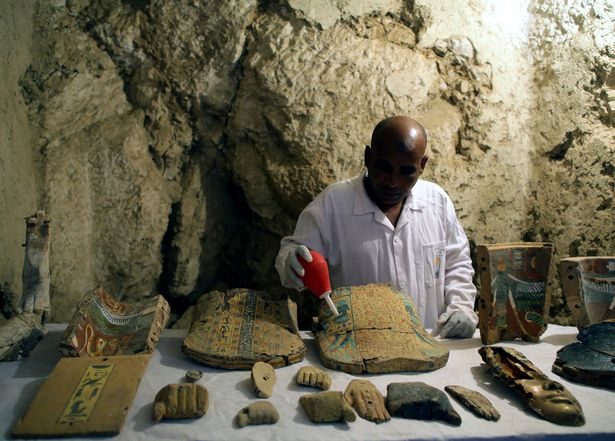
Luxor: Linen-wrapped mummy found in previously unexplored tomb

mummy discovery
© AFP Photo/STRINGEREgyptian archaeological technicians restore a mummy wrapped in linen, found at Draa Abul Naga necropolis on the west bank of the city of Luxor.
Egyptian archaeologists have discovered a mummy in one of two previously unexplored tombs across the Nile from the southern city of Luxor, the antiquities ministry said Saturday.

The tombs were found in the 1990s by German archaeologist Frederica Kampp, though she had only reached the entrance gate "but never entered", the ministry said.

It said that both tombs, which were given numbers by Kampp, were likely to date back to dynasties of the New Kingdom, which lasted several centuries until about 3,000 years ago.

Since Kampp's discovery, "both tombs were left untouched" an Egyptian archaeological mission started work.

Antiquities Minister Khaled al-Enany was in Luxor to announce the discovery in Draa Abul Nagaa necropolis near the famed Valley of the Kings, where many pharaohs, including Tutankhamun, were buried.

Comment: Items found in the tombs, including wooden funerary masks, statuettes and clay vessels, are currently being restored:
tomb artifacts
© REX/Shutterstock
tomb artifacts
© REX/Shutterstock
tomb statuettes
© AFP


Newspaper

Score for climate realists! University of Arizona must disclose 'hockey stick' climate change emails

climate gate
The University of Arizona has been ordered to surrender emails by two UA scientists that a group claims will help prove that theories about human-caused climate change are false and part of a conspiracy.


Pima County Superior Court Judge James Marner rejected arguments by the Board of Regents that disclosure of the documents would be "contrary to the best interests of the state."

Marner said it may be true that some of the documents sought by Energy & Environment Legal Institute might be classified as unpublished research, manuscripts, preliminary analyses, drafts of scientific papers and plans for future research.

But the judge said the subject matter of the documents has become available to the general public. And that, Marner said, does not allow the university to withhold disclosure under a separate section of the law governing university records.

There was no immediate response from the university.

Comment: From the Arizona Capitol Times:
Richardson said he is not denying that the climate is changing.

"It has been for 4.5 billion years," he said. "The question is what's causing it."

He contends that the research studies putting the entire blame on carbon dioxide emissions is flawed. More to the point, Richardson contends that accepting those findings as truth - and basing public policy on them - would have dire consequences in the United States. He said that already is playing out in Europe where "electricity rates are skyrocketing" because of moves away from carbon-produced fuels.

E & E describes itself as a nonprofit that engages in litigation to hold accountable "those who seek excessive and destructive government regulation that's based on agenda-driving policy making, junk science and hysteria."