Science & TechnologyS


Nebula

Some types of black holes erase your past

black hole
© Public domain image originally created by NASABlack Holes: Monsters in Space (Artist’s Concept).
From the UNIVERSITY OF CALIFORNIA - BERKELEY

Einstein's equations allow a non-determinist future inside some black holes

In the real world, your past uniquely determines your future. If a physicist knows how the universe starts out, she can calculate its future for all time and all space.

But a UC Berkeley mathematician has found some types of black holes in which this law breaks down. If someone were to venture into one of these relatively benign black holes, they could survive, but their past would be obliterated and they could have an infinite number of possible futures.

Comment: See also:


Laptop

Are computer algorithms better than people at pre-crime prediction?

handcuffed man
© Billion Photos/ShutterstockWhen it comes to predicting whether or not someone will commit another crime — which can affect lockup time — computer programs don’t have an edge over people.
In courtrooms around the United States, computer programs give testimony that helps decide who gets locked up and who walks free.

These algorithms are criminal recidivism predictors, which use personal information about defendants - like family and employment history - to assess that person's likelihood of committing future crimes. Judges factor those risk ratings into verdicts on everything from bail to sentencing to parole.

Computers get a say in these life-changing decisions because their crime forecasts are supposedly less biased and more accurate than human guesswork.

But investigations into algorithms' treatment of different demographics have revealed how machines perpetuate human prejudices. Now there's reason to doubt whether crime-prediction algorithms can even boast superhuman accuracy.

Comment: More on COMPAS:


Horse

Wild horses are EXTINCT: Domesticated breeds are now the only ones left on the planet, according to shock DNA study

Przewalski's horses were considered to be the last 'wild' species of horse but some of the horses were found to carry genetic variants causing white and leopard coat spotting patterns
Przewalski's horses were considered to be the last 'wild' species of horse but some of the horses were found to carry genetic variants causing white and leopard coat spotting patterns. This artists impression shows how the early horses may have looked
The last 'wild' horses is the world are not truly wild, according to a shock DNA study.

Przewalski's horses, a breed thought to be the last 'wild' species, are the descendants of escaped once-domesticated animals.

The research turns the mysterious origin of domesticated horses 'upside down', experts claim.

Przewalski's horses now number roughly 2,000 in Mongolia.

But researchers this week upended that theory on an examination of the genomes of dozens of ancient and modern horses.

'Our findings literally turn current population models of horse origins upside-down,' said Professor Ludovic Orlando, a molecular archaeologist at the French National Center for Scientific Research who led the study.

Briefcase

Not just meat: MycoWorks is growing leather in a lab - from mushrooms

fungai leather
© MycoWorks.Fungi leather.
Apart from Modern Meadow, a company that grows leather in the lab, another start-up is giving leather makers a run for their money. MycoWorks is using fungi to produce leather substitutes, through a process that's cheaper and faster.

MycoWorks' chief technical officer Phil Ross has been collecting and growing mushrooms since the 1980s. He discovered the vast possibilities resulting from manipulating the growing conditions of the mushroom mycelium-the spiderweb-like fibers that extend through soil or decaying matter to gather nutrients. "Fungi are very sensitive; they will change their growth in relationship to how they're being poked and things like that," Ross says. "You put it in a cup, it would take the shape of a cup."

Comment: For more interesting information about mushrooms and mycelium listen to the The Health & Wellness Show: Fungus Among Us


Pumpkin

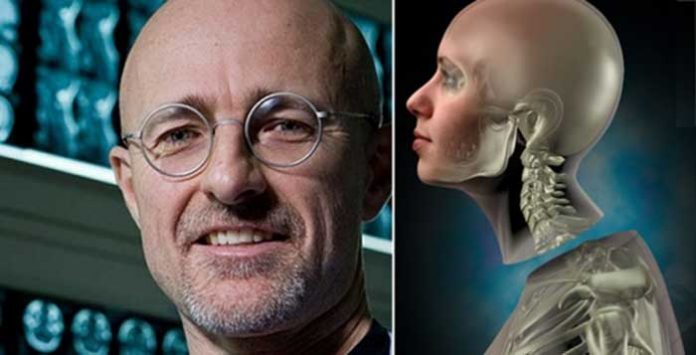
Controversial scientist claims world's first human head transplant... on a corpse

Dr Sergio Canavero head transplant
The world's first human head transplant has been carried out on a corpse in China, according to a controversial Italian doctor who said Friday that he and his team are now ready to perform the surgery on a living person.

Dr. Sergio Canavero, chief of the Turin Advanced Neuromodulation Group, said the operation was carried out by a team led by Dr. Xiaoping Ren, who last year successfully grafted a head onto a monkey's body.

"The first human transplant on human cadavers has been done. A full head swap between brain-dead organ donors is the next stage," Canavero said at a press conference in Vienna, the Telegraph of the UK reported.

"And that is the final step for the formal head transplant for a medical condition which is imminent," said Canavero, who gained a mix of fame and notoriety in 2015 for his Frankenstein-like plans to achieve his feat within two years.

Comment: First, performing this on a live person is much different from doing it on a corpse - there is no need to be a doctor to see that. Second, Assya Pascalev has a point when she asks if a head with a different body would be the same or an entirely different person. Human beings are not just their brains; they are the ensemble of consciousness and body, of which the brain is just one part. The body has its own 'intelligence' and memory - would that be passed along to a new brain and if so how would the latter be affected?


Question

Did humans learn to speak through cave art?

Cave Art
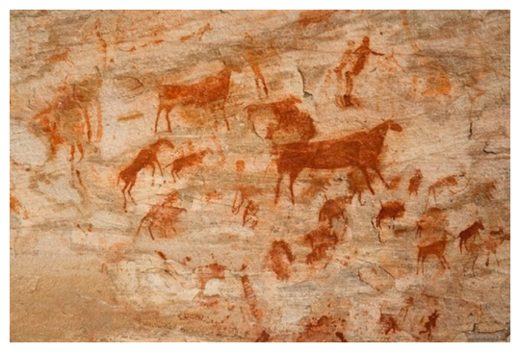
© Stock image of a cave painting in South AfricaWhile the world’s best-known cave art exists in France and Spain, examples of it abound throughout the world.
When and where did humans develop language? To find out, look deep inside caves, suggests an MIT professor.

More precisely, some specific features of cave art may provide clues about how our symbolic, multifaceted language capabilities evolved, according to a new paper co-authored by MIT linguist Shigeru Miyagawa.

A key to this idea is that cave art is often located in acoustic "hot spots," where sound echoes strongly, as some scholars have observed. Those drawings are located in deeper, harder-to-access parts of caves, indicating that acoustics was a principal reason for the placement of drawings within caves. The drawings, in turn, may represent the sounds that early humans generated in those spots.

In the new paper, this convergence of sound and drawing is what the authors call a "cross-modality information transfer," a convergence of auditory information and visual art that, the authors write, "allowed early humans to enhance their ability to convey symbolic thinking." The combination of sounds and images is one of the things that characterizes human language today, along with its symbolic aspect and its ability to generate infinite new sentences.

"Cave art was part of the package deal in terms of how homo sapiens came to have this very high-level cognitive processing," says Miyagawa, a professor of linguistics and the Kochi-Manjiro Professor of Japanese Language and Culture at MIT. "You have this very concrete cognitive process that converts an acoustic signal into some mental representation and externalizes it as a visual."

Cave artists were thus not just early-day Monets, drawing impressions of the outdoors at their leisure. Rather, they may have been engaged in a process of communication.

"I think it's very clear that these artists were talking to one another," Miyagawa says. "It's a communal effort."

The paper, "Cross-modality information transfer: A hypothesis about the relationship among prehistoric cave paintings, symbolic thinking, and the emergence of language," is being published in the journal Frontiers in Psychology. The authors are Miyagawa; Cora Lesure, a PhD student in MIT's Department of Linguistics; and Vitor A. Nobrega, a PhD student in linguistics at the University of Sao Paulo, in Brazil.


Gear

What's wrong with alternative facts? Absolutely nothing!

alternative facts science
Science, the journal, is beginning to go the way of the magazine Scientific American, in that it is beginning to become an oxymoron all by itself, as SciAm did in the Forrest Mims scandal. Science Magazine has turned itself into Politics-uber-Science.

In today's email of Science News, comes this article "Fighting back against 'alternative facts': Experts share their secrets" by Dan Ferber. The article starts out with a clichéd attack on the sitting President of the United States and the repeated-ad-nauseam liberal-progressive assertion that all "alternative facts" are necessarily intentional falsehoods ("lies") for the simple reason that they do not support their favored "experts":

"...Chuck Todd, host of NBC's Meet the Press, confronted her about an overinflated White House estimate of the crowd size at the president's inauguration. "Don't be so overly dramatic about it, Chuck," she shot back. "You're saying it's a falsehood. [But] Sean Spicer, our press secretary, gave alternative facts."

Alarm Clock

Jeff Bezos reveals construction of 500 foot tall 10K-year clock inside a West Texas mountain

The 10,000 Year Clock bezos
© Long Now FoundatioThe 10,000 Year Clock
Amazon's Jeff Bezos just revealed video of a massive 10,000-year clock that's being built inside a West Texas mountain.

The clock is 500 feet tall and powered by the Earth's thermal cycles, Bezos said in a tweet Tuesday.

"It's a special Clock, designed to be a symbol, an icon for long-term thinking," a blog post signed by Bezos says.

The clock has been in the works for nearly three decades, according to the post, and is designed to tick once a year. The century hand advances once every 100 years, and the cuckoo comes out on the millennium.


Dig

Fossilized reptile footprints suggest lizards were running on two feet 110 million years ago

fossilized reptile footprints
© H. Lee et al/Scientific Reports 2018IMPRINTS Scientists think that these fossilized footprints may represent the earliest evidence of a lizard running on two legs. Here, a front print (left) and a back print (right) are shown.
Fossilized footprints from an iguana-like reptile provide what could be the earliest evidence of a lizard running on two legs.

The 29 exceptionally well-preserved lizard tracks, found in a slab of rock from an abandoned quarry in Hadong County, South Korea, include back feet with curved digits and front feet with a slightly longer third digit. The back footprints outnumber the front ones, and digit impressions are more pronounced than those of the balls of the feet. The lizard's stride length also increases across the slab.

That's what you'd expect to see in a transition from moseying along on four legs to scampering on two, says Yuong-Nam Lee, a paleontologist at Seoul National University who first came across the slab back in 2004. A closer examination two years ago revealed the telltale tracks.

Lee and his colleagues attribute the tracks to a previously unknown lizard ichnospecies, that is a species defined solely by trace evidence of its existence, rather than bones or tissue. Lee and his colleagues have dubbed the possible perpetrator Sauripes hadongensis and linked it to an order that includes today's iguanas and chameleons in the Feb. 15 Scientific Reports.

Palette

Inquiry: What color is a tennis ball?

DogTennisballs
© Mother Nature Nework
It seemed like an easy question.

The query came from a Twitter poll I spotted on my news feed last week, from user @cgpgrey. "Please help resolve a marital dispute," @cgpgrey wrote. "You would describe the color of a tennis ball as:" green, yellow, or other.

Yellow, obviously, I thought, and voted. When the results appeared, my jaw dropped with cartoonish effect. Of nearly 30,000 participants, 52 percent said a tennis ball is green, 42 percent said it's yellow, and 6 percent went with "other."

I was stunned. I'd gone from being so sure of myself to second-guessing my sanity in a matter of seconds. More than that, I could never have imagined the question of the color of a tennis ball - surely something we could all agree on, even in these times - would be so divisive.

I dropped the tweet into my team's Slack channel, which includes The Atlantic's science, technology, and health reporters and editors. The long conversation that followed can only be described as a bloodbath.

The seemingly trivial question tore apart our usually congenial group. Lines were quickly and fiercely drawn, team green against team yellow, as my colleagues debated the very definition of color itself. Swords were brandished in the form of links to HTML color codes or the paint selection at Sherwin-Williams. Attempts to broker a cease-fire, to consider that maybe tennis balls are actually yellow-green - or green-yellow, or chartreuse - were brushed aside. At one point, I lashed out at a colleague who then reminded me we were on the same side.