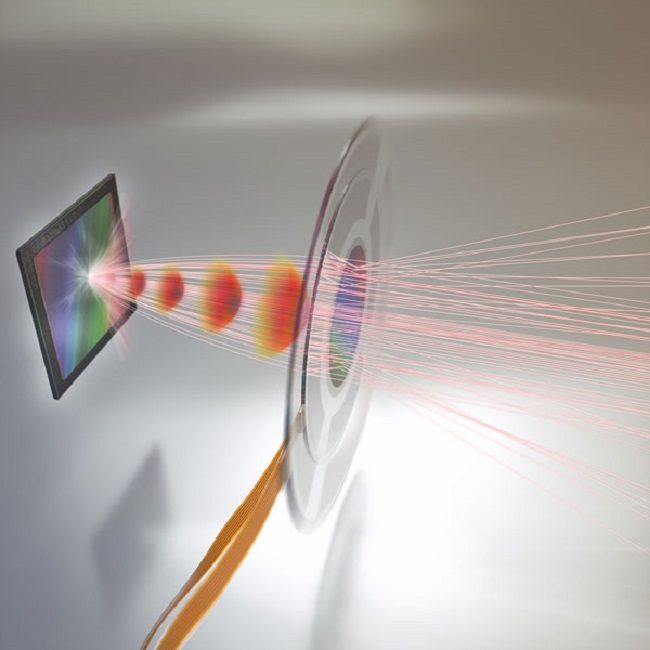
© Image courtesy of the Capasso Lab/Harvard SEASThe adaptive metalens focuses light rays onto an image sensor. An electrical signal controls the shape of the metalens to produce the desired optical wavefronts (shown in red), resulting in better images. In the future, adaptive metalenses will be built into imaging systems, such as cell phone cameras and microscope, enabling flat, compact autofocus as well as the capability for simultaneously correcting optical aberrations and performing optical image stabilization, all in a single plane of control.
Inspired by the human eye, researchers at
the Harvard John A. Paulson School of Engineering and Applied Sciences (SEAS) have developed an adaptive metalens, that is essentially a flat, electronically controlled artificial eye. The adaptive metalens simultaneously controls for three of the major contributors to blurry images: focus, astigmatism, and image shift.
The research is published in
Science Advances.
"This research combines breakthroughs in artificial muscle technology with metalens technology to create a tunable metalens that can change its focus in real time, just like the human eye," said Alan She, a graduate student at SEAS and first author of the paper.
"We go one step further to build the capability of dynamically correcting for aberrations such as astigmatism and image shift, which the human eye cannot naturally do."
"This demonstrates the feasibility of embedded optical zoom and autofocus for a wide range of applications including cell phone cameras, eyeglasses and virtual and augmented reality hardware," said
Federico Capasso, Robert L. Wallace Professor of Applied Physics and Vinton Hayes Senior Research Fellow in Electrical Engineering at SEAS and senior author of the paper. "It also shows the possibility of future optical microscopes, which operate fully electronically and can correct many aberrations simultaneously."


















Comment: There are other theories for why the universe behaves as it does:
- Cosmopsychism: Is the universe a conscious mind?
- Panpsychism: The idea that everything from spoons to stones are conscious is gaining academic credibility
- How quantised inertia gets rid of dark matter
- Study: Galaxy pair contain dark matter halo at least 1 trillion times the sun's mass
- Lumpy Universe: What simulations of the universe have overlooked
- New look at dark energy: Research suggests accelerating expansion of the Universe may not be real, could be only an apparent effect
- Dark matter may be killing galaxies across the Universe
- No need for Dark Matter? Distribution of normal matter determines acceleration in rotating galaxies
Also be sure to check out SOTT radio's: