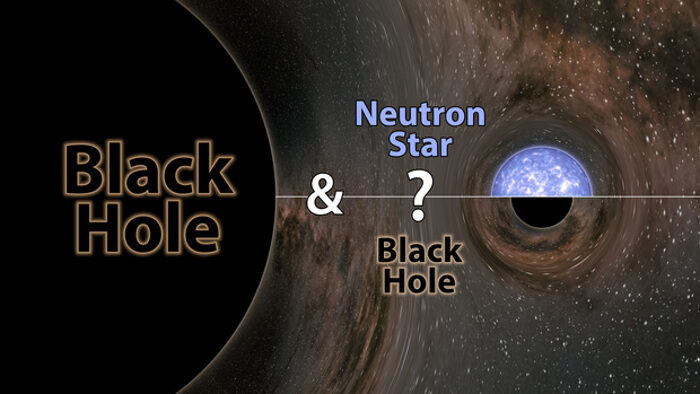
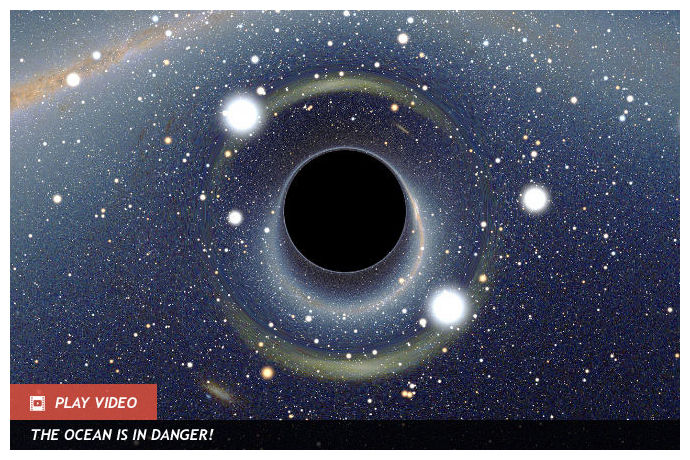
© LIGO/Caltech/MIT/R. Hurt (IPAC)In August of 2019, the LIGO-Virgo gravitational-wave network witnessed the merger of a black hole with 23 times the mass of our sun and a mystery object 2.6 times the mass of the sun. Scientists do not know if the mystery object was a neutron star or black hole, but either way it set a record as being either the heaviest known neutron star or the lightest known black hole.
When the most massive stars die, they collapse under their own gravity and leave behind black holes; when stars that are a bit less massive die, they explode in a supernova and leave behind dense, dead remnants of stars called neutron stars. For decades, astronomers have been puzzled by a gap that lies between neutron stars and black holes: the heaviest known neutron star is no more than 2.5 times the mass of our sun, or 2.5 solar masses, and the lightest known black hole is about 5 solar masses. The question remained: does anything lie in this so-called mass gap?
Now, in a new study from the National Science Foundation's Laser Interferometer Gravitational-Wave Observatory (LIGO) and the Virgo detector in Europe, scientists have
announced the discovery of an object of 2.6 solar masses, placing it firmly in the mass gap. The object was found on August 14, 2019, as it merged with a black hole of 23 solar masses, generating a splash of gravitational waves detected back on Earth by LIGO and Virgo. A paper about the detection has been accepted for publication in
The Astrophysical Journal Letters.
"We've been waiting decades to solve this mystery," says co-author Vicky Kalogera, a professor at Northwestern University. "We don't know if this object is the heaviest known neutron star, or the lightest known black hole, but either way it breaks a record."
"This is going to change how scientists talk about neutron stars and black holes," says co-author Patrick Brady, a professor at the University of Wisconsin, Milwaukee, and the LIGO Scientific Collaboration spokesperson. "The mass gap may in fact not exist at all but may have been due to limitations in observational capabilities. Time and more observations will tell."












Comment: See also: We still don't know why the reign of the dinosaurs ended