Nature turned against one of America's early civilizations 3,600 years ago, when researchers say earthquakes and floods, followed by blowing sand, drove away residents of an area that is now in Peru. "This maritime farming community had been successful for over 2,000 years, they had no incentive to change, and then all of a sudden, boom, they just got the props knocked out from under them," anthropologist Mike Moseley of the University of Florida said in a statement.
Moseley and colleagues were studying civilization of the Supe Valley along the Peruvian coast, which was established up to 5,800 years ago.
Stephanie Stohr
CosmosMon, 19 Jan 2009 19:35 UTC
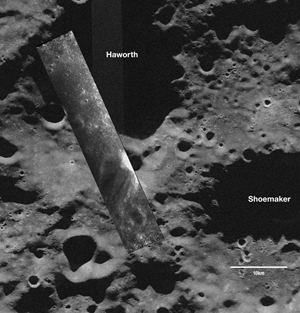
© ISRO/NASA/JHUAPL/LPI/Cornell University/SmithsonianNever seen before: The image shows a radar strip overlain over an Earth-based, Arecibo Observatory radar telescope image of the Moon's surface. Taken Nov. 17, 2008, the radar strip shows a part of the Moon never seen before: a portion of Haworth crater that is permanently shadowed from Earth and the Sun. The only way to explore these regions is by using an orbital radar such as the Mini-SAR.
Sydney - An orbiting Indian probe is sending back the first radar images of mysterious, previously hidden craters near the poles of the Moon.
India's Chandrayaan-1 spacecraft, has captured the images with the help of a NASA-built radar device that is part of the probe's suite of scientific instruments.
The imaging technique can detect features as small as 150 metres wide, and is being used to map the dark side of the Moon and search for evidence of water ice.
Tanya Syed
BBC NewsMon, 19 Jan 2009 17:44 UTC

© Yale UniversityRemains in the city wall suggest toxic gases were used in a siege on the city.
A UK researcher said he found evidence that the Persian Empire used poisonous gases on the Roman city of Dura, Eastern Syria, in the 3rd Century AD.
The theory is based on the discovery of remains of about 20 Roman soldiers found at the base of the city wall.
The findings were presented the Archaeological Institute of America's annual meeting.
The study shows that the Persians dug a mine underneath the wall in order to enter the city.
They also ignited bitumen and sulphur crystals to produce dense poisonous gases, suggested Simon James, an archaeologist at the University of Leicester.

© UnknownThis image illustrates the two ways in which convecting fluid will generally behave; "a" represents rapidly rotating convection, and "b" represents chaotic, non-rotating convection. In the journal Nature, Eric King, Jonathan Aurnou and colleagues report on when a convecting fluid goes from "a" to "b" and on the implications of their surprising findings.
The research, federally funded by the National Science Foundation, unifies results from an extensive array of previous experiments. It appears in the Jan. 15 edition of the journal
Nature.
"The Nature paper allows us new and meaningful predictions for where we should observe different behaviors throughout the universe wherever there are rotating convection systems, and that means planets and stars," said study co-author Jonathan Aurnou, a UCLA associate professor of planetary physics. "This allows us to make predictions for almost any body where we can measure the rotation rate and heat coming out. For me, that's exciting."
Miranda Marquit
PhysOrgMon, 19 Jan 2009 19:30 UTC
When most people think of quantum communication, they think in terms of private communication channels - the ability to send messages without a third-party deciphering them. Indeed, quantum cryptography represents a method of sending information that cannot be eavesdropped upon. Without the proper key for decoding the intercepted message, all an interloper would receive is gibberish. To make quantum cryptography work, Graeme Smith tells PhysOrg.com, "We try to understand the protocols and use specially designed channels to send messages and also to shed light on the general theory of privacy in quantum mechanics."
Conventional wisdom, when applied to quantum communication, seems to say that one must have a private channel in order to communicate privately. Nonprivate channels, the thinking goes, should not be able to send quantum information. It is this very thinking that Smith, along with colleague John Smolin, at the IBM T.J. Watson Research Center in Yorktown Heights, New York, could be overturning. In theory, and with the help of some mathematical equations, Smith and Smolin show that it might be possible to combine nonprivate channels to create a channel that would transmit quantum information - and communicate privately at greater distances than currently possible. Their reasoning can be found in Physical Review Letters: "Can Nonprivate Channels Transmit Quantum Information?"
"If you had a channel that didn't allow you to communicate privately," Smith points out, "you would think you have a weak resource. But when you start looking at these channels, and you start looking at their limits, you begin to see something else." This "something else," Smith continues, includes qualities that allow nonprivate channels to combine in a way that allows them to possibly become useful for quantum communication.
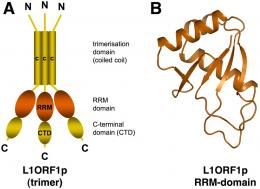
© Max Planck InstituteA Scheme of the L1ORF1p trimer. B Crystal structure of the RRM-domain of the human L1ORF1p protein.
The so-called LINE-1 retrotransposon is a mobile genetic element that can multiply and insert itself into chromosomal DNA at many different locations. This disturbs the genetic code at the site of integration, which can have serious consequences for the organism. On the other hand, this leads to genetic variation, an absolute prerequisite for the evolution of species. The structure of the L1ORF1p protein now allows a much more precise investigation of the mechanism of LINE-1 mobilization. This provides new insight into the relation between retrotransposons and retroviruses and probably also into certain evolutionary processes in humans and animals.
Moreover, the researchers assume that the mechanism of LINE-1 retrotransposition can be exploited one day to precisely insert genetic information into specific locations. This would be an alternative to contemporary, less location-specific methods that are based on a retroviral mechanism. (
PNAS, January 20th, 2009)
Sites claiming President-Elect Barack Obama will refuse to take the oath of office Tuesday are serving up attack code believed to be programmed by the same hackers responsible for the notorious Storm bot Trojan, researchers said this weekend.
According to researchers at several security companies, including F-Secure Corp. , MX Logic Inc. and Trend Micro Inc. , spam campaigns are in gear that try to trick users into visiting malicious Web sites hosting variations of "Waledec," the Trojan horse thought to be the successor to Storm
Sam Masiello, vice president of information security at MX Logic, was one of the first to call attention to the attacks, which begin with one-line spam messages such as "Haven't you heard latest news about our president-elect?", "Barack Obama abandoned sinking ship," and "Obama doesn't wany [sic] anymore to be a president."
The links in those messages lead to a legitimate-looking site that resembles the real Obama-Biden campaign site . The fake site contains both bogus and real news stories. At the top of the page is a story with the headline "Barack Obama has refused to be a president," that includes text which reads, "On the Eve of Inauguration Day President-elect Barack Obama made statement. He declared that he is definitely NOT ready for this position."

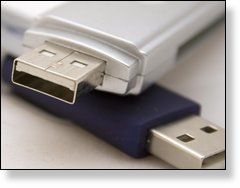
© unknownThe worm can also spread via USB flash drives.
A worm that spreads through low security networks, memory sticks, and PCs without the latest security updates is posing a growing threat to users.
The malicious program, known as Conficker, Downadup, or Kido was first discovered in October 2008.
Although Microsoft released a patch, it has gone on to infect 3.5m machines.
Experts warn this figure could be far higher and say users should have up-to-date anti-virus software and install Microsoft's MS08-067 patch.
To better understand preeclampsia, a sudden rise in maternal blood pressure and onset of kidney disease during pregnancy, researchers from Cornell University and Weill Cornell Medical College are studying mice that have the same affliction. Preeclampsia is the leading cause of both maternal and fetal death - killing more than 500,000 women worldwide each year and causing 15 percent of all premature births - yet the condition is not well understood.
Dr. Robin Davisson, Dr. Shari Gelber, and their team of researchers have developed an experimental gene therapy technique that lessens preeclampsia in mice, with the hope of someday applying their promising findings to humans. Dr. Davisson is a professor of cell and developmental biology at Weill Cornell Medical College and professor of molecular physiology at Cornell University's College of Veterinary Medicine, in Ithaca, New York. Dr. Shari Gelber is a clinical fellow in maternal-fetal medicine in the department of obstetrics and gynecology at Weill Cornell Medical College in New York City.
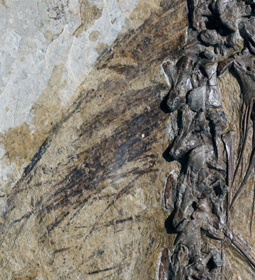
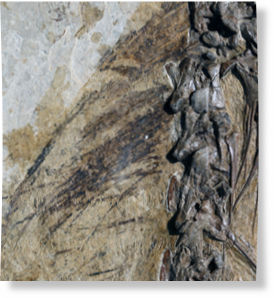
© Zhao Chuang and Xing LidaBeipiaosaurus feather close-up
In what may be the first example of a peacocklike display, researchers are reporting the earliest evidence of a creature that used feathers for showing off. The animal, a 125-million-year-old long-necked bipedal dinosaur named Beipiaosaurus, may have employed the plumage to attract mates or defend its territory.
Fossils found in China in recent years have given paleontologists some of their best evidence for the existence of feathered dinosaurs. This early plumage, which was downy in nature, wasn't used for flight, however. Researchers have speculated that it may have been for thermal insulation, yet its true function remains a mystery.







Comment: Earthquakes, floods and winds - yet no mention of the most obvious explanation for all these phenomena: a cometary impact.
See Laura Knight-Jadczyk's Meteorites, Asteroids, and Comets: Damages, Disasters, Injuries, Deaths, and Very Close Calls.