Science & TechnologyS


Butterfly

Scientists use Brownian Motion to Explore How Birds Flock Together

Locust Swarm
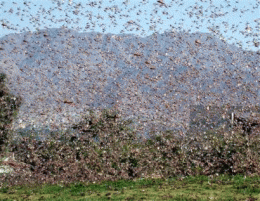
© QuarkfolioInspired by recent research on locust swarms, scientists have used Brownian motion to model how individuals form swarms through escape and pursuit interactions.
How do thousands of fish swim together in giant schools, seemingly moving as a single body? Flocks of birds, herds of beasts, and a variety of other animals in nature seem to share this same "property" of coming together and moving in unison.

The phenomenon, called collective motion, is common in nature, exhibited by groups that fly, run, and swim, such as swarms of insects and colonies of bacteria. In collective motion, groups move together to form patterns as an organized (but not necessarily cooperative) single body. Scientists aren't sure exactly what mechanisms cause the emergence of collective motion. However, the natural phenomenon has attracted the interest of researchers in diverse fields such as physics and computer science.

In a recent study, researchers have modeled collective motion using Brownian particles, and they observed as individual particles interact via escape and pursuit movements. Motivated by a previous study that observed cannibalistic interactions in locust and cricket swarms, the scientists found that both escape and pursuit movements can cause collective motion, but escape movements dominated the particular case of insect swarming. Pawel Romanczuk and Lutz Schimansky-Geier of Humboldt University Berlin, and Iain D. Couzin of Princeton University, have published their study in a recent issue of Physical Review Letters.

Sun

Ring of Fire: Indian Ocean to See Solar Eclipse

Annual Eclipse
© UnknownA few lucky people in the Indian Ocean will be treated to a rare event when an annular solar eclipse will transform the Sun into a dark disc with a blazing ring-shaped corona around its rim.

A few lucky people in the Indian Ocean will be treated to a rare event on Monday when an annular solar eclipse will transform the Sun into a dark disc with a blazing ring-shaped corona around its rim.

In solar eclipses, the Moon moves between the Sun and Earth, casting its shadow on the terrestrial surface.

In an annular eclipse, a tiny shift in distance that results from celestial mechanics means the Moon does not completely cover the Sun's face, as it does in a total eclipse.

Instead, for those directly under the alignment, the Moon covers most of the Sun's surface, and a ring-like crown of solar light blazes from the edge of the disk.

Bug

New Insight Into How Bees See

New Insight
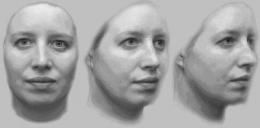
© Monash UniversityFaces can dramatically change appearance when seen from different viewpoints, since the relationship between elements like nose and eyes change depending upon viewing angle. Bees solve this difficult visual problem by averaging previously learnt views.
New research from Monash University bee researcher Adrian Dyer could lead to improved artificial intelligence systems and computer programs for facial recognition.

Dr Dyer is one of Australia's leading bee experts and his latest research shows that honeybees can learn to recognise human faces even when seen from different viewpoints.

Dr Dyer said the research could be applied in the areas of new technology, particularly the development of imaging systems.

Info

Dark flow: Proof of another universe?

Image
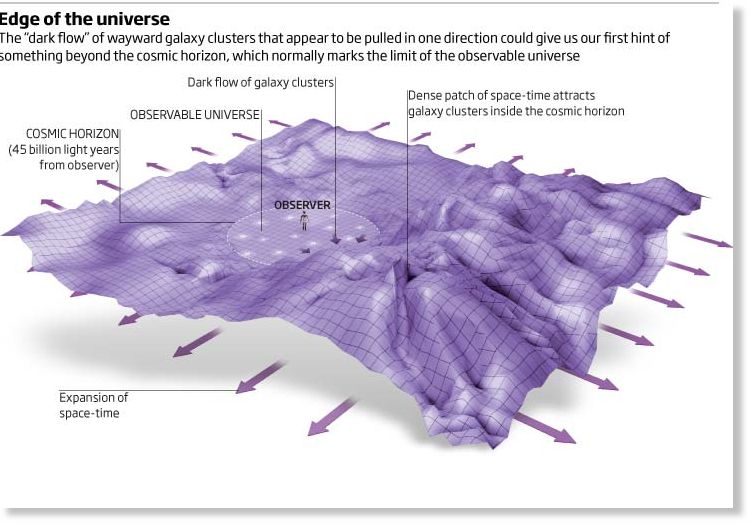
© UnknownEdge of the Universe

For most of us the universe is unimaginably vast. But not for cosmologists. They feel decidedly hemmed in. No matter how big they build their telescopes, they can only see so far before hitting a wall. Approximately 45 billion light years away lies the cosmic horizon, the ultimate barrier because light beyond it not has not had time to reach us.

So here we are, stuck inside our patch of universe, wondering what lies beyond and resigned to that fact we may never know. The best we can hope for, through some combination of luck and vigilance, is to spot a crack in the structure of things, a possible window to that hidden place beyond the edge of the universe. Now Sasha Kashlinsky believes he has stumbled upon such a window.

Kashlinsky, a senior staff scientist at NASA's Goddard Space Flight Center in Greenbelt, Maryland, has been studying how rebellious clusters of galaxies move against the backdrop of expanding space. He and colleagues have clocked galaxy clusters racing at up to 1000 kilometres per second - far faster than our best understanding of cosmology allows. Stranger still, every cluster seems to be rushing toward a small patch of sky between the constellations of Centaurus and Vela.

Telescope

Mars and Mercury Formed From Planetary Scraps According to New Theory

Mars and Mercury were formed from the scraps of Earth and Venus, according to a radical new theory of rocky planet formation. The model could explain some characteristics of Mars and Mercury that have long puzzled scientists, said Brad Hansen, an astronomer at the University of California, Los Angeles.

"In this picture, Mars and Mercury are essentially byproducts" of Earth and Venus, said Hansen, who presented his research at a recent meeting of the American Astronomical Society in Long Beach, California.

Magnify

Genetic study perfectly separates individuals with Ashkenazi Jewish ancestry among European Americans

Carl Zimmer pointed me to a new paper, "A genome-wide genetic signature of Jewish ancestry perfectly separates individuals with and without full Jewish ancestry in a large random sample of European Americans." The title is so informative that pasting the abstract is almost unnecessary, but here is the conclusion which gets to the point:
In conclusion, we show that, at least in the context of the studied sample, it is possible to predict full Ashkenazi Jewish ancestry with 100% sensitivity and 100% specificity, although it should be noted that the exact dividing line between a Jewish and non-Jewish cluster will vary across sample sets which in practice would reduce the accuracy of the prediction. While the full historical demographic explanations for this distinction remain to be resolved, it is clear that the genomes of individuals with full Ashkenazi Jewish ancestry carry an unambiguous signature of their Jewish heritage, and this seems more likely to be due to their specific Middle Eastern ancestry than to inbreeding.

Control Panel

Quantum Leap: Information Teleported Between Ions At A Distance

Einstein
© Library of CongressQuantum entanglement, famously dubbed "spooky action at a distance" by Albert Einstein, is harnessed in a new study to teleport quantum information from one ion to another.
Link between spatially separated ions could form the basis of quantum communications.

Quantum entanglement, whereby two or more objects are linked by an unseen connection, has some famously spooky effects. As quantum researcher Anton Zeilinger has said, entanglement can be thought of as a pair of dice that always land on the same number.

One of the most intriguing applications of this entanglement is quantum teleportation, in which the quantum state of a particle or atom is transferred to its entangled partner, even if they are separated physically. Such relaying of quantum information could form the backbone of long-distance quantum communication channels, but such a network remains far on the horizon.

A group of researchers, however, report today in Science that they've made headway in quantum teleportation, and thus communication. The team, led by physics graduate student Steven Olmschenk at the University of Maryland, College Park, succeeded in teleporting quantum information between ytterbium ions (charged atoms) three feet (one meter) apart.

Saturn

Is that two moons around Saturn I see?

Saturn
© REUTERS/NASA An undated handout image of Saturn from NASA's Hubble Space Telescope, released October 21, 1998.

Italian and British scientists want to exhume the body of 16th century astronomer Galileo for DNA tests to determine if his severe vision problems may have affected some of his findings.

The scientists told Reuters on Thursday that DNA tests would help answer some unresolved questions about the health of the man known as the father of astronomy, whom the Vatican condemned for teaching that the earth revolves around the sun.

"If we knew exactly what was wrong with his eyes we could use computer models to recreate what he saw in his telescope," said Paolo Galluzzi, director of the Museum of History and Science in Florence, the city where Galileo is buried.

Satellite

Old Russian nuclear satellite spewed fragments in orbit

Russia's military said Wednesday that an old Soviet-built nuclear-powered satellite has spewed fragments in orbit, but insisted they do not threaten the international space station or people on Earth.

The military's Space Forces said the decommissioned Cosmos-1818 satellite "partially fragmented" in July.

Space Forces chief of staff Gen. Alexander Yakushin said in Wednesday's statement that the satellite's fragments remained on a high orbit far above that of the international space station. Yakushin added that the fragments do not pose any threat of radioactive contamination on Earth.

Better Earth

Did the Moon's far side once face Earth?

western hemisphere of the Moon
© Johnson Space Center Collection / NASAThe western hemisphere of the Moon, as seen by the Galileo spacecraft

Billions of years ago, the man in the moon may have performed the ultimate about-face, when an asteroid flipped the moon around.

The far side of the moon never faces us, because the moon rotates once for every orbit it makes of the Earth. Yet an analysis of impact craters shows the far side may once have pointed our way.

Mark Wieczorek and Matthieu Le Feuvre at the Paris Institute of Earth Physics in France studied the relative age and distribution of 46 known craters, gouged out by impacts from debris originating in the solar system's asteroid belt.

According to earlier computer simulations, the moon's western hemisphere as viewed from Earth should have about 30 per cent more craters than the eastern hemisphere. That's because the west always faces in the direction in which the moon orbits, which makes it more likely to be hit by debris, for the same reason that more raindrops strike a moving car's front windshield than its rear.