
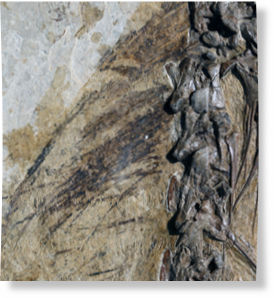
© Zhao Chuang and Xing LidaBeipiaosaurus feather close-up
Fossils found in China in recent years have given paleontologists some of their best evidence for the existence of feathered dinosaurs. This early plumage, which was downy in nature, wasn't used for flight, however. Researchers have speculated that it may have been for thermal insulation, yet its true function remains a mystery.
Now a dino has popped on the scene with another type of mysterious feather. From its fossil remains, paleontologists can see that Beipiaosaurus--which was first discovered in 1999 and lived in a thick forest in what is now Liaoning Province, China--was covered with the short, downy feathers seen before. But it also sports elongated broad filamentous feathers (EBFFs) resembling the quills of a porcupine. The EBFFs are markedly stiffer and longer than the dino's downy feathers, with the largest feather almost as big as the skull and half the length of the neck, says lead author and paleontologist Xing Xu of Institute of Vertebrate Paleontology and Paleoanthropology, CAS.
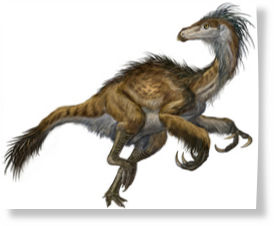
© hao Chuang and Xing LidaBeipiaosaurus's body was covered with downlike plumage,
with stiff quills sticking out on the head, trunk, and tail.
with stiff quills sticking out on the head, trunk, and tail.
It's an "intriguing" result, says paleontologist Gerald Mayr, who studies bird evolution at the Senckenberg Research Institute in Germany. And it may shed light on another dino mystery. Psittacosaurus, a bipedal herbivore unrelated to Beipiaosaurus, sported similar bristlelike structures. Now, says Mayr, we think they may have been feathers.


Reader Comments
to our Newsletter