Science & TechnologyS


Meteor

Tiny diamonds on Santa Rosa Island give evidence of cosmic impact

Image
© UCSBThis is James Kennett (left) and Douglas J. Kennett.
Santa Barbara, Calif. - - Nanosized diamonds found just a few meters below the surface of Santa Rosa Island off the coast of Santa Barbara provide strong evidence of a cosmic impact event in North America approximately 12,900 years ago, according to a new study by scientists. Their hypothesis holds that fragments of a comet struck across North America at that time.

The research, published this week in the Proceedings of the National Academy of Sciences (PNAS), was led by James Kennett, professor emeritus at UC Santa Barbara, and Douglas J. Kennett, first author, of the University of Oregon. The two are a father-son team. They were joined by 15 other researchers.

Laptop

This article will self-destruct: A tool to make online personal data vanish

Computers have made it virtually impossible to leave the past behind. College Facebook posts or pictures can resurface during a job interview. A lost cell phone can expose personal photos or text messages. A legal investigation can subpoena the entire contents of a home or work computer, uncovering incriminating, inconvenient or just embarrassing details from the past.

The University of Washington has developed a way to make such information expire. After a set time period, electronic communications such as e-mail, Facebook posts and chat messages would automatically self-destruct, becoming irretrievable from all Web sites, inboxes, outboxes, backup sites and home computers. Not even the sender could retrieve them.

Info

Tires made from trees -- better, cheaper, more fuel efficient

Corvallis, Ore. - Automobile owners around the world may some day soon be driving on tires that are partly made out of trees - which could cost less, perform better and save on fuel and energy.

Wood science researchers at Oregon State University have made some surprising findings about the potential of microcrystalline cellulose - a product that can be made easily from almost any type of plant fibers - to partially replace silica as a reinforcing filler in the manufacture of rubber tires.

A new study suggests that this approach might decrease the energy required to produce the tire, reduce costs, and better resist heat buildup. Early tests indicate that such products would have comparable traction on cold or wet pavement, be just as strong, and provide even higher fuel efficiency than traditional tires in hot weather.

Sun

Longest Solar Eclipse of the 21st Century

Image
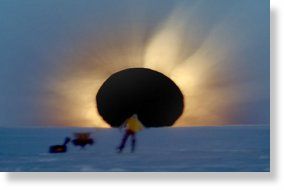
© Fred Bruenjes of moonglow.netA totally eclipsed sunrise in Antarctica.
One one-thousand, 2 one-thousand, 3 one-thousand, 4 one-thousand...

Continue counting and don't stop until you reach 399 one-thousand. Did that feel like a long time? Six minutes and 39 seconds to be exact. That's the duration of this week's total solar eclipse--the longest of the 21st century.

The event begins at the crack of dawn on Wednesday, July 22nd, in the Gulf of Khambhat just east of India. Morning fishermen will experience a sunrise like nothing they've ever seen before. Rising out of the waves in place of the usual sun will be an inky-black hole surrounded by pale streamers splayed across the sky. Sea birds will stop squawking, unsure if the day is beginning or not, as a strange shadow pushes back the dawn and stirs up a breeze of unaccustomed chill.

Most solar eclipses produce this sort of surreal experience for a few minutes at most. The eclipse of July 22, 2009, however, will last as long as 6 minutes and 39 seconds in some places, not far short of the 7 and a half minute theoretical maximum. It won't be surpassed in duration until the eclipse of June 13, 2132.

Meteor

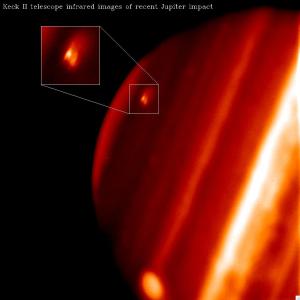
Jupiter sports new 'bruise' from impact

Image
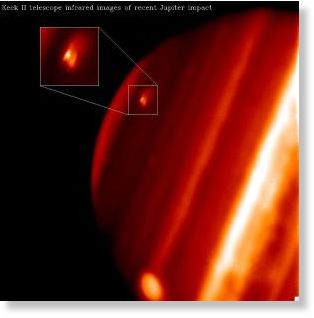
© Paul Kalas/Michael Fitzgerald/Franck Marchis/LLNL/UCLA/UC Berkeley/SETI InstituteInfrared observations taken at the Keck II telescope in Hawaii reveal a bright spot where the impact occurred. The spot looks black at visible wavelengths
Something has smashed into Jupiter, leaving behind a black spot in the planet's atmosphere, scientists confirmed on Monday.

This is only the second time such an impact has been observed. The first was almost exactly 15 years ago, when more than 20 fragments of comet Shoemaker-Levy 9 collided with the gas giant.

"This has all the hallmarks of an impact event, very similar to Shoemaker-Levy 9," said Leigh Fletcher, an astronomer at NASA's Jet Propulsion Lab in Pasadena, California. "We're all extremely excited."

The impact was discovered by amateur astronomer Anthony Wesley in Murrumbateman, Australia at about 1330 GMT on Sunday. Wesley noticed a black spot in Jupiter's south polar region - but he very nearly stopped observing before he saw it.

"By 1am I was ready to quit ... then changed my mind and decided to carry on for another half hour or so," he wrote in his observation report. Initially he suspected he was seeing one of Jupiter's moons or a moon's shadow on the planet, but the location, size and speed of the spot ruled out that possibility.

Blackbox

Myth of raindrop formation exploded

The short lifetime of a raindrop is a complicated and explosive affair, physicists have revealed. Using high-speed video footage they have solved a longstanding conundrum of what determines the size of raindrops.


Info

NYU physicists find way to explore microscopic systems through holographic video

Physicists at New York University have developed a technique to record three-dimensional movies of microscopic systems, such as biological molecules, through holographic video. The work, which is reported in Optics Express, has potential to improve medical diagnostics and drug discovery.

The technique, developed in the laboratory of NYU Physics Professor David Grier, is comprised of two components: making and recording the images of microscopic systems and then analyzing these images.

To generate and record images, the researchers created a holographic microscope, which is based on a conventional light microscope. But instead of relying on an incandescent illuminator, which conventional microscopes employ, the holographic microscope uses a collimated laser beam - a beam consisting of a series of parallel rays of light and similar to a laser pointer.

Info

'Invisibility cloak' could protect against earthquakes

Liverpool, UK - 20 July 2009: Research at the University of Liverpool has shown it is possible to develop an 'invisibility cloak' to protect buildings from earthquakes.

The seismic waves produced by earthquakes include body waves which travel through the earth and surface waves which travel across it. The new technology controls the path of surface waves which are the most damaging and responsible for much of the destruction which follows earthquakes.

The technology involves the use of concentric rings of plastic which could be fitted to the Earth's surface to divert surface waves. By controlling the stiffness and elasticity of the rings, waves travelling through the 'cloak' pass smoothly into the material and are compressed into small fluctuations in pressure and density. The path of the surface waves can be made into an arc that directs the waves outside the protective cloak. The technique could be applied to buildings by installing the rings into foundations.

Meteor

California's Channel Islands Hold Evidence of Clovis-Age Comets

California
© NOAA and UC Santa BarbaraThis map shows California's Channel Islands with the islands of the previously combined islands of Santarosae encircled at the top.
A 17-member team has found what may be the smoking gun of a much-debated proposal that a cosmic impact about 12,900 years ago ripped through North America and drove multiple species into extinction.

In a paper appearing online ahead of regular publication in the Proceedings of the National Academy of Sciences, University of Oregon archaeologist Douglas J. Kennett and colleagues from nine institutions and three private research companies report the presence of shock-synthesized hexagonal diamonds in 12,900-year-old sediments on the Northern Channel Islands off the southern California coast.

These tiny diamonds and diamond clusters were buried deeply below four meters of sediment. They date to the end of Clovis -- a Paleoindian culture long thought to be North America's first human inhabitants. The nano-sized diamonds were pulled from Arlington Canyon on the island of Santa Rosa that had once been joined with three other Northern Channel Islands in a landmass known as Santarosae.

Powertool

At Fault: Did Drilling Cause Earthquakes at Cleburne Texas?

Image
© anonymouswhole lot of shaking goin' on
At last, something that fossil fuels and renewable energy exploration have in common: They both may cause earthquakes.

Whole lotta shakin' goin' on

The New York Times reported Wednesday on concerns that a geothermal energy project about to begin near San Francisco could trigger quakes in the seismically active region. Worried residents point out that a similar project in Switzerland was shut down in 2006 after it was blamed for a magnitude 3.4 quake - enough to cause quite a stir in an area not accustomed to temblors.

If all this sounds familiar, recall the hubbub earlier this month when some residents of Cleburne, Texas, blamed natural-gas drilling for causing a series of minor earthquakes in the town. Geophysicists took the concerns seriously enough to deploy seismic sensors around the town - at which point the quakes promptly stopped.

Among those convinced the drilling and the earthquakes are related: Markus Haring, a former oilman and the head of the Swiss geothermal project. After the Wall Street Journal wrote about the Cleburne quakes, Mr. Haring emailed to say there is "not the slightest doubt" that gas production caused the temblors.