Science & TechnologyS


Info

Reprogramming Human Cells Without Inserting Genes

Worcester, Mass. - A research team comprised of faculty at Worcester Polytechnic Institute's (WPI) Life Sciences and Bioengineering Center (LSBC) and investigators at CellThera, a private company also located at the LSBC, has discovered a novel way to turn on stem cell genes in human fibroblasts (skin cells) without the risks associated with inserting extra genes or using viruses. This discovery opens a new avenue for reprogramming cells that could eventually lead to treatments for a range of human diseases and traumatic injuries by coaxing a patient's own cells to repair and regenerate the damaged tissues.

The research team reported its findings in the paper "Induction of Stem Cell Gene Expression in Adult Human Fibroblasts without Transgenes," published online July 21, 2009 (in advance of September print publication) as a "fast track" paper from the journal Cloning and Stem Cells. (Cloning, Stem Cells. 2009 Jul 21.) "We show that by manipulating culture conditions alone, we can achieve changes in fibroblasts that would be beneficial in development of patient-specific cell therapy approaches," the authors wrote in the paper.

Info

Jet-propelled Imaging for an Ultrafast Light Source

Image
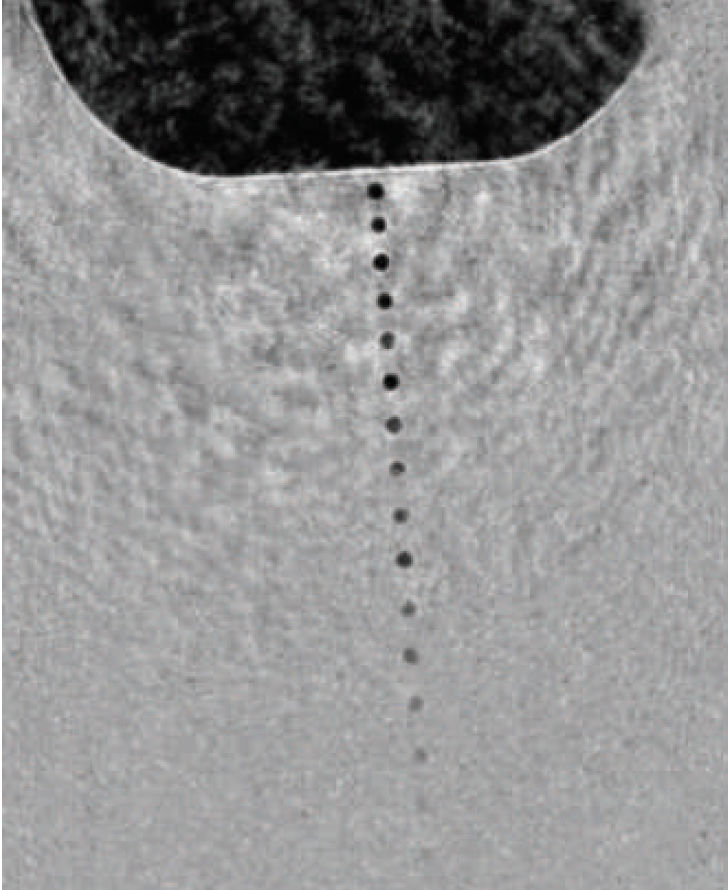
© Berkeley LabA particle gun that fires liquid droplets less than a millionth of a meter in diameter, faster than hundreds of thousands of times a second, is poised to revolutionize biological imaging. Tested at Berkeley Lab’s Advanced Light Source and soon to be installed at SLAC’s Linac Coherent Light Source, the sample jet injects a beam of droplets across a tightly focused x-ray beam in single file, each droplet so small it contains only a single protein or virus.
John Spence, a physicist at Arizona State University, is a longtime user of the Advanced Light Source at Lawrence Berkeley National Laboratory, where he has contributed to major advances in lensless imaging. It's a particularly apt propensity for someone who works with x-rays, since they can't be focused with ordinary lenses.

As new light sources evolve to produce brighter x-rays in faster pulses, lensless imaging becomes ever more critical for science. Among the promises of superbright, ultrafast x-ray pulses is the ability to solve the structure of the complicated molecules from which our bodies are made. All living things are made of proteins and nucleic acids, but relatively few of the atomic structures of the thousands, perhaps millions, of varieties of proteins are known.

Blackbox

Did an ice age boost human brain size?

Image
© Doug Allan/GettyLetting off some steam.
It is one of the biggest mysteries in human evolution. Why did we humans evolve such big brains, making us the unrivalled rulers of the world?

Some 2.5 million years ago, our ancestors' brains expanded from a mere 600 cubic centimetres to about a litre. Two new studies suggest it is no fluke that this brain boom coincided with the onset of an ice age. Cooler heads, it seems, allowed ancient human brains to let off steam and grow.

For all its advantages, the modern human brain is a huge energy glutton, accounting for nearly half of our resting metabolic rate. About a decade ago, biologists David Schwartzman and George Middendorf of Howard University in Washington DC hypothesised that our modern brain could not have evolved until the Quaternary ice age started, about 2.5 million years ago. They reckoned such a large brain would have generated heat faster than it could dissipate it in the warmer climate of earlier times, but they lacked evidence to back their hypothesis.

Now hints of that evidence are beginning to emerge. Climate researcher Axel Kleidon of the Max Planck Institute for Biogeochemistry in Jena, Germany, modelled present-day temperature, humidity and wind conditions around the world using an Earth-systems computer model. He used these factors to predict the maximum rate at which a modern human brain can lose heat in different regions. He found that, even today, the ability to dissipate heat should restrict the activity of people in many tropical regions (Climatic Change, vol 95, p 405).

Blackbox

Enigma of the 23-year-old baby

Image
© Rosamond PurcellWhat the Ole Worm's Wormianum looked like.
The "cabinets of curiosity" of the 16th and 17th centuries housed the extraordinary souvenirs that European missionaries and other travellers brought back from the New World and the East. Stuffed birds with brilliantly coloured plumage sat alongside seashells larger than the human body and mummies plucked from Africa's desert sands. But, as French surgeon Pierre Dionis discovered, sometimes the marvels in your own backyard are the strangest of all. When Dionis stumbled across a leathery fetus-like object in a priest's collection, he resolved to learn the truth about it. Could it really be that this misshapen object was the product of a 23-year-long pregnancy?

In 1678, Pierre Dionis, surgeon in the court of Queen Maria Theresa, accompanied his illustrious patient on a pilgrimage to Pont à Mousson, a small hamlet in north-east France. There, the royal entourage was greeted by the village priest, Father Babilart, a man with a reputation for collecting strange trinkets from around the globe. Babilart was eager to show off his playthings and after ducking skeletons that dangled from the ceiling and side-stepping columns pillaged from Roman ruins, he emerged with a prize he was sure would please both the queen and her companion.

The priest lifted a large jar filled with distilled spirits into the air. Floating inside was a leathery ball-shaped object. Intrigued, the queen and Dionis moved in closer to get a better look. The ball, they now saw, was a horrifically deformed fetus. "Its arms, legs, and spine were so crumpled up together it was impossible to stretch them," Dionis wrote. "Its face was hideous, and was ruddy reddish brown in colour." The priest explained proudly that the child had been cut from its mother's belly after her death - and 23 years after she learned she was pregnant.

The queen left Dionis to investigate the priest's claims. Maria Theresa's fascination for anatomy was well known. Her husband, Louis XIV, kept a menagerie of exotic animals, and whenever one died she summoned the surgeon to dissect it. "The Queen did not have the same repugnance that other women have for anatomical demonstration," Dionis later explained in his influential Dissertation on the Generation of Man in 1698.

Pumpkin

Scary music is spookier with eyes shut

Image
© Archive Photos/Getty ImagesThink this is scary? Try closing your eyes.
Singers and guitar heroes alike have always employed what you might call the Celine Dion effect - closing your eyes to heighten the emotional impact of music.

Now, neuroscientists have discovered that a brain centre involved in sensing emotion and fear called the amygdala kicks into action when volunteers listen to scary music with eyes closed.

"A lot of time we do like to close our eyes when we listen to music, we feel like this is a more powerful experience," says Talma Hendler, a neuroscientist at Tel Aviv Sourasky Medical Center in Israel, who led the new brain imaging study.

Shutting your eyes heightens people's emotional responses to the outside world, suggests previous research - not to mention everyday experience.

Bug

Robotic insect 'flight' may be just good vibrations

Image
© South West News Service / Rex FeaturesWinged flight, or simply fly-by-wire?
Creating a free-flying robotic insect is the dearest wish of many an engineer because such a machine would have great potential in surveillance and in seeking out trapped people in search-and-rescue situations. But a curious effect might upset their plans.

Last year, a team at Harvard University released a video demonstration of a robotic fly they had developed, showing it flapping its wings and levitating up a pair of guide wires.

But Michele Milano of Arizona State University in Tempe wondered whether the wing motion was entirely responsible for giving the robot lift, or whether some other force was involved. "The video showed that the guide wires were vibrating significantly when the wings beat," he told New Scientist.

To find out if these vibrations played a role in the fly's upward motion, his team built a vibrating model "insect" with no wings. The balsa-wood contraption consisted of a motor with an off-centre weight on its spindle that produced vibrations, and four metal tubes through which vertical guide wires were threaded (see Diagram). When they set the motor running, the team discovered that the model moved up the wires despite having no wings. They've dubbed it the "flying brick".

Telescope

Sharpest Views of Betelgeuse Reveal How Supergiant Stars Lose Mass

Betelgeuse
© ESOSupergiant star Betelgeuse has a vast plume of gas almost as large as our Solar System and a gigantic bubble boiling on its surface. These discoveries provide important clues to help explain how these mammoths shed material at such a tremendous rate. The scale in units of the radius of Betelgeuse as well as a comparison with the Solar System is also provided.
Betelgeuse -- the second brightest star in the constellation of Orion (the Hunter) -- is a red supergiant, one of the biggest stars known, and almost 1000 times larger than our Sun. It is also one of the most luminous stars known, emitting more light than 100 000 Suns. Such extreme properties foretell the demise of a short-lived stellar king. With an age of only a few million years, Betelgeuse is already nearing the end of its life and is soon doomed to explode as a supernova. When it does, the supernova should be seen easily from Earth, even in broad daylight.

Red supergiants still hold several unsolved mysteries. One of them is just how these behemoths shed such tremendous quantities of material -- about the mass of the Sun -- in only 10 000 years. Two teams of astronomers have used ESO's Very Large Telescope (VLT) and the most advanced technologies to take a closer look at the gigantic star. Their combined work suggests that an answer to the long-open mass-loss question may well be at hand.

The first team used the adaptive optics instrument, NACO, combined with a so-called "lucky imaging" technique, to obtain the sharpest ever image of Betelgeuse, even with Earth's turbulent, image-distorting atmosphere in the way. With lucky imaging, only the very sharpest exposures are chosen and then combined to form an image much sharper than a single, longer exposure would be.

Sherlock

Scientist Describe First Vertebrate to Live in Trees

Skeleton
© Diane ScottOne of the best-preserved and most complete skeletons of the tree-climbing synapsid Suminia getmanovi from the Later Paleozoic (260 million years ago) of Russia.
In the Late Paleozoic (260 million years ago), long before dinosaurs dominated the Earth, ancient precursors to mammals took to the trees to feed on leaves and live high above predators that prowled the land, Jörg Fröbisch, PhD, a Field Museum paleontologist has concluded. Elongated fingers, an opposable "thumb," and a grasping tail of Suminia getmanovi demonstrate that this small plant-eating synapsid is the earliest known tree-climbing vertebrate

Suminia was relatively small, about 20 inches from its nose to the tip of its tail. The tree-climbing lifestyle of this Paleozoic relative of mammals is particularly important because for the first time in vertebrate evolution it gives access to new food resources high off the ground, and also provides protection from ground-dwelling predators. The evidence for this lifestyle is based on several excellent skulls and more than a dozen exceptionally well preserved, complete skeletons from a single large block of red mudstone that was discovered in central Russia's Kirov region.

Having so many individual specimens, some of mature individuals and some of youngsters, was helpful in providing a complete picture of the animal's skeletal anatomy, said Fröbisch. "It's relatively rare to find several animals locked on a single block," he said. "We have examples of virtually every bone in their bodies."

Robot

Commando Subs Sending Drones, Robo-Torpedos into Combat

Robo Sub
© Navy
The U.S. Navy's four Special Forces-optimized submarines are using a wide range of robots in combat in coastal areas, the Navy's top officer for irregular warfare said in a surprisingly candid interview. The Ohio-class guided-missile subs, modified from surplus ballistic-missile boats, have been outfitted with robotic mini-subs and at least two types of unmanned aerial vehicle, according to Rear Adm. Mark W. Kenny. It seems Kenny's comments, to Special Operations Technology reporter Scott Gourley, just barely slipped under a descending veil of secrecy. "These get classified real fast because we're using these vehicles in operations," Kenny admitted.

The guided-missile subs, called "SSGNs" by the Navy, had their nuclear missiles removed starting in 2002. The boats' nuke missile tubes now contain clusters of conventional Tomahawk cruise missiles or serve as "payload tubes" for equipment, including robots. The SSGNs have accommodations for up to 66 SEALs or other commandos.

Laptop

Game utilizes human intuition to help computers solve complex problems

Image
© University of Michigan
Ann Arbor, Mich. - A new computer game prototype combines work and play to help solve a fundamental problem underlying many computer hardware design tasks.

The online logic puzzle is called FunSAT, and it could help integrated circuit designers select and arrange transistors and their connections on silicon microchips, among other applications.

Designing chip architecture for the best performance and smallest size is an exceedingly difficult task that's outsourced to computers these days. But computers simply flip through possible arrangements in their search. They lack the human capacities for intuition and visual pattern recognition that could yield a better or even optimal design. That's where FunSAT comes in.