Science & TechnologyS


Magnify

How the Brain Localizes Sounds

Specialized neurons sort out overlapping sounds

Ear
© iStockPhotoWHO SAID THAT? A simple mechanism is identified for how we sort through the cacophony of overlapping sounds.
We live in a world full of echoes. Sounds reverberate, bouncing off walls, buildings, rocks and any other nearby surface. These sound waves pile on one another and hurtle down your ear canals from different angles, the echoes from one noise jumbling together with new sounds and their echoes. In spite of that barrage, the neurons in the auditory midbrain, an area that responds before the auditory cortex does, are able to sort out which were the original sounds and where they came from. How they do so has long puzzled scientists, but new research suggests the trick is simpler than expected.

In an April study, neuroscientists led by Sasha Devore at the Massachusetts Institute of Technology tested the widely held hypothesis that specialized cells in the brain actively suppress neuronal response to echoes. Using electrodes in a cat's midbrain, researchers measured cells' responses to a sound and its reverberations. They found that the cells that sense a sound's direction of origin responded more strongly to the first 50 milliseconds of sound waves than they did to the later waves - their activity simply tapered off after the onset of the sound.

Magnify

World's smallest Semiconductor Laser

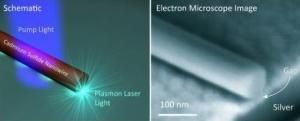
Electron microscope image of laser
© Xiang Zhang Lab, UC BerkeleyThe schematic on the left illustrates light being compressed and sustained in the 5 nanometer gap -- smaller than a protein molecule -- between a nanowire and underlying silver surface. To the right is an electron microscope image of the hybrid design shown in the schematic.
Researchers at the University of California, Berkeley, have reached a new milestone in laser physics by creating the world's smallest semiconductor laser, capable of generating visible light in a space smaller than a single protein molecule.

This breakthrough, described in an advanced online publication of the journal Nature on Aug. 30, breaks new ground in the field of optics. The UC Berkeley team not only successfully squeezed light into such a tight space, but found a novel way to keep that light energy from dissipating as it moved along, thereby achieving laser action.

Monkey Wrench

Brain changes may have led to Stone Age tools

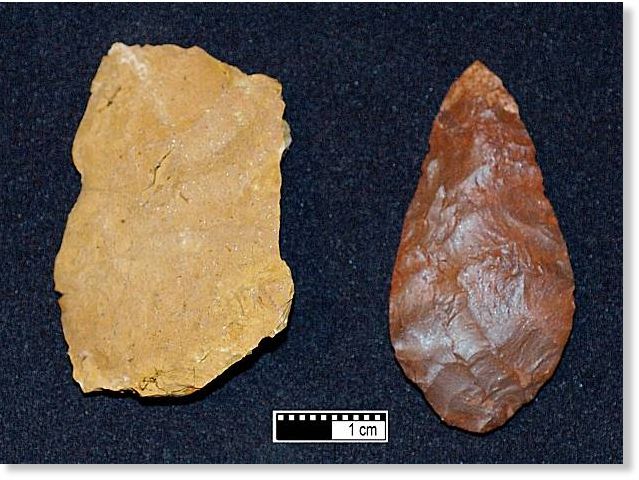
Stone Age Tools
© Kyle Brown / South African PaleoanthropologyScientists duplicated the process used to manufacture Stone Age tools by heating a chunk of yellowish rock called silcrete
Once upon a time in the long evolution of Homo sapiens, a band of our African ancestors learned to use fire for more than cooking meat, lighting the dark or warding off attacking animals.

Those Stone Age people became the world's first engineers - they discovered that the intense heat of a fire's embers could make chunks of stone much easier to flake for making tools, and to make them much sharper too.

It was "a breakthrough adaptation in human evolution," reports an international group of archaeologists and anthropologists. And it may have come about because of changes in those early human's brains, other scientists say.

What began at least 165,000 years ago became the most common method of stone toolmaking in Africa by about 72,000 years ago.

Cowboy Hat

Gold-plated horse head found in Germany

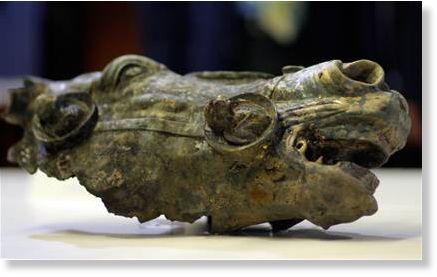
Gold-plated horse head
© Johannes Eisele / Reuters A horse's head, part of an approximately 2,000 years old rider's statue was found in an excavation site in Waldgirmes some 20 miles north of Frankfurt
Scientists say a Roman horse head made from bronze and plated in gold has been discovered at an archaeological site in Germany.

Hesse state archaeologist Egon Schallmeyer says the head is part of a horse and rider statue and "qualitatively one of the best (pieces) created at that time."

Evil Rays

New Look At Gravity Data Sheds Light On Ocean And Climate

Image
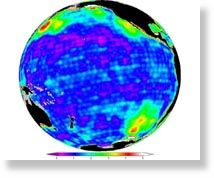
© NASAThis map shows changes in ocean bottom pressure measured by NASA's Gravity Recovery and Climate Experiment (Grace). Red shows where pressure varies by large amounts, blue where it changes very little.
A discovery about the moon made in the 1960s is helping researchers unlock secrets about Earth's ocean today. By applying a method of calculating gravity that was first developed for the moon to data from NASA's Gravity Recovery and Climate Experiment, known as Grace, JPL researchers have found a way to measure the pressure at the bottom of the ocean.

Just as knowing atmospheric pressure allows meteorologists to predict winds and weather patterns, measurements of ocean bottom pressure provide oceanographers with fundamental information about currents and global ocean circulation. They also hold clues to questions about sea level and climate.

"Oceanographers have been measuring ocean bottom pressure for a long time, but the measurements have been limited to a few spots in a huge ocean for short periods of time," says JPL oceanographer Victor Zlotnicki.

Launched in 2002, the twin Grace satellites map Earth's gravity field from orbit 500 kilometers (310 miles) above the surface. They respond to how mass is distributed in the Earth and on Earth's surface -the greater the mass in a given area, the stronger the pull of gravity from that area.

Telescope

Flashback To Neptune's Moon Triton

Image
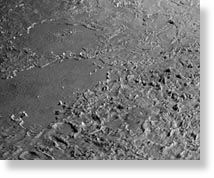
© NASA/JPL/Universities Space Research Association/Lunar and Planetary InstituteThis view of the volcanic plains of Neptune's moon Triton was produced using topographic maps derived from images acquired by NASA's Voyager spacecraft during its August 1989 flyby, 20 years ago this week.
Newly released images commemorate the 20-year anniversary of the Voyager flyby of Neptune's moon Triton on Aug. 24, 2009.

Triton was the last solid object visited by NASA's Voyager 2 spacecraft as it headed toward the edges of our solar system.

Triton, Neptune's largest moon, is one of the "coolest" objects in the solar system, literally, with a surface temperature of minus 235 degrees Celsius (minus 391 degrees Fahrenheit). Voyager 2 discovered that Triton has active geysers.

The images and a movie show the moon's sparsely cratered surface with smooth volcanic plains, mounds and round pits formed by icy lava flows.

Sun

Cygnus X-1: Still A "Star"

Image
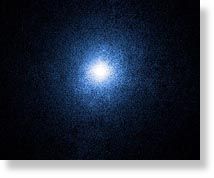
© NASA/CXC
Since its discovery 45 years ago, Cygnus X-1 has been one of the most intensively studied cosmic X-ray sources. About a decade after its discovery, Cygnus X-1 secured a place in the history of astronomy when a combination of X-ray and optical observations led to the conclusion that it was a black hole, the first such identification.

The Cygnus X-1 system consists of a black hole with a mass about 10 times that of the Sun in a close orbit with a blue supergiant star with a mass of about 20 Suns.

Gas flowing away from the supergiant in a fast stellar wind is focused by the black hole, and some of this gas forms a disk that spirals into the black hole. The gravitational energy release by this infalling gas powers the X-ray emission from Cygnus X-1.

Telescope

Trifid Nebula Triple Threat

Image
© ESOThe massive star factory known as the Trifid Nebula was captured in all its glory with the Wide-Field Imager camera attached to the MPG/ESO 2.2-meter telescope at ESO's La Silla Observatory in northern Chile. So named for the dark dust bands that trisect its glowing heart, the Trifid Nebula is a rare combination of three nebulae types that reveal the fury of freshly formed stars and point to more star birth in the future. The field of view of the image is approximately 12 x 16 arcminutes.
Astronomers at the European Southern Observatory (ESO), of which the UK's Science and Technology Facilities Council is a partner, have captured a stunning new image of the Trifid Nebula, showing just why it is a firm favorite of astronomers, amateur and professional alike.

This massive star factory is so named for the dark dust bands that trisect its glowing heart, and is a rare combination of three nebula types, revealing the fury of freshly formed stars and indicating more star birth.

Smoldering some 5,500 light-years away in the constellation of Sagittarius (the Archer), the Trifid Nebula presents a compelling portrait of the early stages of a star's life, from gestation to first light. The heat and "winds" of newly ignited, volatile stars stir the Trifid's gas and dust-filled cauldron; in time, the dark tendrils of matter strewn throughout the area will themselves collapse and form new stars.

The French astronomer Charles Messier first observed the Trifid Nebula in June 1764, recording the hazy, glowing object as entry number 20 in his renowned catalogue. Observations made about 60 years later by John Herschel revealed the dust lanes that appear to divide the cosmic cloud into three lobes, inspiring the English astronomer to coin the name "Trifid".


Question

Doctors Baffled, Intrigued by Girl Who Doesn't Age


Years Pass, but Brooke Greenberg Remains a Toddler. No One Can Explain How or Why.

"Why doesn't she age?" Howard Greenberg, 52, asked of his daughter. "Is she the fountain of youth?"

Such questions are why scientists are fascinated by Brooke. Among the many documented instances of children who fail to grow or develop in some way, Brooke's case may be unique, according to her doctor, Johns Hopkins School of Medicine pediatrician Lawrence Pakula, in Baltimore.

"Many of the best-known names in medicine, in their experience ... had not seen anyone who matched up to Brooke," Pakula said. "She is always a surprise."

Brooke hasn't aged in the conventional sense. Dr. Richard Walker of the University of South Florida College of Medicine, in Tampa, says Brooke's body is not developing as a coordinated unit, but as independent parts that are out of sync. She has never been diagnosed with any known genetic syndrome or chromosomal abnormality that would help explain why.

Battery

Airport travellers get a robot chauffeur

Driverless, battery-powered pod-cars will soon zip passengers around part of London's Heathrow Airport. The manufacturers of the Ultra personal rapid transit (PRT) system say it is the world's first public transport to balance the convenience of a taxi with the efficiency of a bus or light rail - albeit only for business passengers arriving at the world's third busiest airport.