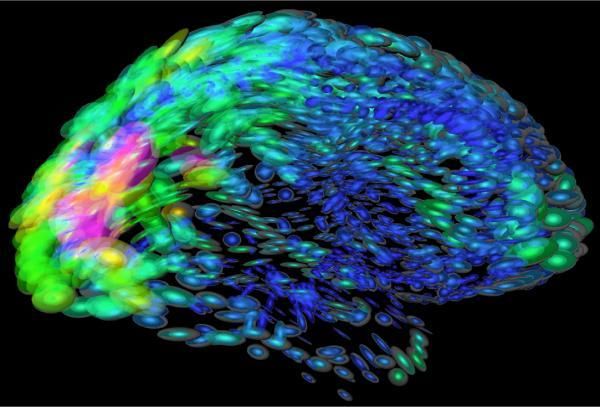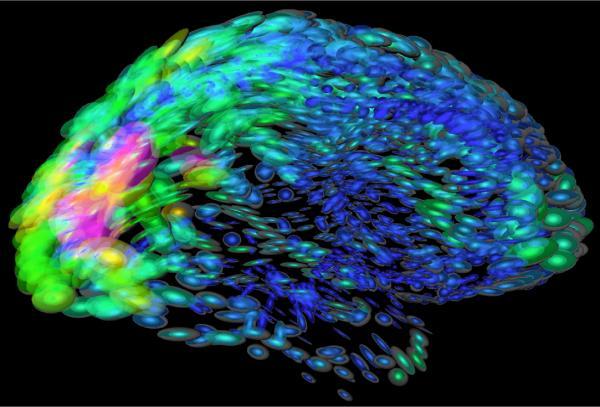
© Arthur Toga/UCLA School of MedicineNeuroscientists at the Massachusetts Institute of Technology in Cambridge, Mass., recently developed a way to turn off abnormally active brain cells using multiple colors of light.
Neuroscientists at the Massachusetts Institute of Technology have developed a powerful new class of tools to reversibly shut down brain activity using different colors of light. When targeted to specific neurons, they could potentially lead to new treatments for abnormal brain activity associated with disorders including chronic pain, epilepsy, brain injury and Parkinson's disease.
Such disorders could best be treated by silencing, rather than stimulating abnormal brain activity. These new tools, or 'super silencers,' exert exquisite control over the timing in which overactive neural circuits are shut down --an effect that is not possible with existing drugs or other conventional therapies.
The National Science Foundation's division of mathematical sciences supports the research through a grant to the Cognitive Rhythms Collaborative, which is comprised of four research groups in the Boston area focused on questions in neuroscience. The collaborative brings together researchers with expertise ranging from experimental design to mathematical modeling. The research paper, "High-Performance Genetically-Targetable Optical Neural Silencing by Light-Driven Proton Pumps," appears in the Jan. 7 issue of the journal
Nature.