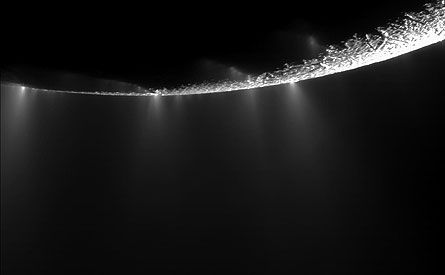
© JPL/NASA, Space Science InstituteThe new Cassini images reveal more than 30 individual jets of water ice and vapor emanating from fissures near the south pole of Saturn's moon Enceladus. More than 20 of these jets had not been seen previously.
New close-ups of Saturn's icy moon Enceladus taken by the Cassini spacecraft during a November flyby and released by NASA February 23 provide fresh evidence that the moon's interior may be hospitable to life.
Cassini observed some 30 small jets of water vapor and water ice spewing from the southern hemisphere of Enceladus, about 20 more than previously seen. In addition, the most detailed infrared map of one of the south pole's fissures, where jets emanate, indicates that the surface temperature there might be as high as 200 kelvins (-73º Celsius), or about 20 kelvins warmer than previously estimated.
Although the temperature estimate is not yet definitive, the hotter the surface temperature, the hotter the moon's interior, notes Cassini imaging team leader Carolyn Porco of the Space Science Institute in Boulder, Colo. That "strengthens the evidence for liquid water as the source of the jets," she says, upping the chances that life could be present in at least part of the moon's interior.