Science & TechnologyS


Saturn

International Team of Scientists Reports Discovery of a New Planet

Image
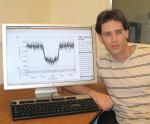
© George FoulshamAvi Shporer with a graph
that shows how the observed
light intensity emanating from a star
drops when the newly discovered
planet moves in front of the star.
Santa Barbara, California - - An international team of scientists, including several who are affiliated with UC Santa Barbara, has discovered a new planet the size of Jupiter. The finding is published in the March 18 issue of the journal Nature.

The planet, called CoRoT-9b, was discovered by using the CoRoT space telescope satellite, operated by the French space agency, The Centre National d'Études Spatiales, or CNES. The newly discovered planet orbits a star similar to our sun and is located in the constellation Serpens Cauda, at a distance of 1500 light-years from Earth.

Radar

Wrong religion: Israeli ruins re-identified

Site was a winter palace used by Muslim caliphs, not an ancient synagogue

Jerusalem - Israeli archaeologists have announced that ruins long thought to be of an ancient synagogue are actually the remains of a palace built by Arab caliphs 1,300 years ago.

The site, on the banks of the Sea of Galilee, was identified as a synagogue in the 1950s because archaeologists found a carving of a menorah, a seven-armed candelabra that is a Jewish symbol. But scholars said in a report published this week that the identification was an error, and that the site was a winter palace used by the caliphs of the Umayyad dynasty, the same rulers who built Jerusalem's gold-capped Dome of the Rock.

Early Arab historians had described the palace, calling it al-Sinnabra, but its location was previously unknown.

Health

Genetic Discovery Promises Healing Without Scars

Image
© guardian.co.ukA white mouse, of the kind scientists use in laboratory experiments.
Human regeneration has to date been the preserve of science fiction. But mammals may have a dormant ability to regrow healthy tissue, research suggests, possibly paving the way for scar-free healing at some point in the future.

Biologists believe that a gene called p21 may hold the key to spontaneous healing, which could allow limited regeneration of the human body, as witnessed in newts, flatworms and the hydra.

It is thought that in mammals this healing potential has been lost through evolution, but may lie dormant in cells and could be reactivated by switching off the p21 gene. Mice engineered in the laboratory to lack the p21 gene, were able to renew surgically removed tissue so that no trace of an injury remained.

Removing p21 causes adult cells to behave like stem cells - those cells in embryos with a "pluripotent" power to become any kind of tissue.

Cult

Racism is linked to Religious dogmatism

excluded egg
© Unknown
Religious people can be racist, and that's not news. But are they more likely to be racist than non-religious people? A new study now confirms this hypothesis.

The February issue of Personality and Social Psychology Review has published a meta-analysis of 55 independent studies conducted in the United States which considers surveys of over 20,000 mostly Christian participants. Religious congregations generally express more prejudiced views towards other races. Furthermore, the more devout the community, the greater the racism.

Satellite

Cassini Cruises By Saturn's Moon Rhea

Image
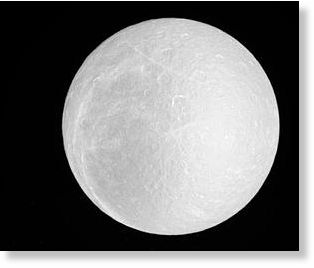
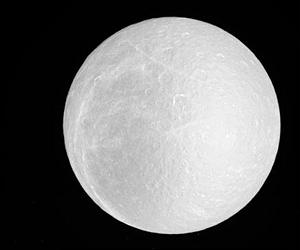
© NASA/JPL/Space Science InstituteThis picture was taken on March 02, 2010 and received on Earth March 03, 2010. The camera was pointing toward RHEA at approximately 38,532 kilometers away, and the image was taken using the CL1 and CL2 filters. This image has not been validated or calibrated. A validated/calibrated image will be archived with the NASA Planetary Data System in 2011.
Cassini's closest-ever flyby of Saturn's moon Rhea went quite smoothly and teams are busy checking out their data! These flybys never fail to amaze me. And the raw images - which give us an unprocessed first look - are really cool!

Raw image N00152150 gives us a view of part of the bright, fractured terrain we refer to as "wispy terrain" from about 14,000 kilometers (8,900 miles) away. We know that Rhea's albedo overall is quite high. (When I say "albedo," I basically mean "brightness" or "reflectivity." Studying the albedo can tell a lot about surface composition, geologic processes, and interactions with external environment.)

But this image demonstrates how bright these cracks are since they are so shiny that the surrounding terrain looks quite dark. There are also some interesting apparent albedo variations seen in this image, which are really intriguing.

This raw image (N00152175) from Cassini's narrow-angle camera image was taken about 40 minutes after closest approach. The image shows a region adjacent to the wispy terrain -craters, craters everywhere! And wow, are those crater rims bright compared to the surrounding terrain.

Camera

New Lunar Images And Data Available To Public

Image
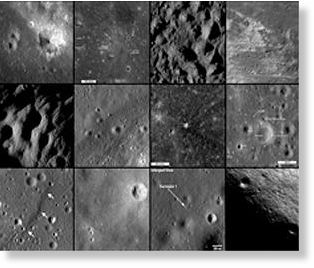
© NASA/GSFC/ASUThe seven instruments aboard the Lunar Reconnaissance Orbiter provide varied and unique datasets. This photo album published in concert with the first major public data release, gives a small taste of each instrument's measurements and highlights some of the notable early achievements of the mission.
The public can follow along with NASA on its journey of lunar discovery. On March 15, the publicly accessible Planetary Data System will release data sets from the seven instruments on board NASA's Lunar Reconnaissance Orbiter.

"The Planetary Data System is a NASA funded program to archive data from past and present planetary missions as well as astronomical observations and laboratory data," said Dr. John Keller, LRO Deputy Project Scientist from NASA Goddard Space Flight Center in Greenbelt, Md.

"The purpose of the Planetary Data System is to make available to the public the fruits of NASA funded research and to allow advanced research on solar system science."

Each of the seven instruments is unique and will provide data in different formats to the Planetary Data System. Much of the data will be in a relatively low level form, not highly processed, which allows researchers to maximize flexibility in working with the data.

Blackbox

Are Venus and Earth in a long-distance relationship?

Image
© CorbisTurn and face us
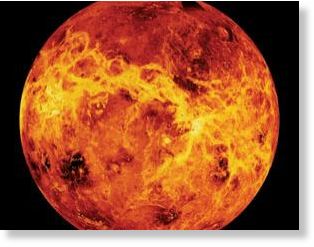
The heart of Venus may belong to Earth. Our planet could be tugging on the core of Venus, exerting control over its spin.

Whenever Venus and Earth arrive at the closest point in their orbits, Venus always presents the same face to us. This could mean that Earth's gravity is tugging subtly on Venus, affecting its rotation rate. That idea, raised decades ago, was disregarded when it turned out that Venus is spinning too fast to be in such a gravitational "resonance".

But Earth could still be pulling on Venus by controlling its core, according to calculations by Gérard Caudal of the University of Versailles-Saint Quentin, France.

Caudal made large assumptions about Venus's interior, which we know little about. For his hypothesis to be correct, the planet would, like Earth, need a solid core surrounded by a liquid layer. This could allow the solid core to rotate slower than the rest of the planet. The core would also have to be asymmetric or heterogeneous, so that Earth can exert a variable tug as Venus spins. "For the resonance to be possible, there should be something that the gravity of the Earth could grasp," Caudal says.

Telescope

Jupiter's spot seen glowing

Image
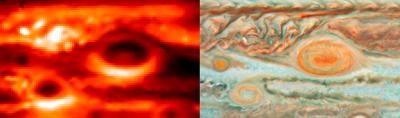
© ESO/NASA/JPL/ESA/L. FletcherNew thermal images from ESO's Very Large Telescope (VLT) and other ground-based telescopes show swirls of warmer air and cooler regions never seen before within Jupiter’s Great Red Spot. The images enable scientists to make the first detailed weather map of the inside of the giant storm system. One observation illustrated by this image is the correspondence between a warm core within an otherwise cold storm system and the reddest colour of the Great Red Spot. The image on the left was obtained with the VISIR on the VLT in Chile on May 18, 2008. It was taken in the infrared wavelength range of 10.8 microns, which is sensitive to Jupiter's atmospheric temperatures in the 300 to 600 millibar pressure range. That pressure range is close to the altitude of the white, red and brown aerosols seen in the visible-light image on the right, which was obtained by the NASA/ESA Hubble Space Telescope on May 15, 2008. These images show the interaction of three of Jupiter's largest storms -- the Great Red Spot and two smaller storms nicknamed Oval BA and Little Red Spot.
"This is our first detailed look inside the biggest storm of the Solar System," says Glenn Orton, who led the team of astronomers that made the study. "We once thought the Great Red Spot was a plain old oval without much structure, but these new results show that it is, in fact, extremely complicated."

The observations reveal that the reddest colour of the Great Red Spot corresponds to a warm core within the otherwise cold storm system, and images show dark lanes at the edge of the storm where gases are descending into the deeper regions of the planet. The observations, detailed in a paper appearing in the journal Icarus, give scientists a sense of the circulation patterns within the solar system's best-known storm system.

Info

Western researcher solves 37-year old space mystery

A researcher from The University of Western Ontario has helped solve a 37-year old space mystery using lunar images released yesterday by NASA and maps from his own atlas of the moon.

Phil Stooke, a professor cross appointed to Western's Departments of Physics & Astronomy and Geography, published a major reference book on lunar exploration in 2007 entitled, "The International Atlas of Lunar Exploration."

Info

How Seismographs Work

Image
© Dreamstime
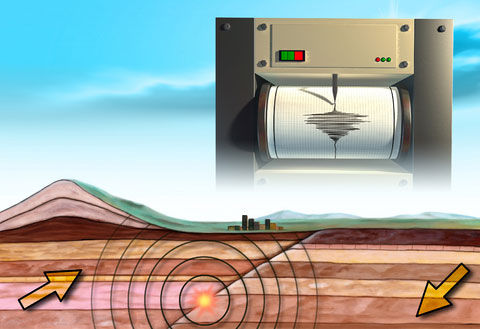
Scientists who weren't in Chile during this morning's aftershocks nevertheless knew the moment the rumbling started, thanks to a global network of quake-detecting instruments called seismographs.

Seismographs are securely mounted to the surface of the Earth, so when the ground starts shaking, the instrument's case moves.

What doesn't move, however, is a suspended mass inside the seismograph, called the seismometer. During an earthquake, the seismometer remains still while the case around it moves with the ground shaking.