Science & TechnologyS


Rocket

Britain launches first space agency

Image
© UKSA
Britain launched its own space agency Tuesday with the help of home-grown astronaut Major Timothy Peake, aimed at boosting the country's multi-billion-pound space technology industry.

While Peake may be its only astronaut, Britain is a world leader in areas such as robotics, satellites and telecommunications, which contribute about six billion pounds (nine billion dollars, 6.7 billion euros) a year to the economy.

The new UK Space Agency, complete with a logo depicting the Union flag morphed into a soaring arrow, will manage what is now a loose partnership of government departments and research councils dealing with space.

About 68,000 people are employed directly or indirectly in the industry and Business Secretary Peter Mandelson said it was "exactly the kind of high value-added industry we need to support".

Meteor

Office worker stares off into space... and is the only man on Earth to see exploding comet

Image
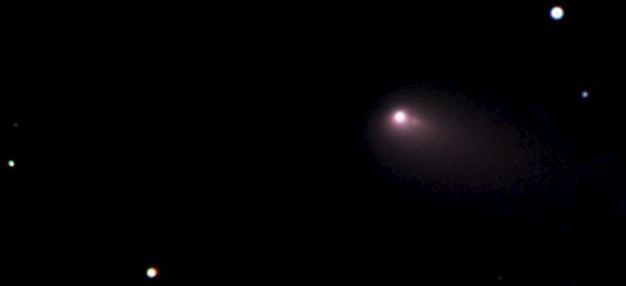
© UnknownCaught on camera: Siding Spring comet breaking up 100 million miles from Earth. The chunk that can be seen behind the comet is said to be the size of Mount Everest

An amateur stargazer has captured the moment a comet exploded in space - an event missed by the world's professional astronomers.

Musical instrument designer Nick Howes, 40, used the internet to access an online telescope as he sat at his desk in his office.

Mr Howes, of Cherhill near Calne, Wilts, logged on to a telescope in Hawaii and began staring into deep space. But he spotted a massive comet breaking up and was able to use the telescope to take photos.

Nick, who works for Yamaha, actually captured the moment the comet exploded, blowing a chunk the size of Mount Everest off one side.

He was the only person in the world to witness the dramatic event - with even American astronomers completely missing the opportunity.

Info

Planetary Proportions Revealed in 3D - After a 20-year-long study

3D Earth
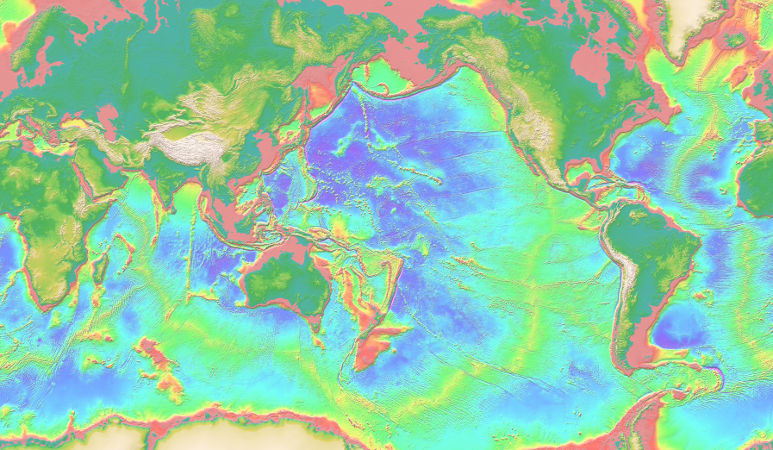
© D. Sandwell / Scripps Institute of Oceanography / W. H. F. Smith / NOAAA new model uses measurements from mid-ocean ridges (yellow and green) to precisely describe the movements of interlocking tectonic plates that make up about 97 percent of the Earth's surface.
Two decades of hard work have finally paid off for a collaboration of researchers from the University of Wisconsin-Madison, the Rice University, and the NASA Jet Propulsion Laboratory (JPL). Geophysicist Chuck DeMets (UWM), alongside colleagues Richard Gordon (Rice) and Donald Argus (JPL), has managed to produce an image of the dynamic 3D puzzle that is the crust of our planet. The investigation has covered 25 tectonic plates in continuous interaction, and 97 percent of the planet's surface, the team says.

"This model can be used to predict the movement of one plate relative to any other plate on the Earth's surface. Plate tectonics describes almost everything about how the Earth's surface moves and deforms, but it's remarkably simple in a mathematical way," the team leader says. "We live on a dynamic planet, and it's important to understand how the surface of the planet changes. The frequency and magnitude of earthquakes depend upon how the tectonic plates move. Understanding how plates move can help us understand surface processes like mountain-building and subsurface processes like mantle convection," Gordon adds.

Though it appears extremely solid, the Earth's crust is in fact moving constantly atop the ocean of magma that is the planet's upper mantle. The crust is not made of a single piece, but out of a lot more, each of different sizes. There are a few impressively large tectonic plates, such as the one under the Pacific Ocean, the Eurasian one, the African one, and so on. There are, however, a myriad of smaller plates, each of them engaged in various collision or separation processes with their neighbors. Studying the interactions between these formations could give researchers some clues as to where the next earthquakes might hit, and which volcanoes may blow their tops off.


Hourglass

Archaeological site found near mosque in West Bank

Image
© Ma'an image
Palestinian Authority security forces discovered several archeological sites belonging under a mosque in the Kefreet village in the West Bank

A police statement said the remains of an Islamic building were found when an excavation for the mosque's renovation was underway. Palestinian archeologists said the remains likely date back to the Ottoman era, the statement added.

Magnify

Lotus Temple Excavated

Image
© StarArchaeologists excavate the 1,400-year-old Buddhist Lotus Temple at the Wari-Bateshwar dig in Narsingdi.
In Wari-Bateshwar of Narsingdi, archaeologists have recently excavated a 1,400-year-old Lotus Temple, the first proof of flourishing of Buddhism in the region.

The brick-built temple constructed around seventh or eighth century--as evidenced by its structure and the size and shapes of the bricks and other finds excavated at Mandirvita at Dhupirtek of Shibpur in the district--suggests existence of a Buddha Vihara there, they said.

"This is the first ever proof that Buddhism flourished and was practised in Wari-Bateshwar region of Madhupur tract," said Prof Sufi Mostafizur Rahman, who is leading the excavation team comprised of researchers from archaeological research centre Oitihya Onneswan, teachers and students of archaeology department of Jahangirnagar University.

Info

University of Kansas Researcher Investigates Mysterious Stone Spheres in Costa Rica

Image
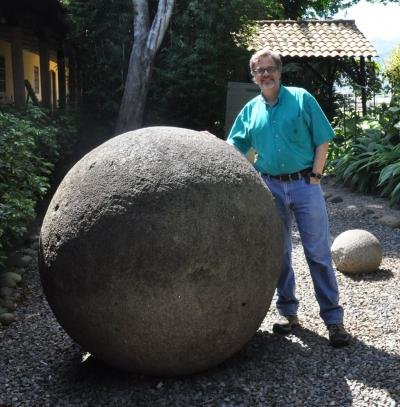
© Courtesy of John HoopesJohn Hoopes, University of Kansas associate professor of anthropology and director of the Global Indigenous Nations Studies Program, recently returned from a trip to Costa Rica where he and colleagues evaluated ancient stone spheres for UNESCO, the United Nations cultural organization that might grant the spheres World Heritage Status.
The ancient stone spheres of Costa Rica were made world-famous by the opening sequence of Raiders of the Lost Ark, when a mock-up of one of the mysterious relics nearly crushed Indiana Jones.

So perhaps John Hoopes is the closest thing at the University of Kansas to the movie action hero.

Hoopes, associate professor of anthropology and director of the Global Indigenous Nations Studies Program, recently returned from a trip to Costa Rica where he and colleagues evaluated the stone balls for UNESCO, the United Nations cultural organization that might grant the spheres World Heritage Status.

His report will help determine if sites linked to the massive orbs will be designated for preservation and promotion because of their "outstanding value to humanity."

Magnify

DNA experts reveal China's ancient open door to West

Image
© Liu Yu Sheng/NYT/Complimentary A 3,800-year-old mummy, known as the Beauty of Xiaohe.
For four millennia their secrets lay hidden beneath the desert sands, the final resting place of a mysterious civilisation. And since their discovery in 1934, the Tarim mummies in China have perplexed historians ad archaeologists.

But a remarkable new study has found that the origins of the inhabitants of the ancient graveyard in the Taklimakan desert north of Tibet lie in Europe.

A team of Chinese geneticists have analysed the DNA of the Bronze Age cadavers and found that they are of mixed ancestry, displaying both European and Siberian genetic markers.

Sun

Study explores link between sunlight, multiple sclerosis

Madison - For more than 30 years, scientists have known that multiple sclerosis (MS) is much more common in higher latitudes than in the tropics. Because sunlight is more abundant near the equator, many researchers have wondered if the high levels of vitamin D engendered by sunlight could explain this unusual pattern of prevalence.

Vitamin D may reduce the symptoms of MS, says Hector DeLuca, Steenbock Research Professor of Biochemistry at University of Wisconsin-Madison, but in a study published in PNAS this week, he and first author Bryan Becklund suggest that the ultraviolet portion of sunlight may play a bigger role than vitamin D in controlling MS.

Info

Seeing a bionic eye on medicine's horizon

Image
© AFTAUThese are two rat neuronal cells bound to a rough carbon nanotube mat.
Television's Six Million Dollar Man foresaw a future when man and machine would become one. New research at Tel Aviv University is making this futuristic "vision" of bionics a reality.

Prof. Yael Hanein of Tel Aviv University's School of Electrical Engineering has foundational research that may give sight to blind eyes, merging retinal nerves with electrodes to stimulate cell growth. Successful so far in animal models, this research may one day lay the groundwork for retinal implants in people.

But that's a way off, she says. Until then, her half-human, half-machine invention can be used by drug developers investigating new compounds or formulations to treat delicate nerve tissues in the brain. Prof. Hanein's research group published its work recently in the journal Nanotechnology.

Family

Stem cells used to rebuild boy's windpipe

airway reconstruction
© PAThe stem cells are now reconstructing the airway and ensuring it is not rejected by his immune system

A British boy has undergone a groundbreaking operation involving the transplantation of a windpipe that is being regenerated inside his body using his own stem cells.

Scientists described the procedure, carried out on Monday at Great Ormond Street Hospital, as a "milestone moment" in the development of techniques that could allow people to rebuild damaged or transplanted organs inside their bodies.

The operation, which lasted nearly nine hours, involved the removal of the boy's faulty trachea - the bony tube that connects the nose, mouth and lungs - which was replaced with a donor windpipe.