Science & Technology
That makes it hard for companies to use the micro-blogging site as an accurate gauge of public opinion, the Harvard Business School study showed.
Twitter Inc is a social networking website in which users post messages of 140 characters or less -- known as "tweets" -- that can be viewed by other users who elect to follow them.
The Harvard study examined public entries of a randomly selected group of 300,000 Twitter users. The researchers studied in May the content created in the lifetime of the users' Twitter accounts.
Nobody advocated a full-on web voting system that would allow voting from any web browser. Instead, the emphasis was on more modest steps, aimed specifically at overseas voters. Overseas voters are a good target population, because there aren't too many of them -- making experimentation less risky -- and because vote-by-mail serves them poorly.
Discussion focused on two types of systems: voting kiosks, and Internet transmission of absentee ballots.

Colour image of supernova SN 2008ha taken on 2008 December 30 at Calar Alto Observatory, with the Zeiss 2.2m Telescope and camera CAFOS. It is a composite of the B, V and R bands. The SN is the faint reddish dot marked with an arrow. The quite irregular shape of the galaxy UGC 12682, that hosts the supernova, is seen at the centre of the image
The total energy suddenly released by such a typical supernova exceeds the total energy release of the Sun during its whole past and future life time of 10 billion years.
However, some core-collapse supernovae are up to 100 times less energetic and luminous than usual. These low-power explosions normally show the presence of hydrogen gas, but a new event, supernova SN 2008ha, is the first dim supernova in which no hydrogen could be detected. This research has been performed by an international team lead by the Italian astronomer Stefano Valenti (Queen's University in Belfast, United Kingdom), including scientists from Max Planck Institute for Astrophysics (Germany), the National Institute for Astrophysics (Italy), and various other institutions.

The object responsible for the mysterious brightening seen in 2006 (right) is ordinarily too dim to detect (left).
The object, called SCP 06F6, was first spotted in the constellation Bootes in February 2006 in a search for supernovae by the Hubble Space Telescope. The object flared to its maximum brightness over about 100 days, a period much longer than most supernovae, which do so in just 20 days.
Further analysis of the object's spectrum in 2008 offered no more clues: SCP 06F6 seemed to resemble no known object, and astronomers couldn't even say whether the event originated in the Milky Way or beyond.

This image shows the area of sky around the Arietid radiant (indicated by a red dot) as seen from mid-northern latitudes at 4 a.m. on June 7th or 8th.
Every year in early June, hundreds of meteors streak across the sky. Most are invisible, though, because the sun is above the horizon while the shower is most intense. These daylight meteors are called the Arietids. They stream from a radiant point in the constellation Aries, which lies just 30 degrees from the Sun in June.
Arietid meteoroids hit Earth's atmosphere with a velocity of 39 km/s (87,000 mph). No one is sure where these meteoroids come from. Possibilities include sungrazing asteroid 1566 Icarus, Comet 96P/Machholz, and the Kreutz family of sungrazing comets. The debris stream is quite broad: Earth is inside it from late May until early July. In most years, the shower peaks on June 7th or 8th.

The South Pole Telescope at the Amundsen-Scott South Pole Station in Antarctica. Antarctica has possibly the clearest skies on Earth
Michael Ashley of the University of New South Wales in Sydney, Australia, and his colleagues wanted to find the best sites for astronomy on the Antarctic plateau. Combining observations from satellites and ground stations with climate models, they evaluated different factors that affect telescope vision, such as the amount of water vapour, wind speeds and atmospheric turbulence.
The team found that the plateau offers world-beating atmospheric conditions - as long as telescopes are raised above its frozen surface. The ice makes the lowest layers of air on the plateau much colder than those above, forming an "inversion layer" that, together with the strong local winds, can lead to severe turbulence. This would blur a telescope's images.
Brother Guy Consolmagno occupies a small space of heaven. A Jesuit brother and astronomer for the Vatican Observatory, he works at the observatory's headquarters at the pope's summer palace in Castel Gandolfo, a 45-minute train ride from Rome.
Castel Gandolfo sits on the high ground of Italy's Lazio region, perched above the exotic, sapphire-blue volcanic Lake Albano. The view you get is magical. "This is a good place for things like an occultation, like the transit of Venus in 2004," Consolmagno says. "We observed the comet hitting Jupiter because the first events were visible only from this part of the world."
Below the observatory's domed chamber are the offices that make up the rest of the Vatican Observatory. One study has bookshelves filled with hardbound journals all the way to the high ceiling. Consolmagno pulls one off a shelf and reads aloud: "Account of a new telescope by Mr. Isaac Newton." He shows me, then smiles. "I think he has a future," he says.
In just four months, Mohamed Altoumaimi has found a formula to explain and simplify the so-called Bernoulli numbers, a sequence of calculations named after the 17th century Swiss mathematician Jacob Bernoulli, the Dagens Nyheter daily said.
Altoumaimi, who came to Sweden six years ago, said teachers at his high school in Falun, central Sweden were not convinced about his work at first.
"When I first showed it to my teachers, none of them thought the formula I had written down really worked," Altoumaimi told the Falu Kuriren newspaper.
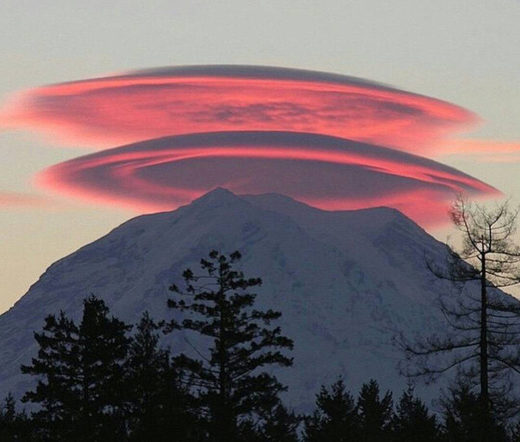
The British cloud enthusiast said he began getting photos of "dramatic" and "weird" clouds (including the above) in 2005 that he didn't know how to define.