
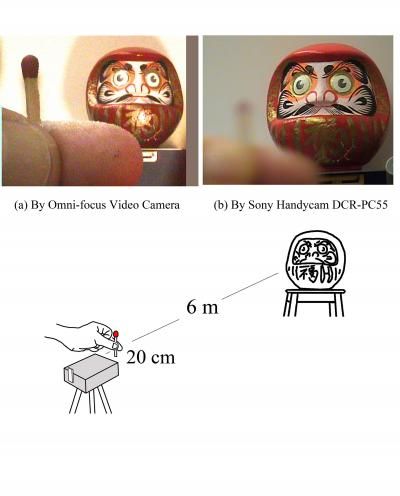
© University of TorontoThe resulting image shown in Figure 1a (taken with a prototype using two-color video cameras) clearly demonstrates how the omni-focused output dramatically differs from that of a conventional camera, shown in Figure 1b. Note that in the omni-focused image, the fingers in the foreground are so sharply focused that even the fingerprints are easily recognized.
Inventor and principal investigator of the Omni-focus video camera, Professor Keigo Iizuka of The Edward S. Rogers Sr. Department of Electrical and Computer Engineering, explains that, "the intensity of a point source decays with the inverse square of the distance of propagation. This variation with distance has proven to be large enough to provide depth mapping with high resolution. What's more, by using two point sources at different locations, the distance of the object can be determined without the influence of its surface texture." This principle led Professor Iizuka to invent a novel distance-mapping camera, the Divergence-ratio Axi-vision Camera, abbreviated "Divcam," which is a key component of the new Omni-focus Video Camera.
The Omni-focus Video Camera is produced in collaboration with consulting investigator Dr. David Wilkes, president of Wilkes Associates, a Canadian high-tech product development company. It contains an array of color video cameras, each focused at a different distance, and an integrated Divcam. The Divcam maps distance information for every pixel in the scene in real time. A software-based pixel correspondence utility, using prior intellectual property invented by Dr. Wilkes, then uses the distance information to select individual pixels from the ensemble of outputs of the color video cameras, and generates the final "omni-focused" single-video image.
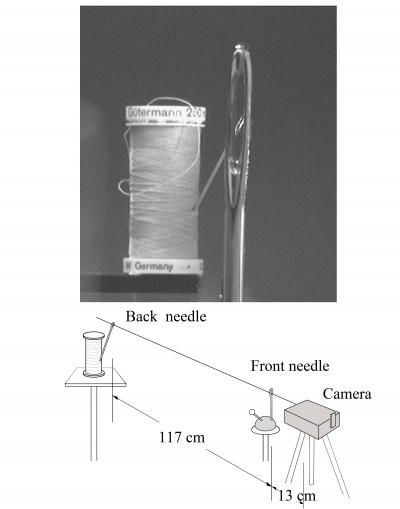
© University of TorontoFigure 2 illustrates the omni-focus video camera’s high pixel resolution. Although the two sewing needles were photographed approximately 1.2 meters apart, both are in sharp focus. Note the eye of the back needle, is actually viewed through the eye of the front needle.
The camera is still in the research phase. But it's not difficult to imagine how far-reaching an impact the Omni-focus Video Camera could have on several industries. As for the future direction of his research, Professor Iizuka sees the following possibilities:
1. Application of the Omni-focus Video Camera to TV studio cameras. Consider the example of a musical concert being televised by a major network. Even though the singer is in sharp focus, band members in the background, are invariably out of focus. Conventional video cameras are unable to focus simultaneously on both the singer and band members in the background. The Omni-focus Video Camera removes this limitation to deliver higher-quality video images and improved quality of experience to potentially millions of TV viewers, worldwide.
2. Application of the Omni-focus Video Camera to medicine. Says Professor Iizuka, "I'd like to apply the principle of the Omni-focus Video Camera to the design of a laparoscope. It would help doctors at the operating table, if they can see the entire view without touching optics of the laparoscope, especially if dealing with a large lesion."



The effect that such a camera would have is to make scenes look more 2D. The human eye can only focus on one thing at a time, and if it's focusing on a distant object, very close objects in the foreground will be out of focus. This helps give depth to the scene. Similarly, conventional cameras can only focus on one thing at a time, emulating the human eye, and giving scenes a more 3D look. Therefore having everything simultaneously in focus would actually diminish the 3D effect of a scene, and would actually be a negative in most instances, at least for the creative industry.