Science & TechnologyS


Robot

The robot journalist: An apocalypse for the news industry?

Image
© AlamyStories generated by Narrative Science will not be winning many Pulitzers, but will pass the Turing test of making one unsure whether they are written by person or machine
A set of algorithms which take data and turn it into words began as an experimental lab, but now appear on Forbes.com

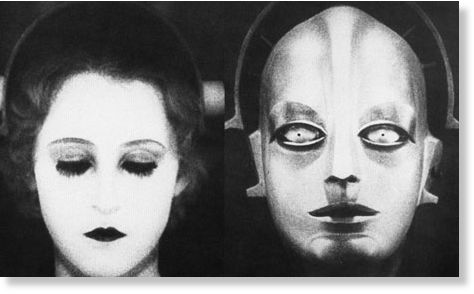
Visit the website of Forbes.com and read the earnings forecasts for the New York Times Company, and you will notice the byline "By Narrative Science". Normally you have to open a copy of Wallpaper* to find someone with such a florid monicker. Except of course Narrative Science is not a person but a robot journalist - actually a set of algorithms which take data and turn it into words.

What started as an experimental lab at Northwestern University with journalists and technologists working together is now a fully-fledged business that turns data into stories of a type which will not be winning many Pulitzers, but which certainly pass the Turing test of making one unsure whether they were written by a person or machine. The lovable "stats monkey", which came from the same series of research experiments, does the same for sports stories, without the attendant vet bills, bananas and spelling errors associated with employing a real monkey.

Although this algorithmic approach to compiling stories is by no means new - the lab which spawned Narrative Science was conducting and publishing work a number of years ago - the ultimate ramifications of what the approach symbolises seem to be taking a long time to sink into most newsgathering organisations.

Airplane

American Airlines grounds entire fleet: Computer glitch

American Airlines
© BoeingAmerican Airlines 737-800 Eco Demonstrator in Flight
American Airlines has resumed at least some flights after a computer glitch forced it to ground all of its flights for several hours this afternoon (April 16).

The carrier resumed some flights right around 5 p.m. ET, but warned "we expect continued flight delays and cancellations throughout the remainder of the day."

More than 730 flights on American and regional affiliate American Eagle had been canceled as of 4:15 p.m. ET, according to flight-tracking service FlightAware. An additional 738 American flights were delayed today because of the glitch.

"This is a major outage for American and is the longest flight disruption as a result of a failure of an airline's back-end technology in recent history," FlightAware CEO Daniel Baker says to Today in the Sky. "It is likely to affect over 125,000 travelers today and tomorrow. United had a few similar outages last year, some as a result of the Continental/United merger and related technology fallout, but none were nearly as long as this" problem, which lasted more than 5 hours.

Info

Business suit turns transparent when wearer lies

Designer and innovator Daan Roosegaarde is known for his exciting projects such as the glow-in-the-dark Smart Highway and the Intimacy project, the interactive dress that becomes transparent in response to social encounters. In a recent interview at Design Indaba, Roosegaarde revealed that his company is taking the Intimacy project to a new direction.

Studio Roosegaarde will be working on business suits for men that turn transparent when they lie. The studio will work with high-end fashion designers to create new products for this new line of Intimacy.

Watch this interview of Daan Roosegaarde as he talks about his studio's latest projects.


Dominoes

Supreme Court hears oral arguments in breast cancer gene patent case

Image
© Shutterstock
The Supreme Court heard oral arguments on Monday in a challenge by a contingent of breast cancer patients and women's health organizations against a Utah company's claim to being able to patent human genes.

Bloomberg News reported that the high court used analogies like chocolate-chip recipes in discussing the case, stemming from a 2009 suit filed by the American Civil Liberties Union (ACLU) against Myriad Genetics for filing patents on two genes connected with increased risk of breast and ovarian cancer.

According to NBC News, mutations in the genes, BRCA1 and BRCA2, can lead to an 85 percent risk of breast cancer and a possible 50 percent risk of ovarian cancer.

Justice Antonin Scalia expressed concern during the discussion for the potential impact of the lawsuit on companies' ability to conduct research.

Info

High glucose levels could impair ferroelectricity in body's connective tissues

Ferroelectirc
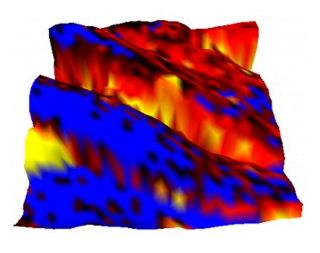
© Jiangyu Li/UWThe blue spots in this image show where glucose has halted ferroelectric switching in an elastin protein.
High sugar levels in the body come at a cost to health. New research suggests that more sugar in the body could damage the elastic proteins that help us breathe and pump blood. The findings could have health implications for diabetics, who have high blood-glucose levels.

Researchers at the University of Washington and Boston University have discovered that a certain type of protein found in organs that repeatedly stretch and retract - such as the heart and lungs - is the source for a favorable electrical property that could help build and support healthy connective tissues. But when exposed to sugar, some of the proteins no longer could perform their function, according to findings published online April 15 in the journal Physical Review Letters.

The property, called ferroelectricity, is a response to an electric field in which a molecule switches from having a positive to a negative charge. Only recently discovered in animal tissues, researchers have traced this property to elastin and found that when exposed to sugar, the elastin protein sometimes slows or stops its ferroelectric switching. This could lead to the hardening of those tissues and, ultimately, degrade an artery or ligament.

"This finding is important because it tells us the origin of the ferroelectric switching phenomenon and also suggests it's not an isolated occurrence in one type of tissue as we thought," said co-corresponding author Jiangyu Li, a UW associate professor of mechanical engineering. "This could be associated with aging and diabetes, which I think gives more importance to the phenomenon."

Comet

Starwatch: Cassiopeia and the comet

Image
© Finbarr Sheahy
The crescent Moon stands in the W at nightfall on the 15th, above and left of the conspicuous Jupiter. Meanwhile, Saturn is climbing clear of the ESE horizon as it approaches opposition on the 28th. Look for Saturn close to the full Moon on the 25th when a slight partial lunar eclipse may darken the N fringe of the Moon's disc at the very beginning of the night.

The constellation of Cassiopeia is at its best as it swims overhead in the middle of our autumn nights, its bright "W" of stars almost drowned in the Milky Way if we are lucky enough to view it against a dark moonless sky. Six months later we find it some 30° high in Britain's NNW sky at nightfall and swinging below Polaris in the N overnight to stand more than 30° high in the NE before dawn. Like the Plough, it is circumpolar from our latitudes so that it never dips below the horizon.

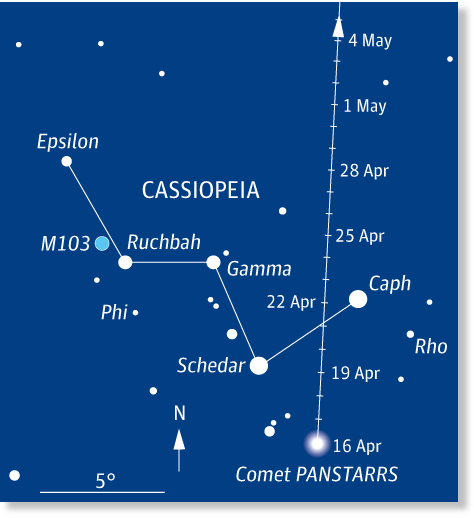
Also circumpolar as it passes through Cassiopeia is the comet of the moment, Comet PANSTARRS, which is fading and receding from the Sun and the Earth after its perihelion on 10 March. Our chart shows its northwards progress between the stars Schedar and Caph in the "W" over the coming days, with ticks marking its position at 00:00 BST each day. Next Saturday night, for example, it lies almost in line between Schedar and Caph, though we probably need binoculars or a telescope to glimpse it.

Magnify

Weird Life: 'Shadow Biosphere' theory gaining scientific support

scientist vial
© Shutterstock
Never mind aliens in outer space. Some scientists believe we may be sharing the planet with 'weird' lifeforms that are so different from our own they're invisible to us.

Across the world's great deserts, a mysterious sheen has been found on boulders and rock faces. These layers of manganese, arsenic and silica are known as desert varnish and they are found in the Atacama desert in Chile, the Mojave desert in California, and in many other arid places. They can make the desert glitter with surprising colour and, by scraping off pieces of varnish, native people have created intriguing symbols and images on rock walls and surfaces.

How desert varnish forms has yet to be resolved, despite intense research by geologists. Most theories suggest it is produced by chemical reactions that act over thousands of years or by ecological processes yet to be determined.

Professor Carol Cleland, of Colorado University, has a very different suggestion. She believes desert varnish could be the manifestation of an alternative, invisible biological world. Cleland, a philosopher based at the university's astrobiology centre, calls this ethereal dimension the shadow biosphere. "The idea is straightforward," she says. "On Earth we may be co-inhabiting with microbial lifeforms that have a completely different biochemistry from the one shared by life as we currently know it."

Comet 2

New calculations effectively rule out comet impacting Mars in 2014?

C/2013 A1
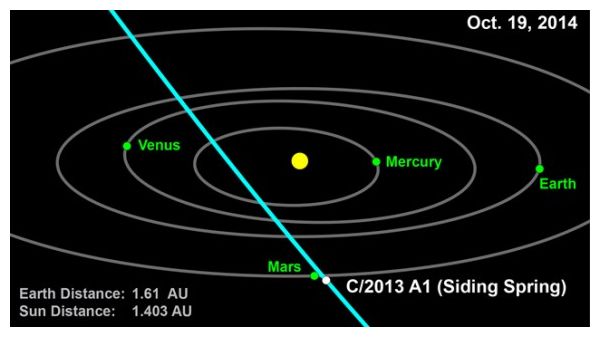
© NASA/JPL-CaltechThis computer graphic depicts the orbit of comet 2013 A1 (Siding Spring) through the inner solar system.
NASA's Near-Earth Object Office says that new observations of comet C/2013 A1 (Siding Spring) have allowed further refinements of the comet's orbit, helping to determine the chances it could hit Mars in October of 2014. Shortly after its discovery in December 2012, astronomers thought there was an outside chance that a newly discovered comet might be on a collision course with Mars.

While the latest orbital plot places the comet's closest approach to Mars slightly closer than previous estimates, the new data now significantly reduces the probability the comet will impact the Red Planet, JPL said, from about 1 in 8,000 to about 1 in 120,000.

The closest approach is now estimated at about 68,000 miles (110,000 kilometers). The most previous estimates had it whizzing by at 186,000 miles (300,000 kilometers).

Satellite

Found? Mars-3 Soviet probe that mysteriously vanished 42 years ago

Image
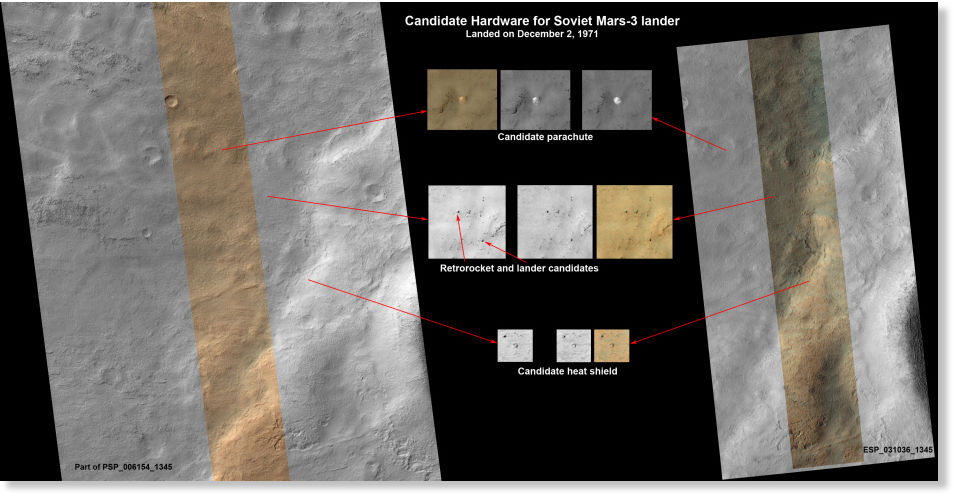
© NASA/JPL-Caltech/Univ. of ArizonaPromising candidates for pieces of the 42-year-old Mars-3 probe were located by a group of Russian space enthusiasts
A group of Russian space enthusiasts may have found the location of the first space probe ever to land on Mars, the 42-year-old Mars-3.

In a post Thursday, NASA highlighted pictures taken from the Mars Reconnaissance Orbiter near the location of the Curiosity rover.

"In 1971, the former Soviet Union launched the Mars 2 and Mars 3 missions to Mars. Each consisted of an orbiter plus a lander," NASA said. "Both orbiter missions succeeded, although the surface of Mars was obscured by a planet-encircling dust storm. The Mars 2 lander crashed. Mars 3 became the first successful soft landing on the Red Planet, but stopped transmitting after just 14.5 seconds for unknown reasons."

The Russian group, which comes together online as a Mars Curiosity Rover community, started searching through images from the High Resolution Imaging Science Experiment (HiRISE) camera on the Mars Reconnaissance Orbiter. Through crowdsourcing, it wasn't long until they found something.

Magnify

Anthropologists carbon date beam from temple holding Mayan calendar

Image
© AFP Photo
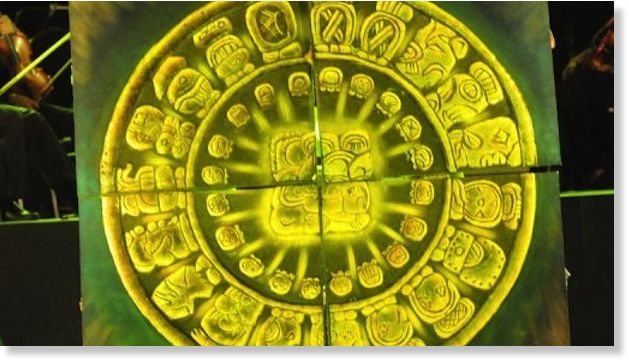
Carbon-dating of an ancient beam from a Guatemalan temple may help end a century-long debate about the Mayan calendar, anthropologists said on Thursday.

Experts have long wrangled over how the Mayan calendar - which leapt to global prominence last year when the superstitious said it predicted the end of the world - correlates to the European calendar.

Texts and carvings from this now-extinct culture describe rulers and great events and attribute the dates according to a complex system denoted by dots and bars, known as the Long Count.

The Long Count consists of five time units: Bak'tun (144,000 days); K'atun (7,200 days), Tun (360 days), Winal (20 days) and K'in (one day).

The time is counted from a mythical starting point.

But the date of this starting point is unknown. Spanish colonisers did their utmost to wipe out traces of the Mayan civilisation, destroying evidence that could have provided a clue.

An example of the confusion this has caused is the date of a decisive battle that shaped the course of Mayan civilisation.